

Asian Markets Exhibit Mixed Performance Following Nvidia's Sharp Decline and AI-Driven Layoffs
Shares across Asia presented a varied picture on Friday, as the reverberations from Nvidia's significant stock plunge and unsettling news of artificial intelligence-related workforce reductions continued to unsettle global financial markets. This cautious sentiment follows the worst single-day performance for Nvidia's stock since the previous spring, which exerted downward pressure on U.S. equity indices.
Regional Market Movements Reflect Divergent Sentiments
In Tokyo, the Nikkei 225 index managed a marginal gain of 0.1%, closing at 58,810.03. Conversely, Hong Kong's Hang Seng index demonstrated more robust optimism, jumping 0.8% to reach 26,578.03. Meanwhile, mainland China's Shanghai Composite index experienced a slight retreat, slipping 0.3% to settle at 4,139.53.
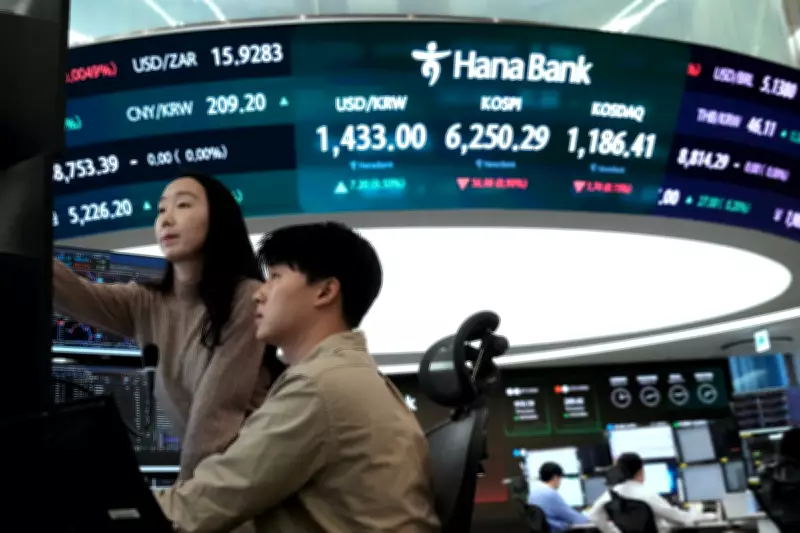
South Korea's Kospi index faced more pronounced selling pressure, losing 0.6% to close at 6,288.40 as traders opted to secure profits from recent advances. Australia's S&P/ASX 200 edged up 0.1% to 9,184.10, while India's Sensex declined by 0.4% amid the broader regional uncertainty.

Wall Street's Previous Session Sets the Tone
The preceding trading day on Wall Street saw the S&P 500 shed 0.5% to close at 6,908.86. The Dow Jones Industrial Average added less than 0.1%, finishing at 49,499.20, while the technology-heavy Nasdaq composite suffered a more substantial decline, sinking 1.2% to 22,878.38.
U.S. futures pointed to continued weakness in early Friday trading, with the S&P 500 futures losing 0.2% and Dow Jones Industrial Average futures falling 0.4%. This downward pressure stemmed primarily from investor focus on comments from Block CEO Jack Dorsey regarding his company's decision to eliminate approximately 40% of its workforce, attributing the move to labor-saving artificial intelligence technologies.
Nvidia's Remarkable Performance Loses Its Momentum
Nvidia, the semiconductor giant whose chips have become synonymous with the artificial intelligence revolution, reported yet another exceptional quarter of profit growth that comfortably surpassed analysts' expectations. The company's revenue forecast for the current quarter again exceeded Wall Street estimates.
However, such extraordinary performances have become so routine for Nvidia that they appear to be losing their capacity to impress investors. The company's stock plunged 5.5%, marking its most significant single-day loss since April of the previous year.
Block's Workforce Reduction Signals AI's Transformative Impact
Shares in Block, the financial services company formerly known as Square, gained 5% during Thursday's regular trading session before the company reported better-than-expected earnings. Following the market close, the stock surged more than 20% after CEO Jack Dorsey detailed plans to lay off approximately 4,000 of the company's 10,000 employees.
In a letter to shareholders, Dorsey articulated the strategic rationale behind this dramatic workforce reduction, stating, "We believe Block will be significantly more valuable as a smaller, faster, intelligence-native company. Everything we do from here is in service of that."
Stephen Innes of SPI Asset Management characterized Dorsey's move as groundbreaking, noting in a commentary, "Dorsey just did what most CEOs have only whispered about in boardrooms. For years we've debated whether AI would dent jobs at the margin. Now we have a public case study where the CEO explicitly says intelligence tools have changed what it means to build and run a company."
Selective Strength Amid Broader Market Concerns
Despite Nvidia's substantial decline, market breadth within the S&P 500 revealed underlying resilience, with seven stocks advancing for every three that declined. Among the notable gainers was Salesforce, which climbed 4% after reporting quarterly profits that exceeded analyst expectations.
Nevertheless, companies across diverse sectors including trucking logistics and financial services have seen their stocks come under pressure from investors concerned that these businesses may become vulnerable to artificial intelligence disruption or even face obsolescence.

Entertainment Sector Developments and Commodity Market Movements
In other corporate developments, streaming giant Netflix saw its shares jump 9.2% in after-hours trading after abandoning its bid to acquire Warner Bros. Discovery's studio and streaming business. This decision positioned Skydance-owned Paramount to potentially take over its Hollywood rival.
Netflix indicated that the price required to purchase Warner following Paramount's superior offer had rendered the deal "no longer financially attractive." Warner Bros. shares edged down 0.3% on Thursday after the entertainment conglomerate reported a $252 million loss for the fourth quarter.
In commodity markets, U.S. benchmark crude oil gained 43 cents to $65.64 per barrel in early Friday trading. Crude prices have exhibited volatility amid indirect talks between the United States and Iran regarding Iran's nuclear program. A barrel of U.S. crude briefly fell to $63.60 on Thursday before recovering.
Market analysts note that a peaceful resolution to these diplomatic tensions would reduce the threat of conflict that could disrupt global oil supplies and drive prices substantially higher. The U.S. military has already assembled the largest concentration of American warships and aircraft in the Middle East in decades, significantly raising regional stakes.
Brent crude, the international benchmark, gained 27 cents early Friday to reach $71.11 per barrel. In currency markets, the U.S. dollar declined to 155.80 Japanese yen from 156.13 yen, while the euro strengthened to $1.1810 from $1.1796.
Labor Market Data Provides Contextual Background
A separate economic report indicated that the number of U.S. workers filing for unemployment benefits increased slightly last week, though the rise remained consistent with economists' expectations. The overall level of jobless claims continues to remain relatively low by historical standards, providing some counterbalance to concerns about AI-driven workforce reductions.





