

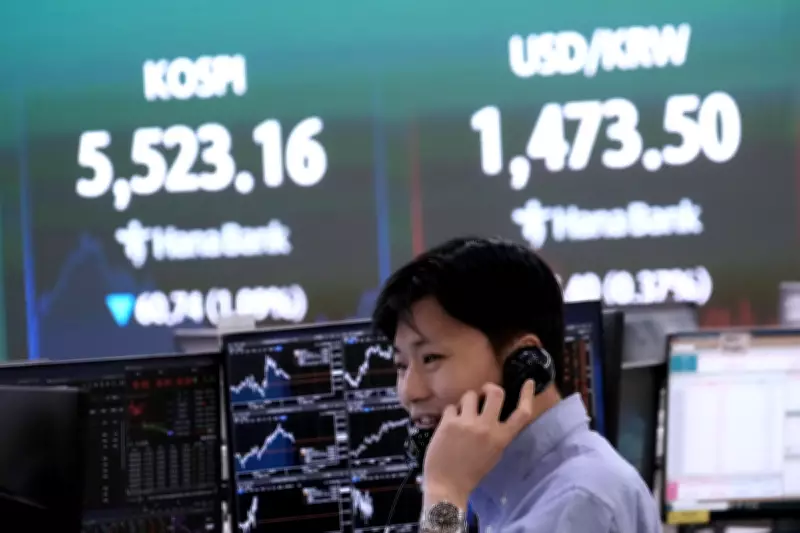
Asian stock markets presented a mixed picture on Friday, reacting to a mild downturn on Wall Street, as oil prices retreated by more than $1 after hitting their highest levels since the summer of 2024. This shift comes amid ongoing geopolitical tensions in the Middle East, with the conflict involving Iran entering its seventh day.
Market Movements Across Asia
In early trading, South Korea's Kospi index slipped 0.8% to 5,536.40, following a volatile week that saw a 12% loss on Wednesday and a nearly 10% rebound on Thursday. The index had previously surged above 6,000 before the war began unsettling global financial markets.
Conversely, Tokyo's Nikkei 225 index gained 0.4% to 55,518.63, while Hong Kong's Hang Seng jumped 1.6% to 25,713.49. The Shanghai Composite index edged 0.1% higher to 4,113.70. However, Australia's S&P/ASX 200 declined 1.1% to 8,845.30, and Taiwan's Taiex traded 0.4% lower. India's Sensex also lost 0.6%.

Oil Prices and Global Economic Concerns
Oil prices fell on Friday, providing a brief reprieve from this week's surges, as production and supply worries intensified due to the war with Iran. Benchmark U.S. crude lost 1.2% early Friday to $80.07 per barrel, after reaching $81.01 a barrel on Thursday. Brent crude, the international standard, dropped 1% to $84.59 per barrel, following a peak of $85.41 the previous day.
Analysts warn that if oil prices spike further to levels like $100 per barrel and remain elevated, it could strain the global economy. Uncertainty surrounding the conflict has triggered frenetic swings in financial markets this week, with fluctuations sometimes occurring hour by hour.
Factors Influencing Oil Market Dynamics
The easing of crude prices on Friday followed a 30-day temporary waiver from the U.S. for Indian refiners to purchase Russian oil, as noted by ING analysts Warren Patterson and Ewa Manthey. While not a "game-changer," this move reflects U.S. efforts to cap oil prices amid the crisis.
Oil prices will largely depend on the steady resumption of oil flows through the Strait of Hormuz, where tanker activities have been disrupted. Approximately one-fifth of the world's seaborne oil is estimated to pass through this critical waterway located between Iran and Oman.
Wall Street's Performance and Sector Impacts
On Thursday, the S&P 500 fell 0.6% to 6,830.71, the Dow industrials lost 1.6% to 47,954.74, and the Nasdaq composite dropped 0.3% to 22,748.99. U.S. futures edged higher on Friday, with the S&P 500 future gaining 0.2% and the Dow Jones Industrial Average future up 0.3%.
Computer chip company Broadcom's shares jumped 4.8% on stronger-than-expected quarterly profit and revenue, helping to contain overall losses on Wall Street. In contrast, airline stocks were among the biggest losers in the U.S. market, as higher oil prices increased fuel costs and hundreds of thousands of passengers were stranded across the Middle East due to the war.
American Airlines fell 5.4%, United Airlines lost 5%, and Delta Air Lines was down 3.9%.
Currency and Commodity Movements
In other early Friday dealings, the U.S. dollar rose to 157.80 Japanese yen from 157.56 yen, while the euro remained unchanged at $1.1611. The price of gold increased by 1.1%, and silver climbed 2.7%, reflecting a flight to safe-haven assets amid the ongoing market volatility.
This complex interplay of factors underscores the heightened sensitivity of global markets to geopolitical events and economic indicators, with investors closely monitoring developments in the Middle East and their ripple effects across financial sectors.






