

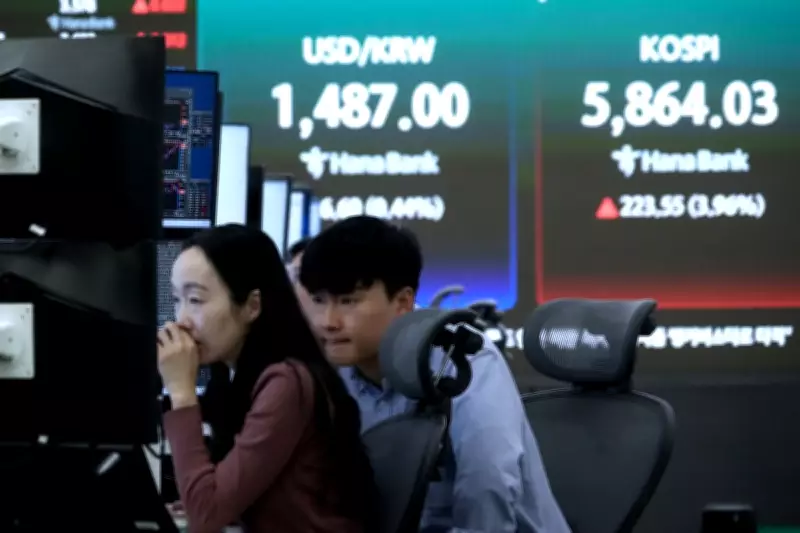
Asian stock markets experienced a broad rally on Wednesday, with major benchmarks in Japan and South Korea posting sharp gains as oil prices retreated from recent peaks. This occurred despite a significant escalation in regional tensions, following a barrage of missile attacks launched by Iran against its Gulf neighbors and Israel.
Market Performance Across Asia
Tokyo's Nikkei 225 index surged by 2.6% to close at 55,106.69, buoyed by a government report showing stronger-than-expected export figures for February. South Korea's Kospi jumped an impressive 3.8% to 5,854.28, reflecting investor optimism in these major oil-importing economies benefiting from lower energy costs.
Other regional markets showed mixed but generally positive movements. Australia's S&P/ASX 200 climbed 0.5% to 8,653.40, while Taiwan's Taiex added 1.3% and India's Sensex advanced 0.6%. Hong Kong's Hang Seng bucked the trend slightly, losing 0.2% to 25,816.92, and the Shanghai Composite index shed 0.5% to 4,028.94.

Oil Price Dynamics and Geopolitical Context
Despite the geopolitical turmoil, oil prices declined on Wednesday. Brent crude, the international benchmark, fell 2.3% to approximately $101 per barrel, down from above $106 on Monday. U.S. benchmark crude experienced an even steeper drop, falling more than 3% to $93.17 per barrel.
This price retreat occurred despite Iran's aggressive military actions, which included multiple attacks using advanced missiles capable of evading air defense systems. The attacks followed the killing of a senior Iranian leader in an airstrike and resulted in casualties near Tel Aviv.
Analysts at ING Bank noted that global oil flows remain largely constrained, even as hopes were growing that Iran might be allowing more vessels through the strategically vital Strait of Hormuz. This critical waterway, through which approximately one-fifth of the world's crude oil passes, has been largely closed, with Iran previously stating it was blocking passage to U.S., Israeli, and allied vessels.
U.S. Market Influence and Corporate Developments
U.S. stock futures rose 0.4% on Wednesday, following a session of moderate gains on Wall Street. Investors were closely watching the Federal Reserve's upcoming interest rate decision, with most expecting rates to remain unchanged as higher oil prices continue to feed into broader inflationary pressures.
On Tuesday, the S&P 500 rose 0.3% to 6,716.09, while the Dow Jones Industrial Average edged up 0.1% to 46,993.26. The Nasdaq composite gained 0.5% to reach 22,479.53.
Several notable corporate developments influenced market sentiment. Delta Air Lines shares rose 6.6% after the carrier raised its revenue forecast, anticipating strong demand that could help offset rising jet fuel costs resulting from the Iran conflict. Uber Technologies gained 4.2% following its announcement of an expanded partnership with chipmaker Nvidia to launch an autonomous vehicle fleet in the United States, beginning in San Francisco and Los Angeles next year.
Currency Movements and Broader Implications
In early Wednesday trading, the U.S. dollar fell slightly to 158.85 Japanese yen from 159.01 yen. The euro traded at $1.1539, down marginally from $1.1542.
The market's relatively calm response to significant geopolitical escalation suggests investors may be focusing more on economic fundamentals and corporate performance than immediate security concerns. However, analysts caution that sustained tensions could still disrupt global energy supplies and transportation routes, potentially reversing the current oil price trend.
The combination of falling oil prices, positive corporate news, and anticipation of stable monetary policy from the Federal Reserve created an environment where Asian markets could rally despite ongoing regional conflicts. This demonstrates the complex interplay between geopolitical events, energy markets, and investor psychology in today's interconnected global economy.






