

Asian Markets Climb as Investors Await Iran War Resolution
Asian shares experienced notable gains on Tuesday, propelled by a relatively stable performance in U.S. stocks as market participants eagerly anticipated clearer signals regarding the potential conclusion of the ongoing conflict with Iran. This upward movement was accompanied by modest increases in U.S. futures and oil prices, reflecting a cautious optimism in financial circles.
Regional Stock Indices Show Strong Performance
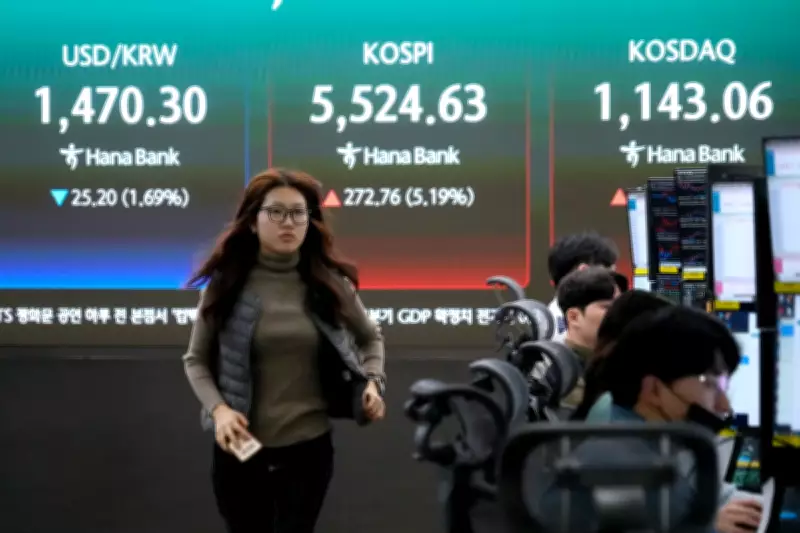
Across the Asia-Pacific region, key stock indices demonstrated robust growth. In Japan, the Nikkei 225 surged by 2.1%, closing at 55,387.75, while South Korea's Kospi jumped an impressive 3.5% to reach 5,724.30. Hong Kong's Hang Seng index rose by 0.3% to 26,039.23, and the Shanghai Composite in China edged up 0.1% to 4,127.34. Australia's S&P/ASX 200 increased by 0.5%, settling at $8,738.50, and Taiwan's benchmark index climbed significantly by 3.9%.
U.S. Market Movements and Oil Price Dynamics
In the United States, the S&P 500 dipped slightly by 0.2% to 6,781.48, following recent volatile swings driven by extreme fluctuations in the oil market. The Dow Jones Industrial Average fell by 34 points, or 0.1%, to 47,706.51, whereas the Nasdaq composite saw a marginal gain of less than 0.1%, closing at 22,697.10.

Oil prices, while edging higher, remained substantially below their peaks from Monday. Early Wednesday, Brent crude, the international benchmark, increased by 9 cents to $85.36 per barrel, yet this represented an 11% decline from its settlement price the previous day. U.S. benchmark crude oil rose by 36 cents to $83.81 per barrel. These prices had plummeted from a high of nearly $120 per barrel on Monday afternoon, a level not seen since 2022, after President Donald Trump suggested in a CBS News interview that the war was "very complete, pretty much." This statement ignited hopes for a relatively swift end to hostilities, potentially facilitating the resumption of unimpeded oil flows from the Middle East to global markets.
Geopolitical Tensions and Market Implications
Despite these optimistic signals, geopolitical tensions have intensified as the conflict enters its eleventh day. U.S. Defense Secretary Pete Hegseth pledged the most intense strikes to date, with the Pentagon detailing broader injuries among U.S. troops. In a recent development, the U.S. reported neutralizing over a dozen minelaying Iranian vessels on Tuesday, while Iran vowed to block regional oil exports, asserting it would not permit "even a single liter" to reach its adversaries.
President Trump has consistently emphasized the importance of keeping the Strait of Hormuz open, a critical waterway off Iran's coast that typically handles a fifth of the world's daily oil shipments. In a social media post late Monday, he warned, "If Iran does anything that stops the flow of Oil within the Strait of Hormuz, they will be hit by the United States of America TWENTY TIMES HARDER than they have been hit thus far."
Historical Context and Economic Risks
Historically, stock markets have rebounded relatively quickly from military conflicts, provided oil prices do not remain elevated for prolonged periods. However, the current uncertainty has triggered dramatic, often hour-to-hour swings in global markets. If oil prices persist at high levels, household budgets already strained by inflation could face severe pressure, and companies might encounter soaring costs for fuel and inventory management. This scenario raises the specter of stagflation, a worst-case economic outcome characterized by stagnant growth coupled with high inflation.
Currency Movements and Additional Insights
In other early Wednesday dealings, the U.S. dollar strengthened slightly against the Japanese yen, rising to 158.26 yen from 158.23 yen. The euro also gained ground, increasing to $1.1625 from $1.1610. These currency shifts reflect the broader market adjustments in response to the evolving geopolitical landscape.
AP Business Writer Stan Choe contributed to this report.






