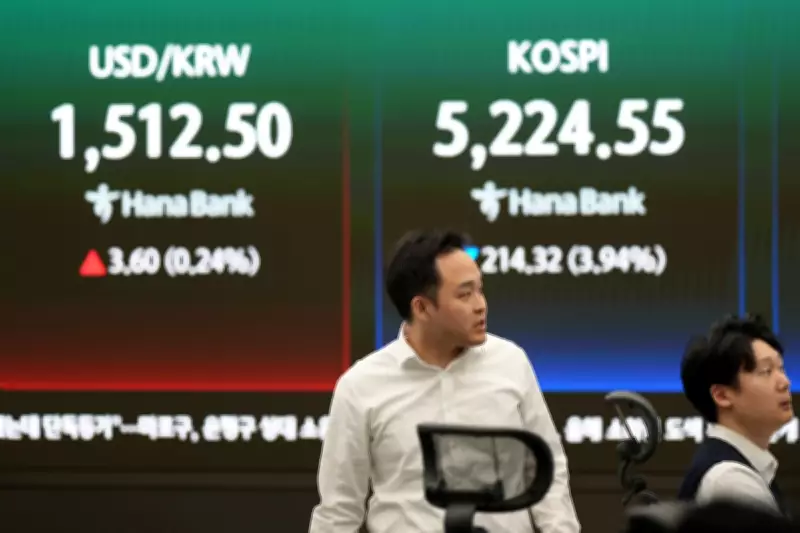
Asian Markets Tumble as Iran Conflict Fuels Oil Price Surge
Asian shares experienced widespread declines in Monday morning trading, echoing last week's sharp drop on Wall Street, as investor anxiety mounted over soaring oil prices and the potential for further escalation in the U.S. war with Iran. The losses across Asia followed a fifth consecutive losing week for U.S. markets, marking the longest such streak in nearly four years, with significant falls recorded on Friday.
Regional Indexes Show Significant Losses
Key Asian benchmarks reflected the downturn. Japan's Nikkei 225 slipped by 4.5% to 50,979.54, while Australia's S&P/ASX 200 lost 1.2% to 8,417.00. South Korea's Kospi dove 3.2% to 5,264.32, and Hong Kong's Hang Seng declined 1.7% to 24,519.63. The Shanghai Composite shed 0.7% to 3,884.57, indicating broad-based concerns across the region.
Oil Prices Spike Amid Geopolitical Tensions
Worries have intensified in Japan and throughout Asia due to the effective lack of access to the Strait of Hormuz, a critical chokepoint for oil shipments, because of the ongoing conflict in Iran. This reliance has driven energy prices sharply higher. In energy trading, benchmark U.S. crude jumped $2.28 to $101.92 a barrel, and Brent crude, the international standard, soared $2.88 to $115.45 a barrel. Before the war, Brent had been priced at approximately $70 per barrel, highlighting the dramatic increase.

Economic Implications and Analyst Insights
Investors are now bracing for the war to persist, which could trigger inflation in global markets and potentially stunt Asia's economic growth. "Although we do not expect the conflict to be protracted, we anticipate heightened volatility in the near term," said Xavier Lee, senior equity analyst at Morningstar Research. Oil prices resumed their climb after a brief easing when President Donald Trump extended a self-imposed deadline to target Iran's power plants to April 6.
Wall Street's Recent Performance
On Wall Street, the S&P 500 fell 1.7% to close its worst week since the war with Iran began, dropping 108.31 points to 6,368.85. The Dow Jones Industrial Average lost 793 points, or 1.7%, falling more than 10% from its record set last month to 45,166.64, while the Nasdaq composite sank 2.1% to 20,948.36. The S&P 500 is now 8.7% below its all-time high from January, with Big Tech stocks like Amazon and Nvidia weighing heavily on the market.
Bond and Currency Market Movements
In the bond market, the yield for the 10-year Treasury rose as high as 4.48% before pulling back to end last week at 4.43%, up from 4.42% late Thursday and significantly higher than the 3.97% level before the war began. In currency trading, the U.S. dollar inched down to 159.97 Japanese yen from 160.32 yen, while the euro cost $1.1505, down from $1.1510.
Overall, the combination of geopolitical instability and rising oil prices continues to unsettle global financial markets, with Asian economies particularly vulnerable due to their dependence on energy imports.