

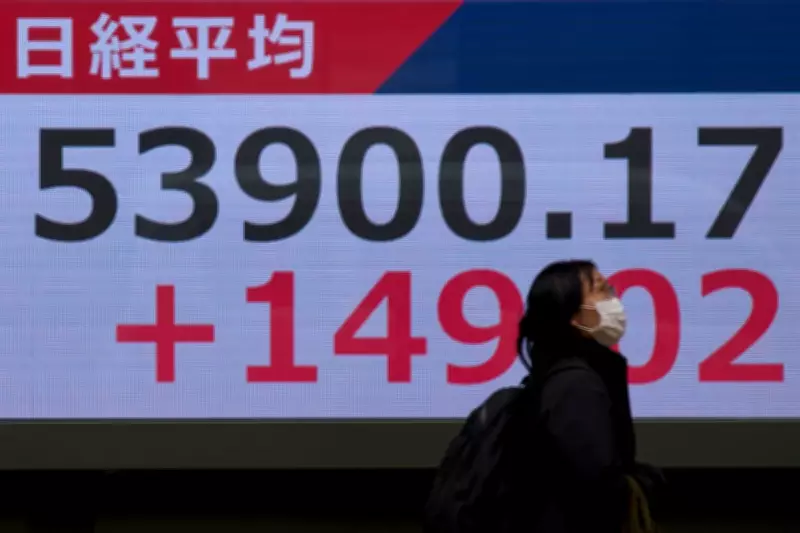
Asian shares exhibited a mixed performance in Tuesday's trading session, while US futures experienced a slight decline as Brent crude oil prices remained elevated above the $100 per barrel mark. This market activity follows a notable drop in oil prices that contributed to the US stock market achieving its best day since the onset of the conflict in Iran.
Oil Price Volatility and Market Reactions
The temporary relief in crude oil prices proved short-lived, with Brent crude surging nearly 3% early on Tuesday to reach $103.17 a barrel. Similarly, the US benchmark crude climbed to $96.20 after dipping to approximately $93 a barrel on Monday. This volatility in oil prices has been a primary driver for financial markets, causing significant fluctuations in stock indices worldwide.
Asian Market Performance
In Asian trading, Tokyo's Nikkei 225 gained 0.4% to close at 53,928.25, while South Korea's Kospi jumped 2.4% to 5,683.61. Hong Kong's Hang Seng surged 1% to 26,088.07, contrasting with the Shanghai Composite index which edged less than 0.1% lower to 4,083.03. Australia's S&P/ASX 200 gained 0.3% to 8,606.60 following the Reserve Bank of Australia's decision to hike its benchmark interest rate to 4.1%.

The Australian central bank cited higher fuel prices as a key factor in its decision to lift the cash rate from 3.85%, which had been set at its February 3 meeting in response to surging inflation. This marked Australia's first interest rate increase since November 2023. Meanwhile, Taiwan's Taiex rose 1.4% and India's Sensex was up 0.1%.
US Market Movements and Futures
US futures fell back during the Asian trading session, with contracts for the S&P 500 and the Dow Jones Industrial Average declining by 0.3%. This followed Monday's strong performance in US markets, where the S&P 500 climbed 1% to 6,698.38 for its biggest gain in five weeks. The Dow Jones Industrial Average added 0.8% to 46,946.41, while the Nasdaq composite jumped 1.2% to 22,374.18.
Geopolitical Factors and Oil Market Dynamics
The primary driver for market volatility has been oil prices, which have spiked from roughly $70 before the United States and Israel initiated attacks on Iran. In response to these military actions, Iran has nearly halted traffic through the narrow Strait of Hormuz, where approximately one-fifth of the world's oil typically transits from the Persian Gulf to global customers.
This disruption has forced oil producers to cut production as their crude has limited transportation options. Financial markets remain concerned that if the strait remains closed for an extended period, it could remove sufficient oil from the market to drive inflation to debilitating levels for the global economy.
Stephen Innes of SPI Asset Management commented on the situation, stating, "The panic is still there, just dialled down a notch as crude slipped off the boil. Brent easing back toward $100 flipped the tape from bunker mentality to opportunistic risk-taking in a heartbeat."
Political and Military Developments
President Donald Trump demanded over the weekend that other countries affected by the closure of the Strait of Hormuz "take care of that passage" while promising that his country "will help - A LOT!" Meanwhile, the US and Israel have continued targeting what they describe as military installations in Iran's capital, with Israel intensifying its campaign against Iran-backed militants in Lebanon.
United Nations peacekeepers report that Israel is massing ground troops along the Lebanese border, with more than 1 million people displaced in Lebanon—approximately 20% of the nation's population. Uncertainty regarding the war's scope and duration has roiled financial markets since the conflict began just over two weeks ago, though markets historically have demonstrated resilience in recovering relatively quickly from military conflicts.
Federal Reserve Considerations and Investor Expectations
Many professional investors anticipate a market recovery if oil prices do not remain excessively high for prolonged periods, which has helped maintain US stock prices near their record levels. However, elevated prices are complicating the Federal Reserve's mission of balancing economic growth and inflation, particularly as President Trump pressures the central bank to slash interest rates.

Traders do not expect the Fed to implement rate cuts at its policy meeting concluding on Wednesday. In corporate news, Nvidia saw its shares rise 1.6% on Monday as CEO Jensen Huang discussed artificial intelligence's potential at a conference, forecasting $1 trillion in demand for AI chips through 2027. Nvidia's performance represented the strongest single force lifting the S&P 500 index.
Currency Market Movements
In early Tuesday dealings, the US dollar strengthened to 159.32 Japanese yen from 159.05 yen, while the euro slipped to $1.1496 from $1.1507. These currency movements reflect ongoing market adjustments to the geopolitical and economic uncertainties affecting global financial systems.





