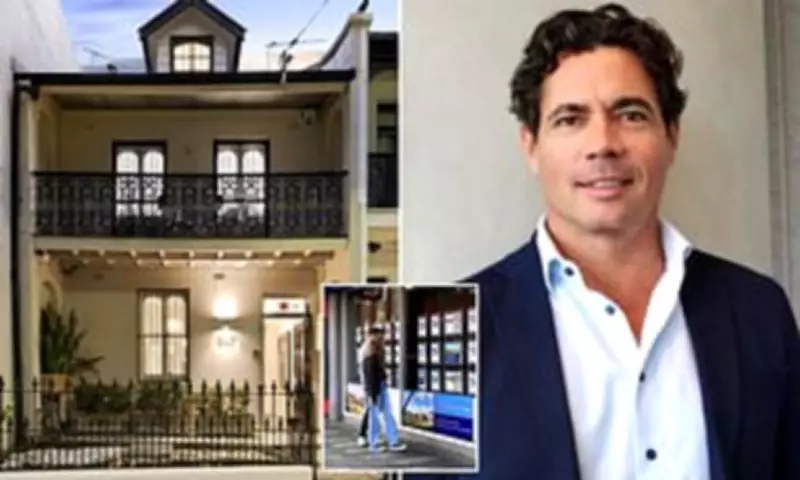
Sydney Wealth Manager Rejects Homeownership, Advocates for Renting and Investing
At a time when purchasing a home remains deeply entrenched as the ultimate financial achievement in Australian society, Sydney-based wealth manager Mark Welch has boldly chosen a different path. The 47-year-old professional, who resides with his partner and child in a three-bedroom terrace in Surry Hills, has conducted a rigorous financial analysis that led him to conclude that, for many Australians, the numbers simply do not justify buying property.
Crunching the Numbers: Why Buying Didn't Stack Up
Mark Welch is not inherently opposed to property ownership. In fact, he readily acknowledges that buying a home can be a sensible decision for the right individual under specific circumstances. However, when he applied the same meticulous financial scrutiny he employs for his clients to his own personal situation, the results were unequivocal. 'I did the numbers, and it just didn't work out,' he revealed in an interview.
Even with a substantial deposit of approximately $600,000, Welch calculated that the cost of owning a comparable property—valued between $3 million and $3.5 million—would be significantly higher than continuing to rent. The requirement to repay both principal and interest on a mortgage meant the financial disparity between owning and renting quickly became, in his own words, 'astronomically different.'

Prioritising Lifestyle Over Financial Leverage
For Welch, the decision to rent was driven as much by a desire for quality of life and personal freedom as by pure financial logic. 'Lifestyle's super important to me,' he stated, explaining that committing to estimated monthly mortgage repayments exceeding $20,000 would severely restrict his ability to enjoy life on his own terms.
Instead of stretching his finances to secure ownership, he has adopted a more balanced strategy. He invests a portion of the money saved by renting into diversified assets, while allocating the remainder to fund immediate experiences and pleasures. 'If I put the difference into an investment account… and then the rest I can spend and enjoy life, I'm kind of achieving the same result,' he elaborated.
This philosophy enables him to prioritise travel, family time, and hobbies—experiences he believes many homeowners sacrifice under the burden of a substantial mortgage. 'A couple of trips a year… going to Europe for summer… I would not be able to do it if I had a mortgage like that.'
Challenging the Deeply Ingrained 'Australian Dream'
Welch identifies a critical issue within Australia's property discourse: the cultural obsession with homeownership often occurs without a full comprehension of the financial ramifications. 'There are people out there with less money than me getting these astronomical mortgages… complaining about not having money to do anything.'
Drawing on his early career experience as a mortgage broker, where a mentor emphasised understanding debt as a fundamental pillar of wealth creation, Welch gained a clear perspective on the dual nature of borrowing—it can be powerful yet perilous. He argues that the focus should shift from the mere act of ownership to the actual cost of achieving it, particularly given rising and often unattainable ongoing repayments.
Many prospective buyers, he suggests, become so fixated on securing a property that they overlook how the associated debt can adversely affect their lifestyle, increase stress, and reduce long-term flexibility. 'Why is he giving it all to the bank in interest?' he questioned rhetorically.
A Diversified Strategy for Building Wealth
Rather than tying up his capital in real estate, Welch has constructed a wealth-building strategy centred on diversification, liquidity, and disciplined long-term planning. Superannuation forms the cornerstone of this approach, which he maximises due to its considerable tax advantages.
'The benefit… between what I would pay in my marginal tax rate versus what I pay to get the money into the super fund… is more than the return that properties and shares give me combined.'

Beyond super, he invests in a portfolio of Exchange-Traded Funds (ETFs) and maintains both a liquid investment account and a substantial cash reserve equivalent to approximately twelve months of living expenses. 'I've always got access to cash… if something goes wrong, that's my first port of call,' he noted, highlighting the flexibility this provides compared to the illiquid nature of property assets.
Practical Advice for Prospective Buyers
Despite his personal preference for renting, Welch is careful to clarify that purchasing a home is not inherently a poor decision. However, he stresses that it must always be an informed choice, tailored to individual circumstances. His foremost recommendation is to thoroughly understand one's cash flow and rigorously stress-test finances before committing to a mortgage.
'What happens if that second income loses their job?' he pointed out, highlighting the risks many households face when relying on dual incomes to service large loans. He advises building a robust financial buffer of at least twelve to eighteen months and resisting the temptation to 'just scrape in' with a minimal deposit. 'Put some money aside just in case there's an emergency.'
A Shifting Mindset Among Younger Generations
While previous generations frequently viewed property ownership as non-negotiable, Welch observes that attitudes are gradually evolving, particularly among younger Australians. 'They're not kind of fixated on it… they also want to have a lifestyle.'
As for his own future, he has not entirely ruled out the possibility of buying a home. For the present, however, he remains confident that renting—combined with disciplined investing—better aligns with both his financial objectives and his desired way of living. 'I enjoy my life. I'm happy,' he concluded, articulating a perspective where true wealth is not merely about asset ownership but about the freedom to live well throughout the journey.