

Uncovering the UK's Forgotten Railway Marvels
From Grade-II listed edifices to unique iron bridges like the locally dubbed 'Spider Bridge,' the United Kingdom boasts an array of remarkable constructions that have fallen into disuse. Graeme Bickerdike's recently released book, Railway Wonders, explores numerous abandoned viaducts and railway tunnels scattered across the nation. While some have been entirely neglected and left to decay, others have been ingeniously repurposed as scenic walking and cycling trails through picturesque landscapes.
A Collection of Engineering Feats and Stories
In the book, now available for purchase online, Bickerdike clarifies: 'This is not a book of the 100 most impressive stone-arched viaducts, however awe-inspiring that might be.' Instead, it assembles a diverse collection of structures with a broad geographical spread, though choices are limited in eastern, southern, and south-eastern England. The selection highlights varied building techniques, notable engineers, and captivating narratives from their construction, operational phases, and periods of redundancy. 'A handful of the featured viaducts have substantially been lost, but there will always be some physical remnant to fire the imagination,' Bickerdike notes.
Below, discover some of the most historic railway tunnels and viaducts featured in the UK.

Wylam Bridge: A Pioneering Structure
Wylam Bridge, consisting of three wrought iron lattice arches, now serves as a pathway through Tyne Riverside Country Park. When first constructed in 1876, it broke boundaries as what was believed to be the first bridge of its kind capable of supporting railway loads. Standing as a single-span bridge without supporting piers—unusual for its time—it weighs 282 tons and is painted a striking white. Northumberland County Council invested £224,000 in retouching it in 1997. Although closed to rail use in 1968, it once carried two train tracks and is now a Grade II listed structure.
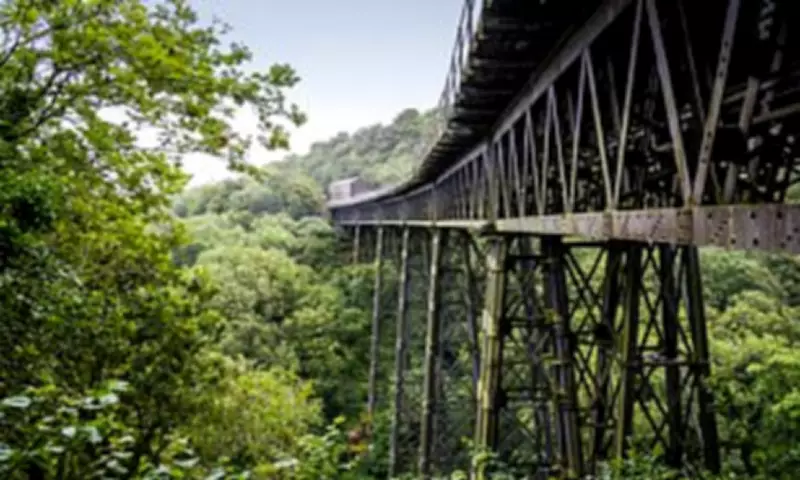
Meldon Viaduct: The Eerie 'Spider Bridge'
Now a scheduled monument, this eerie iron structure, nicknamed 'The Spider Bridge' by locals, provides a route through Dartmoor. Built in the 1870s as a railway viaduct, it impressively survived a fire and an expansion before train services were withdrawn in 1968. Today, it functions as a cycle path across Dartmoor and The Granite Way.
Tidenham Tunnel: A Miner's Achievement
Located in South West England, Tidenham Tunnel was constructed in 1874 by local miners who completed it in under 20 months using Ingersoll rock drills. The build saw many injuries and fatalities. Stretching 1,129 yards, it was later joined with a second tunnel to form a longer route. Passenger services ended in 1959, with goods trains continuing until 1964, and carriages for Tintern Quarry using it until 1981. The track was fully removed in 2019, and it is now tarmacked and open to pedestrians and cyclists from April to September.
Lady Wimborne's Bridge: Ornate Aristocratic Display
An ornate structure with intricate carvings and brickwork, Lady Wimborne's Bridge is situated in Dorset. Made of limestone ashlar and built in 1855, it allowed the London and South Western Railway to cross over Canford Manor's private drive, now part of Canford School. Described in Railway Wonders as 'a monument to the aristocracy’s willingness to demonstrate its wealth through architectural embellishment,' it is one of the UK's most intricately decorated bridges.
Conisbrough Viaduct: An Immense Brick Structure
Described by Bickerdike as an 'immense structure,' Conisbrough Viaduct was built by Dearne Valley Railway in 1909 in South Yorkshire. Its construction required 250 men, 15 million bricks, and 2,000 tons of cement. Standing 116 feet above the River Don, all railway services were suspended by 1966. It remains undemolished due to high costs and is maintained by the Railway Paths charity.
Grace Dieu Viaduct: Swamped by Greenery
Surrounded by trees and greenery, Grace Dieu Viaduct features six tall arches built with red brick. Located near the remains of the 13th-century Grace Dieu Priory, it has been disused since passenger services ended in 1931 and goods transport ceased in 1963. Instead of trains, ivy now winds up its walls.

Hownes Gill Viaduct: A Stable Landmark
Peeking over trees in County Durham, Hownes Gill Viaduct began construction in 1857. Now a Grade II listed structure, it boasts 12 arches, each 50 feet wide, and is part of the Waskerley Way Railway Path. Designed for stability with piers and 'stepped buttresses,' it closed in 1969 but is regularly used by passersby, featuring a tall, curved metal fence along its length.
Oxendon Tunnel: A Walk Through History
Located in Northamptonshire, Oxendon Tunnels saw their last train in 1981, over a century after construction. One tunnel is open for walkers to admire its curved brick walls and archways, with a shaft allowing light to illuminate the former track bed. Other sections remain closed off.
Shankend Viaduct: The Waverley Line's Feat
Stretching across 15 arches, Shankend Viaduct overlooks rolling hills in the Scottish Borders and is described by Bickerdike as the Waverley line's 'greatest engineering feat.' Built in the 1860s, it faced structural issues, heavy loads, and harsh weather, requiring numerous repairs during its operational life. Now unused, Bickerdike describes it as looking 'scruffy.'
Wickham Bishops Viaduct: Last of Its Kind
Though it may seem simple compared to towering brick structures, Wickham Bishops Viaduct should not be overlooked. Two viaducts were built in the 1840s to carry the Witham to Maldon line over the River Blackwater. Now standing in water surrounded by woodland and out of use, they are England's last surviving timber trestle viaducts, restored by Essex County Council in 1995.
Railway Wonders by Graeme Bickerdike was published on March 15, 2026, and is available for purchase now.





