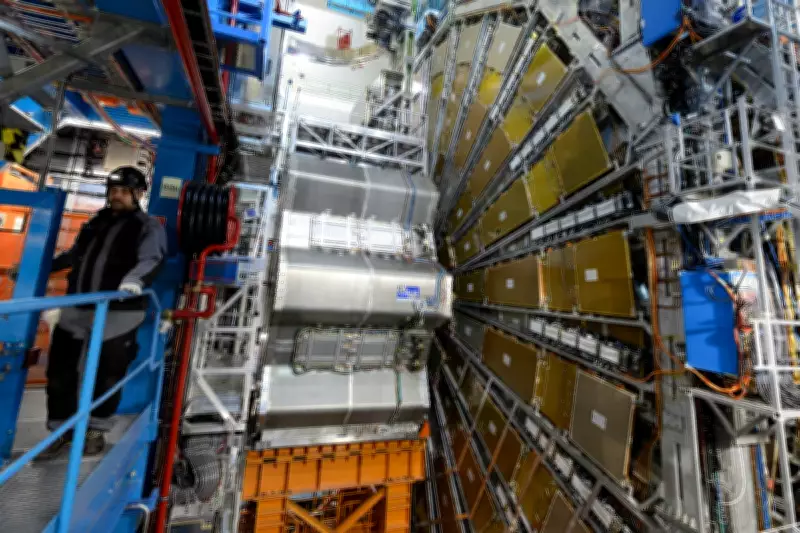
CERN's Pioneering Antimatter Road Test: Transporting Antiprotons by Truck
In a groundbreaking scientific endeavour, researchers at the European Organization for Nuclear Research, commonly known as CERN, have embarked on a never-before-attempted experiment to transport ultrasensitive antimatter by road. This delicate test drive, conducted on Tuesday, 24 March 2026, involves moving approximately 100 antiprotons in a specially designed truck, marking a significant step towards enabling advanced antimatter studies at external facilities.
The Delicate Nature of Antimatter Transport
Antimatter, such as antiprotons, poses a unique challenge due to its volatile interaction with ordinary matter. When antimatter comes into contact with matter, even for a fleeting moment, it annihilates in a burst of energy. To mitigate this risk, CERN scientists have developed a sophisticated transport system. The antiprotons are suspended in a vacuum within a compact, 1,000-kilogram box called a "transportable antiproton trap." This apparatus uses superconducting magnets cooled to an extreme -269 degrees Celsius to keep the particles from touching the inner walls, which are composed of matter.
During the four-hour test, the team carefully wheeled the trap from the lab, loaded it onto a truck, and undertook a half-hour drive to assess the feasibility of road transport. The primary goal was to ensure that the antiprotons remain contained without seeping out, despite potential road bumps or sudden stops. As CERN spokeswoman Sophie Tesauri explained, the trap is engineered to withstand various driving conditions, including braking and acceleration, to safeguard the antimatter.

Implications for Future Research
This experiment serves as a preliminary effort to eventually deliver antiprotons from CERN in Geneva to researchers at Heinrich Heine University in Düsseldorf, Germany—a journey that typically takes about eight hours by road. The university is considered an ideal location for in-depth antiproton studies because it offers a environment with minimal magnetic interference, unlike CERN's bustling complex, which can skew antimatter research due to its numerous activities.
CERN's Antiproton Decelerator, part of its "Antimatter Factory," is the sole facility worldwide capable of producing and storing low-energy antiprotons for scientific exploration. Over the years, CERN has achieved notable breakthroughs in measuring, storing, and interacting with antimatter. For instance, two years prior, the team successfully transported a cloud of protons across the campus, but this test with antiprotons requires a more advanced vacuum chamber, as noted by Christian Smorra, head of the apparatus design team.
Technical Challenges and Safety Measures
The mass involved in Tuesday's test was minuscule—equivalent to less than 100 hydrogen atoms—meaning that even in a worst-case scenario of annihilation, the energy release would be undetectable without specialized equipment like an oscilloscope. However, the trap's current limitation is its four-hour containment capability, which falls short of the eight-hour drive needed for the Düsseldorf route, highlighting areas for future improvement.
CERN, renowned for its Large Hadron Collider and contributions such as the invention of the World Wide Web, continues to push the boundaries of particle physics. While test teams were unavailable for pre-exercise interviews, they planned to disclose the results afterward, providing insights into the viability of antimatter transport. This initiative underscores CERN's commitment to expanding collaborative research opportunities and advancing our understanding of fundamental particles in the universe.