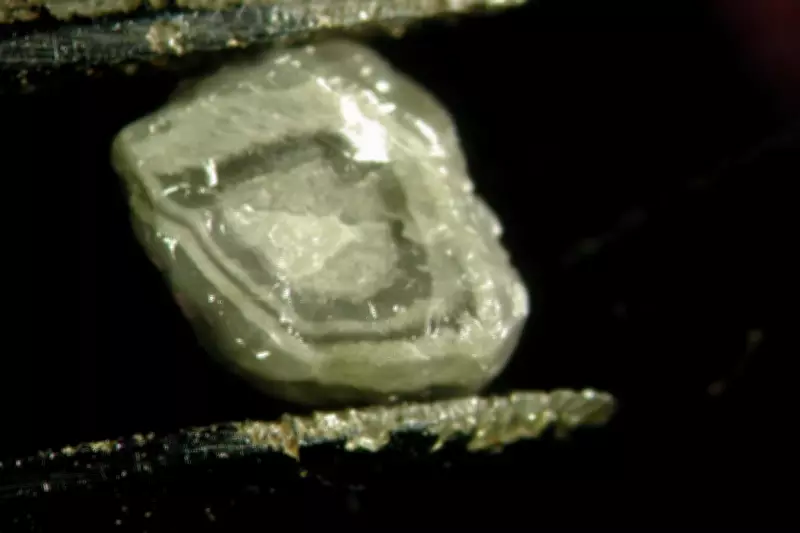
Scientists from China have announced a groundbreaking achievement in materials science, claiming the first-ever successful laboratory creation of a 'hexagonal diamond'. This unique form of carbon, previously only identified at meteorite impact sites, has now been synthesised under controlled conditions, resolving decades of scientific debate.
Unprecedented Hardness and Production Method
The synthetic hexagonal diamond demonstrates a remarkable hardness of approximately 114 gigapascals, slightly surpassing the typical 110 gigapascals of natural cubic diamonds. This enhanced durability could pave the way for advanced industrial and technological applications where superior material strength is critical.
Laboratory Synthesis Under Extreme Conditions
Researchers at China's Henan Key Laboratory of Diamond Materials and Devices produced a millimetre-sized piece of pure hexagonal diamond by subjecting highly ordered graphite to extreme pressure of 20 gigapascals and temperatures ranging from 1,300°C to 1,900°C. This meticulous process replicates the intense conditions found in meteorite impacts, allowing for the first controlled synthesis of this elusive carbon phase.

Resolving a Long-Standing Scientific Controversy
The existence of hexagonal diamonds has been a topic of intense debate within the scientific community due to a persistent lack of solid experimental evidence. Prior to this breakthrough, the physical properties of hexagonal diamond remained largely unexplored and theoretical.
This achievement not only confirms the material's existence but also provides crucial new insights into carbon phase transitions. Understanding how carbon transforms under extreme conditions has significant implications for both fundamental science and practical engineering.
Future Research and Technological Implications
The successful synthesis opens numerous avenues for future research and potential technological applications. Areas of interest include advanced cutting tools, high-performance electronics, and novel composite materials. The ability to produce hexagonal diamonds in a laboratory setting allows scientists to study its properties in detail, potentially leading to innovations across multiple industries.
This milestone represents a significant leap forward in materials science, demonstrating how controlled laboratory experiments can unlock mysteries of natural phenomena and create materials with superior characteristics.