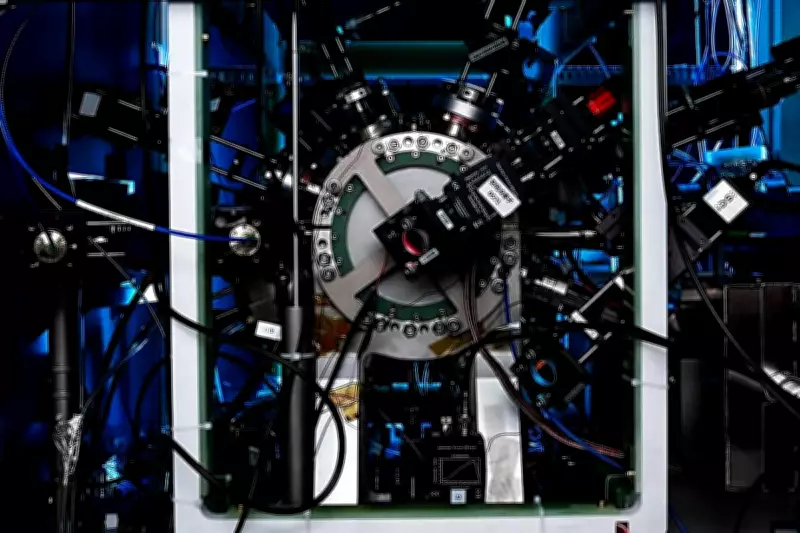
Chinese Scientists Develop Revolutionary Optical Clock with Unprecedented Accuracy
Researchers at the University of Science and Technology of China have engineered an optical clock of such extraordinary precision that it could lead to a fundamental redefinition of the second and establish a new global time standard. This breakthrough device represents a significant leap forward in chronometric technology.
Unparalleled Precision in Timekeeping
The newly developed optical clock demonstrates accuracy so remarkable that it would lose or gain less than one second over approximately 30 billion years. To put this in perspective, if this clock had been running since the dawn of the universe, it would currently be off by only about one second. This achievement surpasses previous limitations in timekeeping technology.
Optical clocks measure time by utilizing the frequency of light emitted when electrons transition between energy levels within atoms. These sophisticated devices can measure seconds to an astonishing 19 decimal places, making them the most precise timekeeping instruments currently available to scientists worldwide.

Scientific Applications and Implications
The implications of this technological advancement extend far beyond simple timekeeping. According to research published in the journal Metrologia, this level of precision opens doors to numerous frontier applications in both practical and theoretical sciences.
- Geophysical monitoring: The clock could enable millimeter-level observations of gravity and altitude variations, monitor Earth's crust deformation, track groundwater changes, and provide more precise measurements of volcanic activity.
- Fundamental physics research: Such precise timekeeping devices are crucial for testing fundamental physics principles, detecting gravitational waves, and searching for evidence of dark matter.
- Technological infrastructure: Optical clocks provide highly accurate time references essential for modern technologies including satellite navigation systems, telecommunications networks, and precision measurement instruments.
Redefining the Second
The historical definition of the second has evolved significantly over time. Originally defined as 1/86,400th of a day, this measurement proved insufficient for scientific applications. In 1967, with the advent of atomic clocks, the International System of Units redefined the second based on 9,192,631,770 oscillations of the caesium-133 atom.
Now, optical clocks have demonstrated even greater precision, potentially enabling another redefinition of this fundamental unit of time. The study notes that "this performance meets the 2 x (10^-18) single-clock accuracy requirement for redefining the SI second" and could facilitate high-resolution dark matter searches.
To officially redefine the second, at least three optical clocks with comparable precision and stability must operate simultaneously at different institutions. Currently, two other optical clocks have already achieved this milestone, and as more ultra-precise clocks become operational, the criteria for redefining the second may soon be met.
Future Scientific Possibilities
With this enhanced accuracy, scientists anticipate new approaches to detecting dark matter by capturing low-frequency signals potentially induced by dark matter interactions. The strontium optical lattice clock developed by Chinese researchers represents not just a technical achievement but a potential paradigm shift in how we measure time and explore fundamental aspects of our universe.
As optical clock technology continues to advance, it promises to revolutionize fields ranging from fundamental physics to practical applications in navigation and communication, while potentially giving humanity a new, more precise definition of one of our most basic units of measurement.