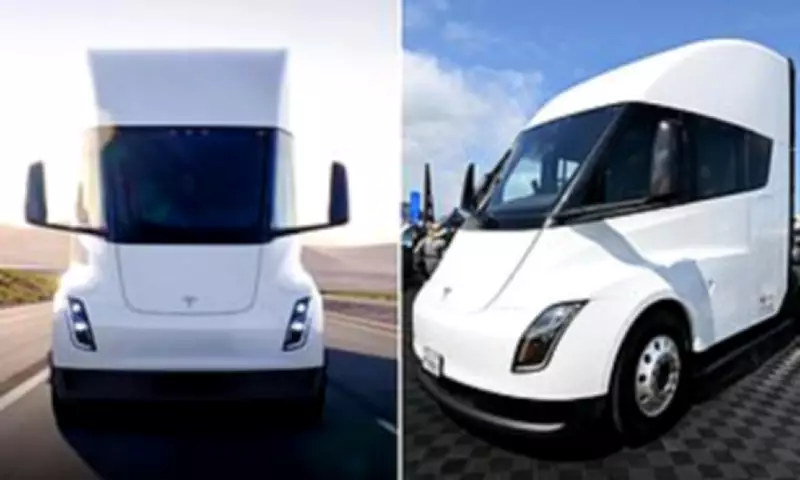
Tesla's inaugural semi-truck has officially commenced operations, with a select group of drivers hailing a pivotal feature as potentially revolutionary for the transportation sector. Elon Musk's clean energy enterprise is set to initiate shipments of its new semi-trucks this summer, projecting up to 15,000 units traversing highways by 2026.
Early Adopters Offer Glowing Reviews
Several drivers have already experienced the vehicle firsthand, delivering enthusiastic assessments of its unconventional attributes, including a centered driving position that enhances visibility and control. The trucks are additionally equipped with advanced rearview cameras and remarkably rapid charging capabilities.
Impressive Performance Specifications
Promotional materials indicate the Tesla Semi can achieve a 60 percent battery capacity in merely 30 minutes and cover 500 miles on a single charge. Jennie Abarca, CEO and co-founder of King Fio Trucking in Long Beach, California, expressed profound admiration after testing the vehicle.

Having previously experimented with other electric semis, Abarca noted she was particularly impressed by the Tesla's endurance. 'The Teslas change everything,' she remarked. 'It opens up a whole different type of delivery that I can make.'
Overcoming Historical Delays
Tesla originally unveiled its blueprint for a battery-powered semi-truck a decade ago, yet a succession of postponements and strategic realignments deferred its actual road debut. Following the initial launch, Tesla intends to escalate production to 50,000 units annually, as reported by the Wall Street Journal.
Driver Testimonials Highlight Advantages
Angel Rodriguez, aged 56, participated in a one-month trial of the automatic Semi and described the Tesla model as 'easier on your body.' He elaborated, 'It's less stressful because you're not really having to engage the clutch and the stick shift.'
Dakota Shearer, among the first American truckers to test drive the vehicle, inadvertently navigated the Tesla truck into a wrong turn. Typically a challenging predicament for his 40-foot trailer, he extricated himself effortlessly. 'I backed right out of there, no problem. It's like I'd never done it in the first place,' he informed the Journal. 'That right there showed me that the technology the Tesla has makes a big difference.'
Economic and Operational Considerations
The Tesla Semi purportedly charges four times faster than competing electric trucks and is advertised as costing $100,000 less. Although Tesla has not disclosed precise pricing, Electrek estimates quotes commencing around $290,000, whereas a conventional diesel truck ranges from $125,000 to $200,000.
Maintenance and Infrastructure Challenges
Tesla asserts that with remote diagnostics, over-the-air software updates, and fewer mechanical components requiring upkeep, operators will dedicate less time at service centers and more time driving. Companies have discovered that electric vehicle fleets necessitate fewer mechanics, though the high-voltage systems may demand more specialized technicians.
Tesla also emphasized that charging with electricity can be more economical than refueling with diesel, potentially justifying the higher initial investment. However, the charging infrastructure essential for powering the Semis remains insufficiently widespread across the United States, complicating long-haul journeys.
Future Expansion and Corporate Adoption
Elon Musk and Tesla have declared intentions to construct a network of 'mega chargers' nationwide by 2026, according to Forbes. DHL and Pepsi are among the pilot corporations that have already commenced operating a modest Tesla Semi fleet as part of ongoing endeavors to reduce carbon emissions.
Other drivers praised the cameras for facilitating straightforward backup and U-turn maneuvers, which would otherwise be unfeasible. The Daily Mail has contacted Tesla for further information regarding these developments.