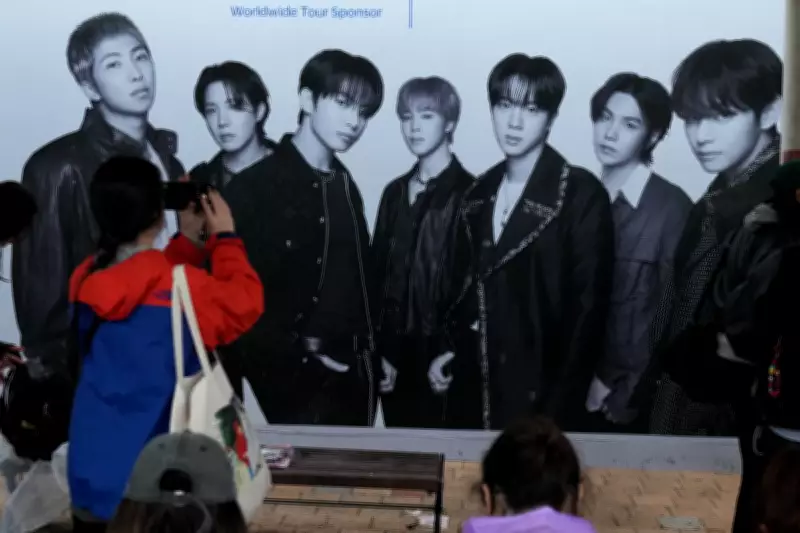
The South Korean economy received a significant boost of approximately £27 million from foreign fans attending the recent reunion concerts of global K-pop sensation BTS. According to data from credit card company Hana Card, around 30,000 overseas visitors spent about 55.5 billion won on airfare, accommodation, food, and retail during the three-day performances at Goyang Stadium earlier this month.
Economic Impact and Spending Surge
Foreign card transactions in the Goyang area skyrocketed by 807 percent from 6 to 12 April compared to the previous week, with overall spending increasing by 231 percent. The data revealed extraordinary spikes in specific categories: convenience store spending rose by 1,069 percent, cafe expenditures by 1,109 percent, restaurant spending by 600 percent, and retail purchases by 629 percent.
The total number of cards used surged by 1,252 percent, indicating massive engagement from international visitors. On average, concert attendees spent 616,000 won (£307) on airfare, 480,000 won (£240) on accommodation, and 314,000 won (£157) on shopping. Notably, their spending at convenience stores and cafes exceeded that of general tourists, suggesting consumption was heavily concentrated around the concert venue.

Tourism Boom and Fan Engagement
The economic phenomenon, dubbed "BTSnomics," was evident even before the concerts began. Searches for travel to Seoul increased by 155 percent within 48 hours of the Arirang World Tour announcement in January. Interest in Busan, where BTS has scheduled June performances, soared by 2,375 percent according to Hotels.com data.
Domestic searches for travel to Seoul and Busan grew by 190 percent and 3,855 percent respectively, demonstrating the group's powerful influence across both international and local markets. The comeback has coincided with record tourism numbers for South Korea, with 4.76 million foreign visitors in the first quarter of 2026 and 2.06 million in March alone - the highest monthly figure ever recorded.
Broader Economic Implications
BTS's return to the stage marks their first group activities since completing mandatory military service, which began in 2022. The seven-member group - consisting of RM, Jin, Suga, J-Hope, Jimin, V, and Jung Kook - launched their comeback with a free concert at Gwanghwamun Square in central Seoul on 21 March, followed by the Arirang World Tour beginning on 9 April in Goyang.
All three shows at the 41,000-seat Goyang Stadium sold out during presales. The Goyang concerts represent just the beginning of an extensive 82-date world tour spanning 34 cities through March 2027. Financial analysts project staggering revenue from the tour, with NH Investment & Securities estimating it could generate as much as £4 billion when accounting for both direct ticket sales and secondary consumer spending.
Merchandise and Retail Growth
The economic impact extended beyond immediate concert spending. Shortly before the Gwanghwamun concert, sales of BTS merchandise at Shinsegae Duty Free increased by 430 percent. Major retail centers experienced significant growth, with Lotte Department Store in Myeongdong seeing a 30 percent revenue increase compared to the previous year, while Shinsegae's revenue grew by 48 percent.
Fans' engagement with BTS-related tourism has created new commercial opportunities. Specialized tours have emerged catering to visitors wanting to explore locations significant to the group's early career, including former BigHit Music headquarters and Hakdong Park in Gangnam where members trained. Even fans without concert tickets contributed substantially to the local economy, with some visitors like Maria Herrera from Canada spending approximately £2,700 on week-long trips that included beauty treatments and other services.
Lee Hwa Jeong, a researcher at NH Investment & Securities, emphasized that "performances by artists with a global fandom like BTS do not end with ticket sales but drive tourism consumption throughout the entire city." This comprehensive economic impact demonstrates how cultural phenomena can significantly influence national economies through tourism, retail, and associated industries.