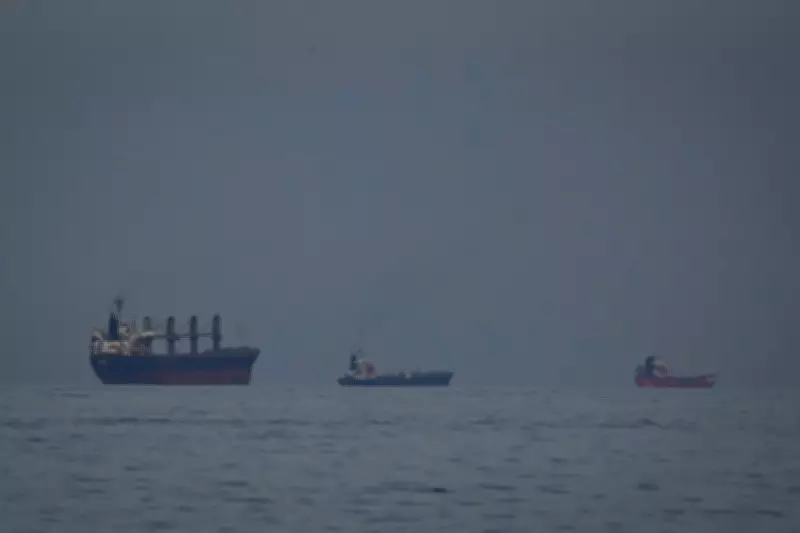
Ships Adopt Chinese Disguises in Hormuz to Evade Iranian Military Strikes
Commercial vessels navigating the volatile waters around the Strait of Hormuz and Persian Gulf are increasingly broadcasting false declarations of Chinese ownership through their transponder systems in a calculated attempt to avoid being targeted by Iranian forces during the ongoing conflict. According to an analysis of MarineTraffic ship tracking data conducted by The Associated Press, at least eight ships in or near the Persian Gulf and Gulf of Oman have altered their destination signals to display short messages like "CHINA OWNER" or "CHINA OWNER&CREW." Some vessels have already transited the strategic strait, while others remain in the high-risk area.
Strategic Deception for Risk Reduction
Ana Subasic, a trade risk analyst at data firm Kpler, which owns MarineTraffic, explained that the primary objective of this practice is risk mitigation rather than navigational facilitation. "The main goal of vessels publicly identifying themselves as 'Chinese' while transiting the Gulf or the Strait of Hormuz is primarily to reduce the risk of being attacked rather than to facilitate passage through the strait itself," Subasic stated. She noted that Iran and its affiliated militant groups have generally refrained from targeting ships linked to China, owing to Beijing's relatively neutral diplomatic stance and its substantial economic ties with Tehran.
Kun Cao, client director at consulting firm Reddal, characterized the signals as a clear warning: "The message is more like 'do not mistake me for the kind of ship you said you would hit.'" This tactic emerges against a backdrop of heightened anxiety among shippers, with at least 19 commercial ships damaged in the region as of Thursday, according to the latest reports.

Questionable Effectiveness and Operational Details
Most of the eight vessels identified by MarineTraffic were not actually flagged in China; instead, they sailed under registries such as Panama and the Marshall Islands. Cao pointed out that in commercial shipping, a vessel's flag state often "has little to do with the ship owner's nationality," highlighting the complexity of maritime ownership structures.
Rico Luman, a senior economist at Dutch bank ING specializing in transport and logistics, expressed skepticism about the actual effectiveness of these declarations. While many bulk carriers have strong connections to China through ownership, operation, and cargo, Luman emphasized that the real-world impact on avoiding attacks remains unclear and unverified.
Subasic detailed the technical mechanism behind these signals: destination signals are short notes manually entered by a ship's crew into the vessel's transponder, a GPS-based locator, and broadcast publicly. Typically used to indicate the next intended port for navigation safety, traffic awareness, and port planning, these signals are not strictly verified in real time. "Some vessels occasionally use it to display additional information or signals, such as references to ownership or nationality," she explained.
Historical Precedent and Broader Implications
This strategy is not entirely novel; during earlier Houthi attacks in the Red Sea, some vessels similarly declared links to China in an effort to reduce risks from the Iranian-backed group. The current situation underscores the escalating dangers in key global shipping lanes, where commercial operators are resorting to deceptive practices to safeguard their assets amid geopolitical tensions.
The broader regional conflict has severely disrupted maritime security, forcing ship operators to adopt unconventional measures. As the war continues, the reliance on such declarations may increase, though their efficacy in deterring targeted attacks by Iranian forces remains a subject of debate among analysts and industry experts.