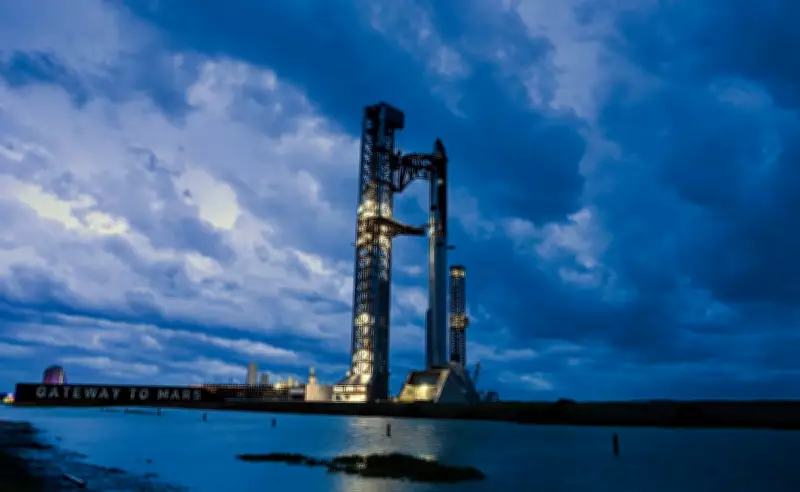
Under stormy skies at dawn, the SpaceX Super Heavy Booster and Starship spacecraft stand on Orbital Launch Pad 2 at Starbase, Texas. The image captures the scale of Elon Musk's flagship company as it barrels toward a historic initial public offering (IPO) valued at $1.75 trillion. On Wednesday, SpaceX publicly released an investor prospectus, offering unprecedented insights into its finances, cosmic ambitions, and the quirks of Musk's tech empire.
Cybertruck Purchases Total $131 Million
SpaceX appears to have done extensive business with Tesla, spending hundreds of millions of dollars in recent years. While much of that sum—$506 million to Tesla in 2025 and $191 million in 2024—went toward purchasing Megapack battery products, SpaceX also spent lavishly on Cybertrucks. The prospectus reveals that in 2025, SpaceX obtained $131 million worth of Cybertrucks at the manufacturer's suggested retail price, which ranges from about $69,900 to $99,900 depending on options. At that price, SpaceX would have acquired at least 1,300 vehicles. Tesla sold only 20,237 Cybertrucks last year, meaning SpaceX's purchases constituted a significant portion of total sales.
Extending Consciousness to the Stars
Throughout the prospectus, SpaceX reiterates its ultimate goal: establishing colonies on the Moon and Mars to usher in humanity's next evolution. "By moving beyond the only home we have ever known, we ensure species-level redundancy and that the light of consciousness will not be tied to a single planet subject to the inevitable hazards of a harsh and vast universe," the document states. "We do not want humans to have the same fate as dinosaurs." The filing includes an AI-generated rendering of life on Mars, depicting a family watching a rocket launch amid geodesic domes and solar panels. This rhetoric carries financial stakes: Musk will receive 1 billion shares if SpaceX achieves a permanent Mars colony with at least 1 million inhabitants. However, the company warns that such goals—including understanding the "true nature of the universe"—may prove difficult.

Risks from Grok Chatbot
The risk factors section highlights legal and regulatory issues involving Musk, including those tied to xAI, which SpaceX acquired in February. The prospectus discloses that xAI's Grok chatbot, particularly its "spicy" and "unhinged" modes, presents heightened risks of generating explicit content, misinformation, nonconsensual imagery, and discriminatory material. The company faces multiple domestic and international investigations related to Grok creating nonconsensual images. According to the Center for Countering Digital Hate, Grok generated over 3 million sexualized images in 11 days earlier this year before restrictions were increased. The bot itself admitted to generating images of "minors in minimal clothing." Several lawsuits, including from minors, allege the company profited from sexual predation and child sexual abuse material.
Security Spending on Musk
SpaceX's filing shows increasing amounts funneled to Musk's personal security firm: $2 million in 2023, $3 million in 2024, and $4 million last year, with $1 million spent in the first three months of 2026. Musk has repeatedly cited death threats and safety risks, especially during his role in the "department of government efficiency" effort to cut federal agencies.
Profitability Uncertain
Despite its ambitions, SpaceX has posted huge losses: $4.9 billion in 2025 and $4.3 billion in Q1 2026 alone. "We have a history of net losses and may not achieve profitability in the future," the prospectus states. The company acknowledges that its innovative products and services may ultimately be unsuccessful and require great expense.