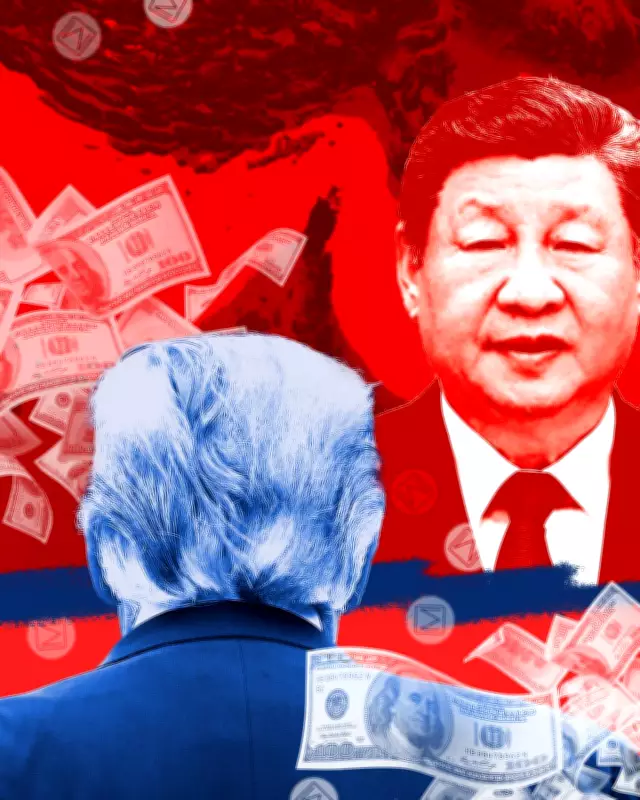
Donald Trump is set to arrive in Beijing on Wednesday for a high-stakes summit with Chinese leader Xi Jinping, marking the first visit by a US president to China in nearly a decade. The last such visit was also by Trump, in 2017, during his first term. That trip was a three-day affair featuring a private tour of the Forbidden City and a Peking opera performance, described by China as a 'state visit-plus'.
Since then, relations have soured due to a trade war, the COVID-19 pandemic, heightened US concerns over Chinese military activity, and another trade war. Trump's current trip has been delayed by the US attack on Iran and shortened to just two days, reflecting a shift in the global balance of power.
'The idea of an American president going to a summit with our foremost competitor at a time when he has just experienced the most catastrophic strategic debacle in recent memory is going to be a striking moment,' said Suzanne Maloney of the Brookings Institution. The optics of the summit will be heavily scrutinised, as Trump—less hawkish on China than in his first term—values personal diplomacy with Xi, contrasting with his abrasive tone toward traditional allies.

Key Issues on the Agenda
The summit will address trade, Iran, and Taiwan. In October 2025, the US and China agreed a temporary trade truce in Busan, South Korea, after Trump imposed tariffs as high as 145% on Chinese goods. China retaliated by restricting rare earth exports, crippling US factories. Both sides now seek a broader deal.
China wants to extend the truce, secure US technology access, and roll back export controls. In return, it may offer substantial US investments, mirroring deals with Japan and South Korea. Beijing is in talks with Boeing for up to 500 737 Max jets, which would be its first major Boeing order since 2017. Agricultural purchases are also on the table, with Washington pressing for 25 million tonnes of soya beans annually for three years.
A wild card is rare earth minerals. China may offer stable commercial access to rare earths and magnets, excluding military uses, in exchange for trade concessions.
Iran and the Middle East
The Iran war has reshaped summit dynamics. The closure of the Strait of Hormuz threatens China's oil supply and economy. Trump's erratic statements have caused diplomatic whiplash, while Pakistan claims a temporary ceasefire is near. China has pushed Iran toward a truce, and US Treasury Secretary Scott Bessent called on Beijing to 'step up with some diplomacy.'
China is the biggest buyer of Iranian oil and has some influence, but relations are 'delicate,' said Dali Yang of the University of Chicago. 'China knows the Middle East is not an easy place to get things done.' Beijing views the Iran crisis as US-made and far from its borders.
Taiwan and Regional Security
Taiwan remains the 'biggest risk' in US-China relations, according to Chinese Foreign Minister Wang Yi. Beijing claims the self-ruled island as its territory and vows to take control by force if necessary. The US supplies Taiwan with arms but does not formally recognise it. Trump has taken a softer stance, describing Taiwan as an economic competitor rather than a democratic ally. An $11 billion US arms package for Taiwan has reportedly been stalled before the summit.
Beijing may push for the US to shift from 'does not support' Taiwanese independence to 'opposes' it. Mira Rapp-Hooper, former top White House adviser on Asia, warned that allies will watch for any sign Trump has acknowledged Xi's interests over Taiwan, even casually.
Other Topics and Risks
Cooperation on fentanyl and synthetic opioids could be discussed, as well as human rights cases like those of Jimmy Lai and Pastor Jin Mingri. The AI arms race between the two superpowers may also feature, with Xi potentially proposing global standards for AI safety.
Trump enters the talks from a vulnerable position, with domestic disapproval at a record high of 62% and mired in the Iran conflict. A successful meeting could spook regional allies if it signals US concessions. 'A very positive, adulatory meeting could be the worst possible outcome,' said Jonathan Czin of Brookings, 'because it'll spook the rest of the region—it means we've made some kind of accommodation.'