

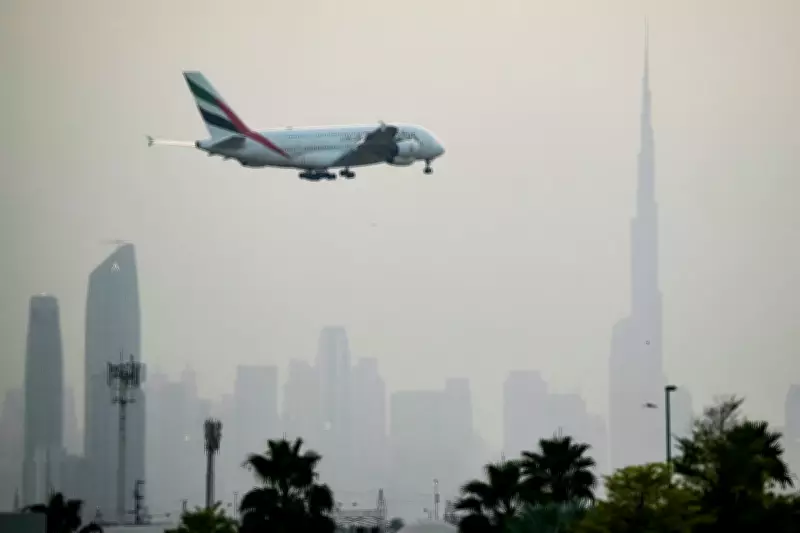
Dubai Extends Flight Restrictions Until End of May Amid Ongoing Iran Conflict
Dubai has implemented significant flight restrictions on foreign airlines, limiting them to just a single daily service to its airports until 31 May. This decision, directly linked to the ongoing crisis involving Iran, has sparked considerable concern among international carriers, particularly those from India, which stand to suffer the most substantial financial losses.
Indian Airlines Bear the Brunt of New Aviation Caps
According to detailed schedules data from Cirium for April and May, Indian airlines are projected to be the hardest hit by these new limitations. The Federation of Indian Airlines (FIA), representing major carriers including IndiGo, Air India, and SpiceJet, has urgently called upon the Indian government to intervene. In a formal letter dispatched on 31 March, the FIA requested that authorities pressure Dubai to lift the curbs and suggested potential reciprocal measures against Dubai-based airlines such as Emirates and flydubai should negotiations prove unsuccessful.
This development adds another layer of financial strain on Indian aviation companies, which are already contending with elevated fuel prices and extended flight paths to Western destinations. These existing challenges stem from a ban on using Pakistani airspace, implemented last year following military tensions between India and Pakistan.

Official Communication and Uneven Application of Rules
The flight restrictions, which extend measures initially put in place after the conflict began, were formally communicated to airlines via a private email from Dubai Airports on 27 March. The correspondence, reviewed by Reuters, explicitly states that carriers will be permitted only one round trip per day to Dubai International Airport (DXB)—typically the world's busiest international travel hub—and the smaller Al Maktoum International Airport (DWC) throughout the summer season, specifically between 20 April and 31 May.
The email clarified, "Carriers continue to be limited to one rotation per day, until capacity allows more to be facilitated ... Additional slots will be allocated if capacity is available." The FIA has highlighted to the Indian government that these curbs are not being applied to Dubai's own airlines, such as Emirates and flydubai, creating an uneven competitive landscape that could lead to what they describe as "substantial" revenue losses.
Specific Impact on Flight Schedules and Carrier Operations
Analysis of the data reveals the scale of the disruption. Air India and its budget subsidiary Air India Express had scheduled more than 750 flights into DXB during the affected period. IndiGo had planned 481 flights, followed by Saudia and Gulf Air with 480 and 404 respectively. SpiceJet had arranged 61 flights. The imposition of a one-flight-per-day cap would limit each foreign airline to just 30 or 31 flights per month, a stark contrast to the hundreds of daily flights operated by Emirates and flydubai, as indicated by Flightradar24 data.
In a statement to Reuters, IndiGo confirmed that the Middle East crisis and the extended Dubai restrictions have "significantly constrained" its operations. The airline had an approved summer schedule of 15 daily flights from India to Dubai, leading to a situation where "a significant portion of IndiGo’s capacity and aircraft time is currently underutilized."
Broader Aviation Context and Alternative Strategies
This situation occurs against a backdrop of long-standing complaints from Emirates and other Gulf airlines regarding India's bilateral air service agreements, which cap the number of seats that can be deployed between the countries. Indian authorities have defended these pacts as necessary to protect domestic carriers in a highly competitive market. Notably, India was the largest source of passengers for DXB in 2025, with 11.9 million travellers passing through the hub.

Meanwhile, other major international airlines such as Lufthansa, Singapore Airlines, and British Airways, which had far fewer flights to Dubai than Indian carriers prior to the crisis, have cancelled all services to the city until at least 31 May. These airlines are strategically reallocating resources, adding more non-stop Asia-Europe flights to capitalise on strong passenger demand that has driven up ticket prices.
Requests for comment from Dubai Airports, Dubai's media office, and several airlines including Air India and SpiceJet went unanswered. Flydubai stated that its flight schedules were approved by the relevant authorities, while Emirates did not respond to inquiries.





