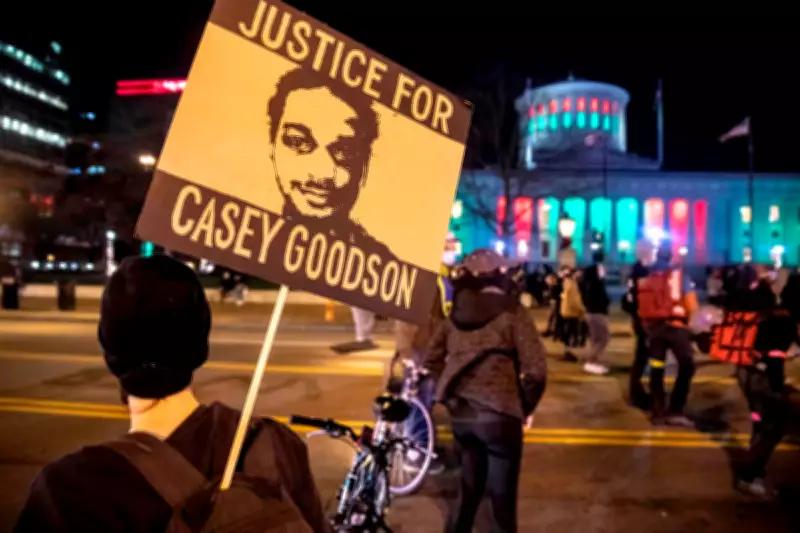
A former sheriff's deputy in Ohio has been convicted of reckless homicide for the 2020 fatal shooting of Casey Goodson Jr., a Black man who was carrying sandwiches to his grandmother's home. The killing by Jason Meade sparked widespread outrage across the state.
Verdict and Charges
Jurors delivered their verdict on Thursday, but stated they could not reach an agreement on the more severe charge of murder, leading the judge to declare a mistrial on that count. Meade, who is white, maintained that his actions were justified, claiming he saw the 23-year-old holding a gun and turning towards him in the doorway of the Columbus residence. Goodson was shot five times in the back and once in the side. However, no other witnesses testified to seeing Goodson, who was licensed to carry a firearm, holding a weapon, and no camera footage of the shooting exists.
Second Trial and Context
This marks Meade's second trial for murder, with the first concluding in a mistrial two years prior. His conviction makes him only the second white law enforcement officer in Ohio to be found guilty in the killing of a Black man since the 2020 death of George Floyd ignited national protests. Meade, now 47, retired from the Franklin County Sheriff’s Department in 2021 and also serves as a Baptist pastor. His defense attorney relied on Meade’s own accounts to argue the shooting was justified.

Conflicting Testimonies
During earlier proceedings, Meade testified he pursued Goodson after the man allegedly waved a gun at him from his vehicle. Conversely, Goodson's family and prosecutors asserted that he was holding a bag of Subway sandwiches in one hand and his keys in the other, listening to music through earbuds, when he was killed. Prosecutors also presented evidence suggesting the gun was not in Goodson's hands but in a flimsy holder under his belt, found beneath his body with its safety mechanism still engaged as he lay mortally wounded on the kitchen floor.
Christopher Corne, a prosecution witness who was driving nearby, testified at both trials that Goodson appeared to be dancing and singing in his truck shortly before the shooting and that he did not see a gun in Goodson’s hand. Meade’s attorney highlighted inconsistencies in Corne's testimony, including his description of Goodson's hair. Columbus police Officer Samuel Rippey, however, testified at the second trial that he observed a gun with an extended magazine on the grandmother’s floor while administering emergency treatment to Goodson.
Public Outcry and Background
Goodson’s death fueled public anger in Ohio, intensifying calls for police reform in the wake of numerous killings of Black individuals by white officers. Banners demanding "Justice for Casey Goodson Jr." and "Convict Murderer Meade" were displayed on highway overpasses in Columbus, which the judge ordered law enforcement to remove during the trial.
Prior Ohio prosecutions in similar cases have resulted in only one other conviction: that of Columbus police officer Adam Coy, who was indicted on charges including murder for the 2020 killing of Andre Hill. The state has seen several other fatal shootings of Black individuals by law enforcement, including children such as Tamir Rice (12) in Cleveland in 2014, Tyre King (13) in Columbus in 2016, and Ma’Khia Bryant (16) in Columbus in 2021. Other notable cases include John Crawford III in Beavercreek (2014), Samuel DuBose in Cincinnati (2015), Miles Jackson in Westerville (2021), Donovan Lewis in Columbus (2022), Jayland Walker in Akron (2022), and Ta’Kiya Young, who was pregnant, in Columbus (2023).