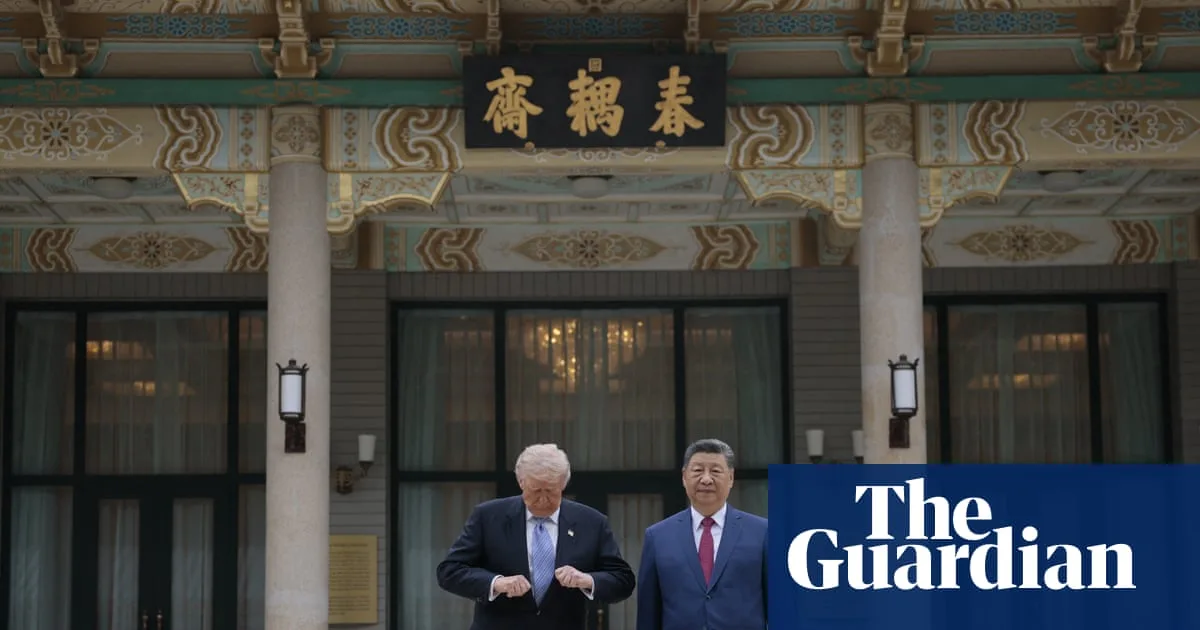
Donald Trump left China on Friday after a much-hyped summit with Xi Jinping that was rich in pageantry but offered little tangible progress on key issues such as Iran, Taiwan, and artificial intelligence. The US president, weakened by his prolonged war in Iran, failed to secure major breakthroughs, while Xi delivered sharp rhetoric over Taiwan without significant pushback from Trump.
In his final remarks in Beijing, Trump claimed the US and China struck “fantastic trade deals,” though details were scarce. He posted on Truth Social about China having a ballroom, referencing his campaign to build one at the White House. Critics, however, suggest the summit was more performative than substantive, with no major agreements on Iran, Taiwan, or the AI arms race.
On Iran, Trump said he and Xi discussed the issue and agreed on the need to keep the Strait of Hormuz open. The White House readout noted both leaders supported the free flow of energy, and Xi opposed militarisation of the strait. Trump later said he was considering lifting sanctions on Chinese companies buying Iranian oil, after Xi assured him China would not supply military equipment to Iran.

Beijing made clear that Taiwan was a top priority, with Xi warning that mishandling the issue could lead to “clashes and even conflicts.” Trump insisted US policy on Taiwan had not changed but admitted he might not approve a major arms sale to the self-governing island. Taiwan’s foreign ministry noted Trump’s remarks, stressing that arms sales are a security commitment under the Taiwan Relations Act.
China’s foreign ministry called for a ceasefire in Iran and the reopening of the Strait of Hormuz. Many in Beijing feel the crisis is not China’s responsibility, with retired senior colonel Zhou Bo stating, “Why should I clean your shit?” The summit highlighted the shifting power dynamics, with Xi appearing more assertive while Trump struggled to maintain influence.