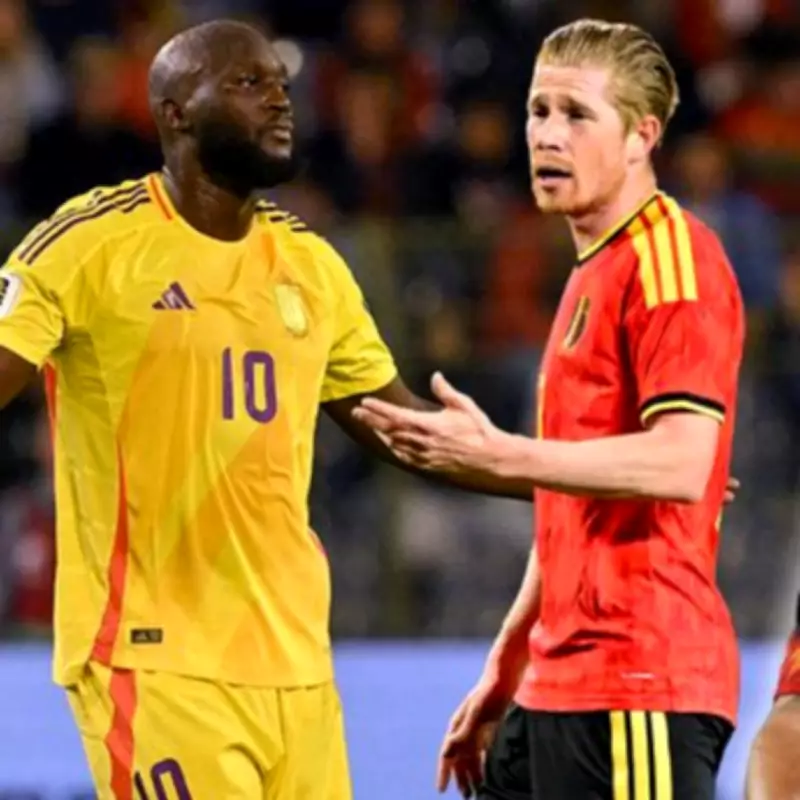
Eden Hazard, Vincent Kompany, Thibaut Courtois, Kevin De Bruyne, Romelu Lukaku—the list goes on. These are just some of the star names from Belgium's golden generation that etched their names into Red Devils history, finishing third at the 2018 World Cup. While the vast majority of that glittering squad have now retired, a few stars remain, still seeking one last taste of glory. The likes of Lukaku and De Bruyne remain key players at Napoli and Manchester City respectively, but there is a perception that the last remnants of the golden generation are past their prime.
They are determined to prove the doubters wrong at this summer's World Cup. Admittedly, Belgium are not quite the same team that beat England to claim bronze in Russia, but there remains a romantic hope they can go far in the competition.
A Turbulent Road to the World Cup
It is no secret that the most recent major tournament was a disaster for the Belgians. Domenico Tedesco's side were dumped out of the 2024 European Championships by France after narrowly progressing through a group featuring Romania, Ukraine, and Slovakia. Real Madrid's Courtois had fallen out with the head coach and was omitted from the squad, while Lukaku admitted he wanted to quit the team, citing a toxic environment within the group.

Tedesco was relieved of his duties after the tournament, and French head coach Rudi Garcia was tasked with reigniting Belgium's fortunes ahead of the World Cup. Scott Coyne of the Belgian Football Podcast provided insight into the current state of affairs and why Hazard could influence this summer's tournament, despite retiring from football in 2023.
"Absolutely," Coyne said when asked if this was the last chance saloon for the final few members of the 'Golden Generation'. "That's the spine of the side. Obviously, Courtois, De Bruyne, and Lukaku, who have one more tournament in them and are going to have to not only be fully fit but perform at their best if Belgium are to do well."
"What we've seen in their qualification for the World Cup has been, for the most part, unconvincing. They've really been untested on the whole. They were in a qualification group where Wales were probably their stiffest competition by quite some distance and were always going to be. But that's not enough to give us a gauge on where this side actually are. Garcia is the second coach to have come in since Roberto Martinez left, and it's part of what is really a continuing transition. The work that Tedesco did didn't generally go down that positively with the fan base, but I think he's been quite harshly treated."
Tedesco's Legacy and Garcia's Appointment
Belgium sneaked through their group at the recent European Championship and were not particularly convincing before being knocked out by France. Tedesco was sacked after less than two years in the job, leaving Belgian fans wondering what would come next.
Coyne said: "I think history might remember that relatively short spell that Tedesco did positively because the one thing he did do was realise that they were essentially at the end of a major cycle. That this was going to have to be the beginning of something new, and that the process in itself is often long, longer than fans' patience tends to be, and sometimes quite painful as well, with a lot of experimentation."
"That's exactly what we saw under Tedesco, this wave of youth and players getting their first caps, which I think was a good thing, and it was certainly something that had to happen. But at the same time, you're still looking to get results, and I think he did. I think just patience ran out a little bit, and there was a feeling that they needed to make a change, because I think the confidence and the speed of the process probably was waning a little bit, rather than what he was actually doing in itself. On the whole, there were far more positives than negatives to take out of what he did during a short time."
"Garcia's come in, his appointment's interesting insofar as there's been a lot of change at the Belgian FA in the background. So Roberto Martínez leaves, a lot of staff leave with him, and then the FA go on effectively what is a downsizing programme under a new sporting director, where they're cutting costs."

Premier League Talent and Hazard's Potential Role
Despite Belgium being somewhat of an unknown quantity heading into this summer's tournament, they still boast an array of Premier League talent, including Manchester United's No.1 Senne Lammens, Aston Villa midfield duo Amadou Onana and Youri Tielemans, and Manchester City's electric winger Jeremy Doku, currently enjoying his best season for the club.
Although they lack the hype of the previous golden generation, they can also call on one of the country's best-ever players—Eden Hazard—for vital tournament experience. Coyne said: "Most of the side don't come from the sort of background that a lot of the golden generation did. I think it's very difficult for somebody to fulfil that same role really on any level."
"It's one of the reasons that Rudi Garcia has brought back in players like Axel Witsel, albeit on a short-term basis. It's more about having that experience and that presence in the camp to rub off on younger players than to be able to go and play and contribute too much. I don't think the expectation was that somebody like Axel is going to get that much game time for obvious reasons, but just having him around."
Thomas Tuchel has taken a similar approach in reintegrating Jordan Henderson into the Three Lions' set-up, but England have not yet brought in one of their nation's best-ever players to help the national side. Belgium, however, have given Hazard a call.
"It's the same as being able to bring Eden Hazard into that training environment as well and deliver some training sessions," Coyne said. "He's not officially part of Rudi's coaching staff, but he has done some work in there because they know each other very well. There was an expectation that Hazard probably would join the staff. And who knows? There is still the possibility that he might join the staff to go to the tournament, just to be in there as well, because the influence of these players is a very difficult thing to put a value on."
"I think there are indications that some players who, given time, could step into what would be considered a senior leadership role. They are still very, very reliant on De Bruyne and Lukaku as well."
Low Expectations and Historical Context
De Bruyne boasts 115 caps for his country, while Lukaku has scored an incredible 89 goals in 124 caps. In the international break, 17-year-old Nathan De Cat made his debut for the senior team—not only one to watch in the future, but someone the Red Devils believe can make an impact this summer.
Of those players called up for recent international friendlies, just seven players had over 30 caps, with De Bruyne, Witsel, Thomas Meunier, Timothy Castagne, Tielemans, Lois Openda, and Doku among the most experienced players in the squad, though the latter two have only 33 and 41 caps respectively.
Despite their reliance on the likes of De Bruyne and Lukaku, the Red Devils' expectations are low ahead of the World Cup, but that is where previous teams have thrived. "The thing they've built up historically is they've always done better when they've had no real expectation of them," Coyne said. "For a long time, up until probably the early 2000s, Belgium nationally had a reputation for being very good defensively and on the whole quite good in midfield."
"There was a good balance between the defensive side of the game and offensively in midfield. But it was always up top that the doubts were about; they always lacked world-class strikers. That was the thing that held them back. The reason they did punch above their weight in a number of tournaments, pre the golden generation, was probably because the collective was greater than the sum of its parts."
"A series of coaches had really done very well, knitting together a really good team ethic. And that's something people forget, that it is a team game. Everyone focuses on the stars and always talks about them at the expense of the collective unit. Belgium were very, very good at employing that over a 20, 30-year period leading up to the golden generation, exceeding expectations at tournaments for that very reason."
"They then had a terrible Euro 2000, and off the back of that started to invest in their footballing infrastructure in a major way. That leads to a kind of revolution in their coaching methods and their academies, with some of the Belgian club academies now some of the best ones in Europe."