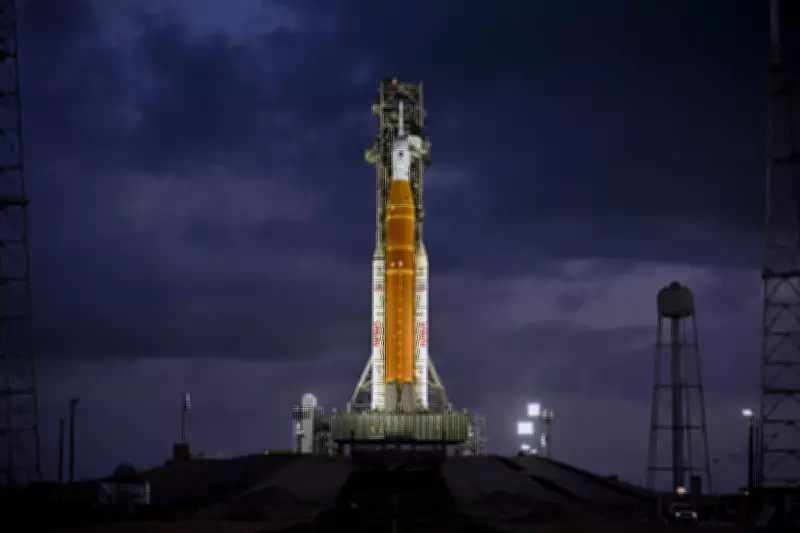
Artemis II Launch: Crowds Gather for Historic NASA Moon Mission
NASA engineers are making final preparations for the Space Launch System (SLS) rocket at Complex 39B in Florida, as crowds of up to 400,000 people gather on beaches and causeways to witness a historic event. The Artemis II launch, scheduled for 6:24 PM ET on Wednesday, marks the first time since Apollo 17 in December 1972 that humans will venture beyond lower Earth orbit.
A Mission Packed with Milestones
The fully crewed rocket will carry four astronauts on a 10-day test flight that will not land on the moon but is filled with significant achievements. NASA astronauts Christina Koch and Victor Glover will become the first woman and first person of color to fly into cislunar space, the region between Earth's orbit and the moon. Jeremy Hansen of the Canadian Space Agency will be the first non-American to achieve this feat.
Collectively, the Orion space capsule could propel the crew farther from Earth than any humans before them. If launched on Wednesday, they are expected to reach more than 4,600 miles beyond the far side of the moon on flight day six, coming within 253,000 miles of home. This would break the record set by Apollo 13 in April 1970, which reached 248,655 miles from Earth.

Diversity and Politics in Space Exploration
Before Donald Trump's return to office, NASA celebrated the diversity of Artemis crews on its website but removed this recognition last year, aligning with an executive order to eliminate diversity, equity, and inclusion practices. In pre-flight interviews, Glover and Koch downplayed the significance of their historic status.
"It's not about celebrating any one individual," Koch said during the crew's final media briefing. "If there's something to celebrate, it's that we are at a time when anyone who has a dream gets to work equally hard to achieve that dream."
Glover expressed a similar sentiment, hoping for a future where such milestones are seen as part of human history rather than segregated achievements.
Technical Preparations and Future Plans
NASA is keen for Artemis II's lunar flyby to succeed as a foundation for ambitious plans, including a $20 billion moon base by the end of the decade, as announced by newly confirmed administrator Jared Isaacman. A key part of this mission involves photographing the moon's south pole from a height of 4,000 to 6,000 miles, where future landings and the lunar base are planned.
The long journey will allow astronauts to test crucial hardware and life-support systems needed for future flights, such as Artemis IV in 2028, which aims to place human footprints back on the lunar surface. The crew's health will be monitored throughout, studying effects of increased radiation and microgravity, while they live in the confined space of the Orion capsule, comparable to a small camper van.
Launch Details and Challenges
The SLS rocket and Orion capsule stand at 322 feet on the launchpad, with NASA confident it has resolved previous issues, including a heat-shield problem from Artemis I and a helium leak that caused delays. The final weather briefing gave an 80% chance of favorable conditions, with backup launch windows available over the following five nights if needed.
Excitement is mounting in Cape Canaveral and Cocoa Beach, with hotel rooms in short supply due to spring breakers and launch spectators. Despite running years behind schedule and billions over budget, NASA remains committed to its lunar goals. "NASA was established to undertake big, bold endeavors in air and space," Isaacman stated. "The next up is America's return to the lunar environment."