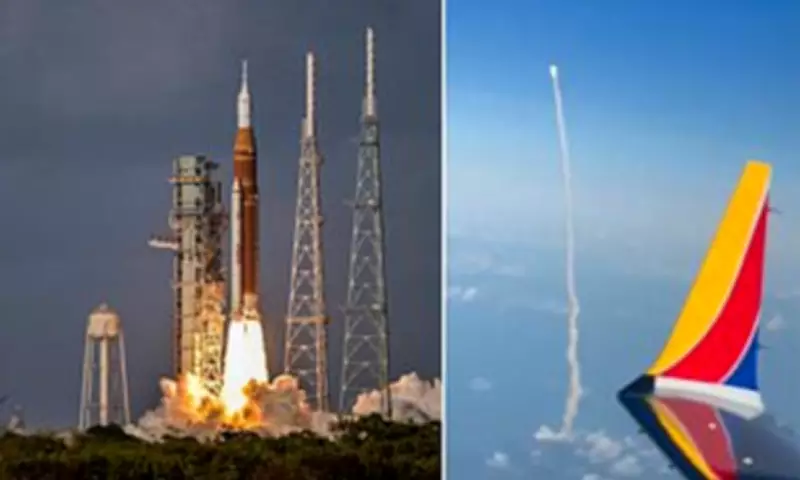
Passenger Films Historic Artemis II Launch from Plane Window
A Southwest Airlines passenger has captured breathtaking footage of NASA's Artemis II lunar mission launch directly from his airplane window, providing a unique aerial perspective on the historic event. Chris Pappas spotted the rocket ascending from Earth's surface while peering through the window and immediately recorded the remarkable scene on video.
Viral Video Captures Rocket's Ascent
The footage begins with clear blue skies visible beyond the plane's wing, before a distinct line of smoke appears trailing behind the flaming rocket in the distance. Within mere seconds, the rocket accelerated beyond the plane's field of view, disappearing into the sky above while leaving only its smoke trail visible. Pappas described the experience as "most insane" on Instagram Threads, praising Southwest Airlines pilots for "understanding the assignment."
The video quickly garnered over 65,000 likes, with viewers expressing astonishment at the incredible timing and perspective. One user commented they would be "sobbing because this timing is unreal," while another marveled at how the aerial view demonstrated the rocket's astonishing speed: "You actually see how fast it goes up. The perspective scale is not understood seeing it either live on TV or on the ground."

Launch Details and Mission Progress
Artemis II launched from Kennedy Space Center on Wednesday evening, carrying NASA astronauts Reid Wiseman, Victor Glover, Christina Koch, and Canadian Space Agency astronaut Jeremy Hansen. The mission represents the farthest human space exploration in history, traveling approximately 250,000 miles from Earth—surpassing even the Apollo missions.
On Thursday evening, NASA confirmed completion of the critical engine burn that moved the spacecraft out of Earth's orbit. The nearly six-minute burn, occurring just before 8 PM, placed the crew on a free-return trajectory that will utilize both Earth and Moon gravity to guide the spacecraft around the Moon and back to Earth.
NASA Administrator Jared Isaacman announced on X: "Nominal translunar injection burn complete. The Artemis II crew is officially on the way to the Moon. America is back in the business of sending astronauts to the Moon. This time, farther than ever before."
Technical Aspects and Challenges
The orbital maneuvering system engine generated approximately 6,000 pounds of thrust during the burn—sufficient power to accelerate a car from 0 to 60 mph in just 2.7 seconds. However, the mission experienced a brief communications issue about 51 minutes into flight during a planned satellite handover, resulting in temporary partial loss of communication with the crew.
Isaacman clarified at a post-launch press conference that while ground control could transmit to the crew, they couldn't hear responses for a brief period. He emphasized the issue didn't affect the spacecraft itself and has since been resolved, with NASA actively investigating the cause.
Broader Context and Future Implications
Artemis II represents the initial phase of NASA's multi-step plan to return humans to the Moon by 2028 at the earliest. The ten-day journey involves astronauts launching into orbit, separating their Orion spacecraft from the launch vehicle, breaking out of low-Earth orbit, circling the Moon, and returning to Earth.
Beyond lunar exploration, the Artemis campaign establishes groundwork for future Mars missions while creating sustainable human presence beyond Earth. The program also positions the United States in strategic competition with China, which plans its own lunar landing by 2030, marking the beginning of what experts describe as an extraterrestrial infrastructure race with significant implications for space-based technology and artificial intelligence development.
As Isaacman noted regarding future operations: "Meanwhile, back at Kennedy Space Center, the teams are out at the pad getting ready for what comes next. We are going to get into a rhythm of launching Moon rockets around here."