As a young astronomer at Cambridge University 57 years ago, I vividly recall sitting in my college room, captivated by the flickering images on a black-and-white television as Apollo 11 made its historic lunar landing. Like millions around the globe, I was utterly transfixed by this monumental achievement. The following day, I encountered my supervisor, the distinguished Professor Fred Hoyle, who shared an even greater sense of elation than my own. It truly felt as if the future had arrived overnight.
The Pace of Progress Then and Now
The 1969 Moon landing occurred merely 12 years after the Soviet Union's Sputnik I became the first satellite to enter low Earth orbit. The velocity of technological advancement during that era was nothing short of exhilarating, fostering a widespread belief that such progress would only accelerate. Many, including myself, assumed that human footprints on Mars would be witnessed within our lifetimes. Now, at 83 years of age and having served as Astronomer Royal, I can confidently state that seeing an astronaut walk on Mars in the foreseeable future seems as improbable as witnessing cows leap over the Moon.
Half a Century of Stagnation
Our daily lives are profoundly dependent on space technology for satellite navigation, global communications, and accurate weather forecasting. Yet, since the return of the Apollo 17 crew in 1972, no human has ventured more than a few hundred miles beyond Earth's atmosphere. For five decades, crewed space exploration appeared to languish in a state of suspended animation. However, this prolonged period of inertia now shows signs of ending, with human spaceflight experiencing a remarkable resurgence.

A New Dawn with Artemis II
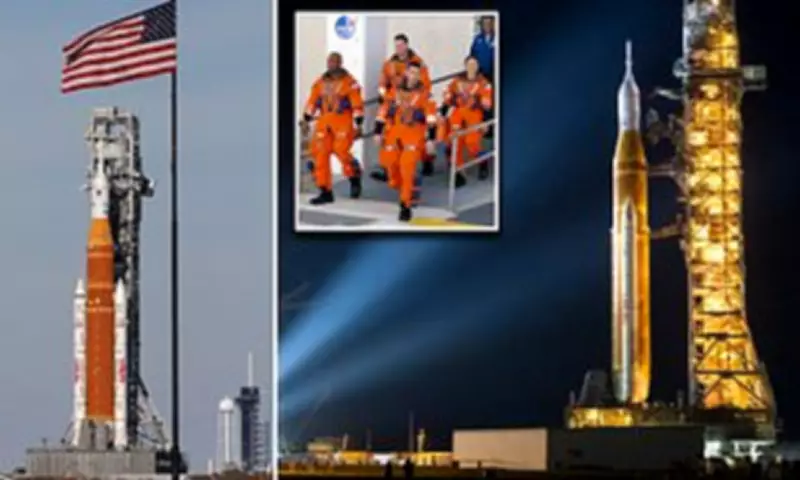
This week heralds a significant new chapter. NASA is poised to launch its Artemis II mission, potentially as early as this evening. This pioneering endeavor will send four astronauts on a lunar orbit, marking the first crewed mission to the Moon in half a century. Should this mission prove successful, NASA aims to return astronauts to the lunar surface by 2028. Nevertheless, the poetic wonder of this occasion is once again tempered by the familiar specter of human rivalry.
A fresh space race is undeniably underway, not solely between the United States and China but also involving ambitious private corporations seeking to mine asteroids, colonize Mars, and commercialize space travel. This thrilling yet formidable competition is likely to become a defining characteristic of the 21st century.
The Slowdown After Apollo
The final Moonwalk was conducted by Eugene Cernan in 1972, after which the momentum of space exploration decelerated dramatically. Following the Soviet Union's collapse, the U.S. government could no longer rationalize allocating 4 percent of the federal budget to NASA; today, that figure stands at approximately 0.3 percent. Perhaps most significantly, public enthusiasm for such ventures gradually waned.
Over the past fifty years, despite the dedication and sacrifices of crews aboard the International Space Station, no human has traveled beyond Earth's orbit, let alone reached the Moon or farther destinations. Consequently, it is perhaps unsurprising that the Artemis II mission has encountered its share of obstacles.
Technical Challenges and Delays
NASA initially planned to launch the Artemis II rocket in February of this year. However, scientists detected a hydrogen rocket fuel leak during preparatory checks, prompting a postponement to March 6. A subsequent "helium flow anomaly" on the 322-foot Space Launch System (SLS)—the most powerful rocket ever constructed by the agency—resulted in further delays.
This week, however, all systems finally appear ready. NASA technicians recently announced an "80 percent go" weather forecast for the launchpad at Cape Canaveral, Florida, with a potential launch window opening as early as Wednesday evening local time (early Thursday morning BST).

The Significance of the Mission
Whenever lift-off occurs, the importance of Artemis II should not be underestimated. The ten-day voyage will carry three American astronauts and one Canadian—Commander Reid Wiseman, Victor Glover, Christina Koch, and Jeremy Hansen—a staggering 257,061 miles from Earth, farther into space than any human has previously traveled. This mission will also mark the first time a woman or a Black individual has journeyed to the Moon.
The SLS rocket, comprising two solid rocket boosters and four engines, will propel the Orion spacecraft, which houses the crew module where the astronauts will reside. This mission builds upon the success of Artemis I, an uncrewed capsule that orbited the Moon in 2022.
The Geopolitical and Economic Stakes
While these technological marvels are fascinating, they remain mere mechanisms. The crucial development is that, after fifty years of painstakingly slow progress, humanity seems finally prepared to explore the final frontier once more. The pressing question is: why now?
In 2024, China's space agency, CLEP, successfully landed a spacecraft on the far side of the Moon. The Chang'e-6 mission retrieved soil samples from the Apollo Basin crater in the lunar southern hemisphere, a historic achievement. The sample originated from the Shackleton Crater, a site considered potentially viable for sustaining human life due to its unique conditions.
Most lunar regions experience two weeks of sunlight followed by two weeks of darkness. However, the Shackleton Crater, near the Moon's south pole, features terrain in perpetual sunlight while its center remains in permanent shadow, harboring ice and possible water reserves. NASA confirmed the presence of water molecules on the lunar surface in 2020.
The New Space Race Intensifies
Bolstered by its success, China announced tentative plans to land astronauts on the Moon by 2030. It is therefore no coincidence that NASA aims to achieve this feat by 2028. A two-year margin may seem substantial, but in space exploration, engineering delays, launch failures, or other malfunctions can set programs back by a decade. The competition between China and the United States to return to the Moon is exceedingly close.
As Donald Trump has emphasized, he desires a mission that encompasses "more than getting rocks this time." Unlike the Cold War era, the current space race involves more than soft power; control of space carries immense economic and security implications. Consider how Elon Musk's Starlink satellite system has provided strategic advantages to Ukrainian forces, or recent suspicions that Iran has utilized Russian satellite intelligence to target U.S. bases in the Middle East.
Furthermore, the potential for mining rare metals in space represents an industry that could be worth trillions of dollars in the coming decades.
Safety Concerns and Competitive Advantages
Critically, China possesses a significant advantage. NASA's paramount concern is safety, and rightly so. The American public has little tolerance for loss of life, and a human tragedy would almost certainly jeopardize taxpayer funding. The Apollo I disaster in 1967, which claimed three astronauts during a simulated countdown, remains etched in national memory. Although NASA has maintained a safety record exceeding 98 percent with only two fatal crashes since, even one accident is unacceptable.
In contrast, China's more authoritarian governance structure may allow its space program to assume greater risks, as public opinion is less likely to influence governmental ambitions.
The Role of Private Enterprise
The drive to explore space mirrors the commercial and exploratory motives that propelled Columbus to America and Marco Polo along the Silk Road. Unsurprisingly, private companies like Elon Musk's SpaceX and Jeff Bezos's Blue Origin have entered the arena. With these commercial players emerging, my intuition suggests that the latest space race between the U.S. and China—featuring human crews rather than robots—may be the last predominantly contested by nation-states.
Elon Musk has expressed a desire to die on Mars (though not via crash landing). At 54 years old, his ambitions underscore the long-term vision of private space ventures.
The Elusive Dream of Mars
Will humans set foot on Mars within the next fifty years? Having made an incorrect prediction half a century ago, I hesitate to speculate. Mars undoubtedly holds greater allure than the already "conquered" Moon, but a crewed mission to the red planet is extraordinarily complex. The journey alone takes six months, necessitating over a year's worth of supplies. The psychological toll of long-term isolation in a confined space, akin to a pickup truck, presents formidable challenges before even addressing scientific and engineering hurdles.
As Artemis II prepares for launch, Mars remains a distant speck on the horizon of our collective imagination. Despite lofty discussions about interstellar mining and colonization, humanity is still striving to retrace the small steps of Neil Armstrong from 57 years ago, let alone take the next giant leap.
Lord Rees of Ludlow served as Astronomer Royal from 1995 to 2025, is a Fellow of Trinity College, and Emeritus Professor of Cosmology and Astrophysics at the University of Cambridge.