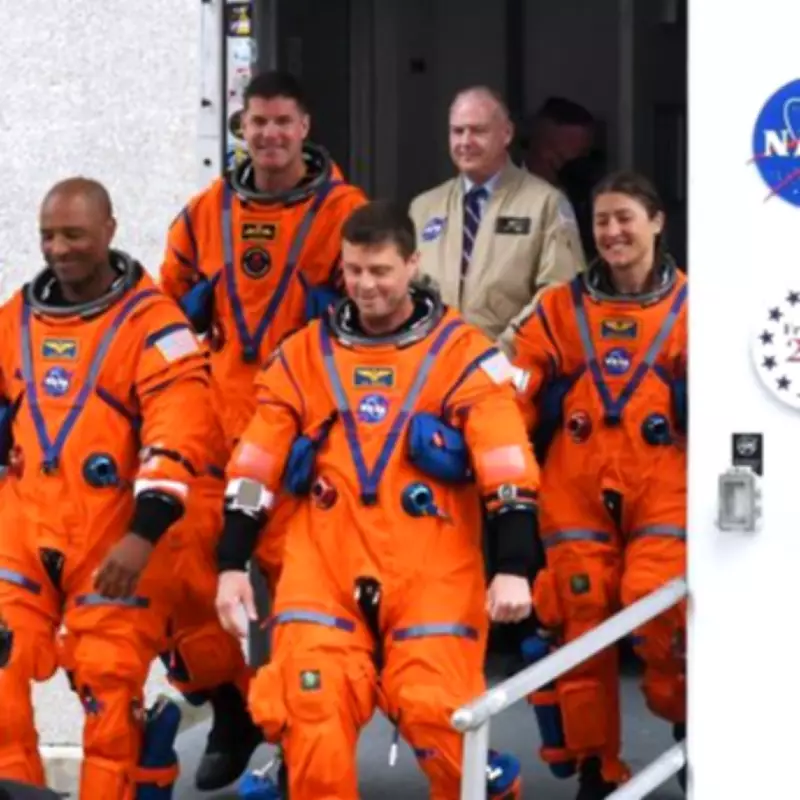
Artemis II Successfully Departs Earth Orbit on Historic Moon Mission
NASA has confirmed that the Artemis II spacecraft has successfully completed its critical engine burn and departed Earth's orbit, marking a significant milestone in humanity's first crewed lunar mission in more than five decades. The announcement came during a news conference where NASA deputy associate administrator Lori Glaze expressed profound excitement about this historic achievement.
Historic Moment for Space Exploration
"Ladies and gentlemen, I am so, so excited to be able to tell you that for the first time since 1972 during Apollo 17, human beings have left Earth orbit," Glaze declared to reporters. She confirmed that the engine firing proceeded flawlessly without any technical issues, setting the stage for the remainder of the mission.
The four astronauts aboard the Orion capsule - Commander Reid Wiseman, pilot Victor Glover, mission specialist Christina Koch, and Canadian Space Agency astronaut Jeremy Hansen - launched from Cape Canaveral in Florida on Wednesday evening. They spent the initial 25 hours of their journey circling Earth before the successful orbital departure.

Astronauts' Inspiring Messages from Space
Canadian astronaut Jeremy Hansen described how the crew had been captivated by the "phenomenal" view from their spacecraft windows. He shared a powerful message about human achievement and unity, stating: "Humanity has once again shown what we are capable of, and it's your hopes for the future that carry us now on this journey around the moon."
Pilot Victor Glover offered his own perspective on Earth's appearance from space, telling mission control: "Trust us, you look amazing, you look beautiful, and from up here you look like one thing. Homosapiens are all of us; no matter where you're from or what you look like, we're all one people." He emphasized that this mission demonstrates what humanity can accomplish "not just when we put our differences aside but when we put our differences together."
Technical Details and Mission Trajectory
NASA confirmed that the successful engine burn has placed the Artemis II crew in a free return trajectory, allowing them to utilize the Moon's gravity for their journey back to Earth. The Orion capsule's main engine burned for five minutes and fifty seconds, generating up to 6,000 pounds of thrust - sufficient power to accelerate a car from zero to sixty miles per hour in approximately 2.7 seconds.
The spacecraft is now en route to travel approximately 4,000 miles beyond the Moon, with a lunar flyby scheduled for Monday as the next major milestone. This trajectory will send the crew some 252,000 miles (406,000 kilometers) into space before their return to Earth, potentially breaking the current record for the furthest human spaceflight held by Apollo 13 astronauts since 1970.
NASA Leadership Celebrates Achievement
NASA Administrator Jared Isaacman took to social media platform X shortly after 1:00 AM UK time to announce: "Nominal translunar injection burn complete. The Artemis II crew is officially on the way to the Moon. America is back in the business of sending astronauts to the Moon. This time, farther than ever before."
Approximately two and a half hours later, he added: "Our four astronauts aboard Orion said it was a great ride during launch. Artemis II is on its way to the Moon. This mission is critical in setting us up for success for our next missions - Artemis III, Artemis IV, and beyond." He concluded by noting that NASA was receiving positive feedback from the astronauts about their experience.
Broader Mission Context and Future Implications
While the Artemis II astronauts will not land on the lunar surface, this mission serves as a crucial precursor to future Moon landings and establishes foundational capabilities for eventual crewed missions to Mars. The mission had previously experienced a two-month delay due to technical issues including hydrogen fuel leaks and clogged helium lines, making Thursday's successful orbital departure particularly significant.

NASA aims to return astronauts to the lunar surface by 2028, positioning the United States ahead of China's planned lunar landing around 2030. The Artemis program represents the most ambitious human space exploration initiative since the Apollo era, with Artemis II serving as the first crewed test of the Orion spacecraft and Space Launch System rocket combination.
The successful departure from Earth orbit marks a triumphant moment for international space cooperation and human exploration, demonstrating technological capabilities that will enable future missions deeper into our solar system while inspiring global audiences with messages of unity and hope from the astronauts themselves.