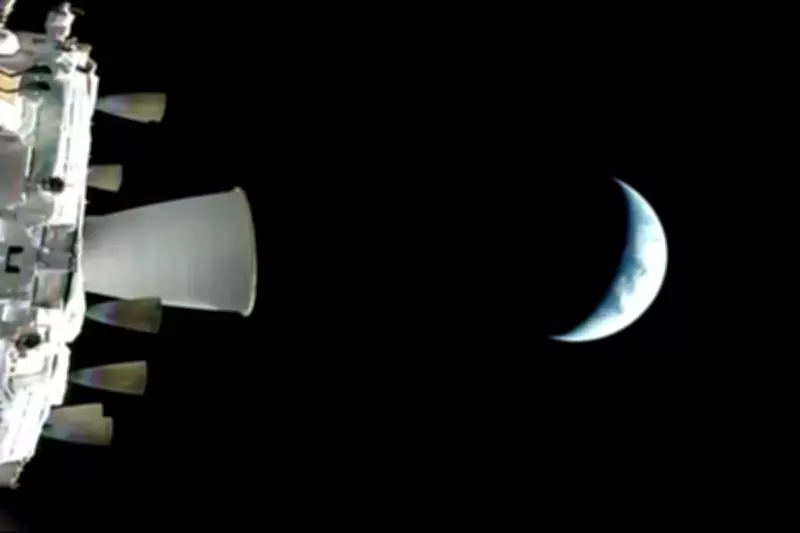
Artemis II Mission Exits Earth Orbit, En Route to Lunar Flyby
NASA's Artemis II mission has achieved a significant milestone, successfully propelling its crew of astronauts out of Earth's orbit and onto a precise trajectory toward the moon. This critical maneuver occurred approximately 25 hours after the spacecraft's liftoff, marking a pivotal moment in human space exploration. The mission, which launched on Friday, 03 April 2026, is now advancing steadily toward its lunar destination, with the astronauts set to conduct a fly-around of the moon early next week.
Historic Crew and Record-Breaking Journey
The Artemis II crew comprises three American astronauts and one Canadian astronaut, each making history in their own right. Astronaut Victor Glover has become the first Black individual to launch to the moon, while Christina Koch is the first woman to embark on such a mission. Jeremy Hansen, representing Canada, marks the first non-U.S. citizen to participate in a lunar launch. Together, they are pursuing the moon, which lies nearly 250,000 miles away, and will soon surpass the distance record set by Apollo 13 in 1970, making them the farthest humans have ever traveled from Earth.
Mission Objectives and Challenges
This test flight is a crucial step in NASA's broader Artemis program, which aims to establish a sustainable human presence on the moon, including plans for a moon base and long-term lunar living. Despite the mission's success, minor initial issues were reported, including concerns with the capsule's toilet system and cabin temperature. However, these challenges have been addressed, and the spacecraft continues to operate smoothly as it heads deeper into space.

Significance for Future Space Exploration
The Artemis II mission represents a major advancement in space technology and international cooperation. By pushing the boundaries of human travel beyond Earth, it sets the stage for future missions that could lead to permanent lunar settlements and, eventually, manned missions to Mars. The successful exit from Earth orbit is the first such event since 1972, reigniting global interest in lunar exploration and highlighting NASA's ongoing commitment to expanding humanity's reach in the cosmos.