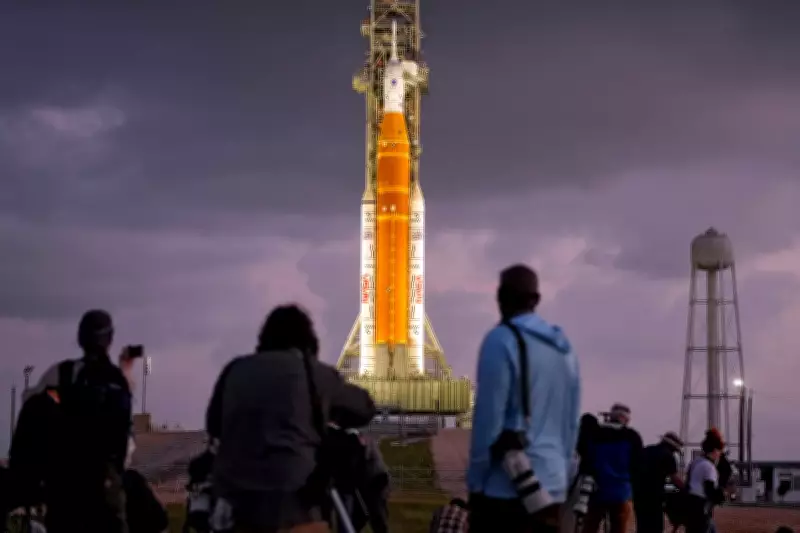
NASA is embarking on a historic return to the Moon for the first time in more than five decades. The Artemis mission, set to launch this week, represents a pivotal step in the space agency's ambitious plans to establish lunar bases and eventually facilitate travel to Mars.
A New Era of Lunar Exploration
This mission marks the first human journey to the Moon since the Apollo program concluded in 1972. Unlike the Apollo landings, Artemis II will not involve a lunar touchdown. Instead, the crew will undertake a 10-day voyage, flying around the far side of the Moon before returning to Earth. NASA envisions this as a foundational practice run for more extensive future missions aimed at sustained lunar presence and interplanetary travel.
The Diverse Artemis II Crew
The astronauts selected for this groundbreaking flight include Reid Wiseman, Victor Glover, Christina Koch, and Jeremy Hansen. This team is notable for its diversity: Koch will become the first woman to orbit the Moon, Glover the first person of color, and Hansen the first non-American on such a mission. Koch previously set a record for the longest single spaceflight by a woman during her 328-day stay on the International Space Station, where she participated in the first all-female spacewalk. Glover, a Navy test pilot, was the first Black astronaut to live and work aboard the space station and was among the early astronauts to launch with SpaceX. Hansen, a former fighter pilot from the Canadian Space Agency, is the sole space rookie, while Wiseman, a retired Navy captain with prior space station experience, serves as commander. The crew members range in age from 47 to 50.

Advanced Technology and Challenges
Powering the mission is NASA's new Space Launch System (SLS) rocket, which stands 322 feet tall—shorter than the Apollo-era Saturn V but more powerful at liftoff due to its strap-on boosters. The Orion capsule, carrying the astronauts, sits atop the rocket. The SLS utilizes liquid hydrogen fuel, a choice that has presented challenges, including hydrogen leaks that delayed earlier test flights and a recent practice run in February. Similar issues with helium flow further postponed the launch to April.
Mission Timeline and Objectives
After liftoff, the astronauts will spend approximately 25 hours in a high, lopsided orbit around Earth, using the separated upper stage of the rocket for docking practice. They will rely on visual cues to maneuver, maintaining a distance of no less than 33 feet. Orion's main engine will then propel the crew toward the Moon, following a free-return trajectory that leverages gravitational forces to conserve fuel.
On the sixth day, Orion will reach its farthest point from Earth, sailing 5,000 miles beyond the Moon—surpassing the distance record set by Apollo 13 and making the Artemis astronauts the most remote travelers in history. The crew will then return home, with a splashdown in the Pacific Ocean scheduled for the tenth day, completing a journey of nine days, one hour, and 46 minutes.
Scientific Observations and Innovations
During their flyby, the astronauts will observe previously unseen regions of the lunar far side, with the Moon appearing as large as a basketball at arm's length. They have studied maps and satellite images extensively, guided by NASA geologist Kelsey Young, who will monitor the mission from Houston. In addition to professional cameras, the crew will use smartphones for photography, a move by NASA administrator Jared Isaacman to capture inspiring images. These observations are particularly valuable, as only China has landed on the far side, making this a unique opportunity for data collection.
Return and Future Implications
The mission concludes with a splashdown, where all eyes will be on Orion's heat shield, which sustained damage during a 2022 test flight. NASA has modified the descent to limit heat exposure, and Navy recovery ships will be stationed off the coast of San Diego. This mission not only tests critical systems for future Artemis launches but also symbolizes a unifying global effort in space exploration, bringing the wonders of the Moon closer to people worldwide.