Comet MAPS: A Celestial Spectacle or Cosmic Fizzle in April 2026?
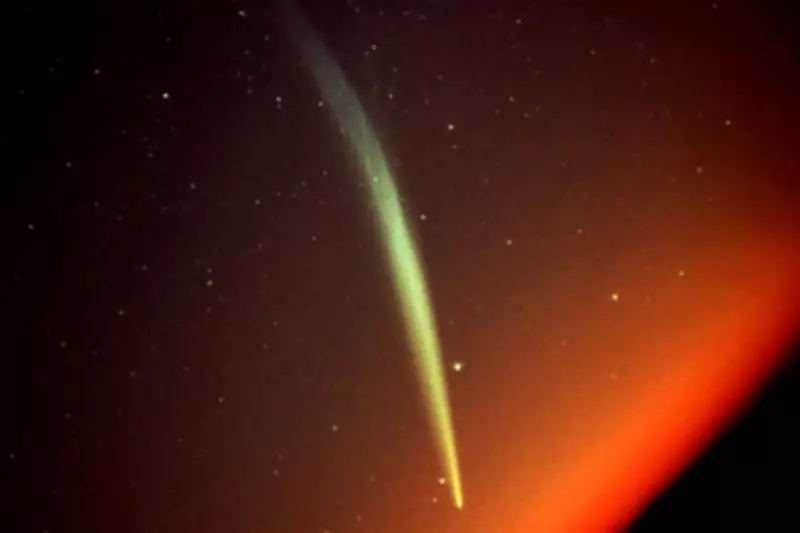
In the early days of April 2026, skywatchers across the globe may witness a breathtaking celestial event: the possible emergence of a Great Comet, officially designated Comet C/2026 A1 (MAPS). This icy wanderer from the outer Solar System could outshine the Moon and stretch a luminous tail halfway across the night sky, or it might vanish entirely, leaving observers with nothing but binoculars and dashed hopes. The uncertainty stems from its perilous path, which will bring it within 160,000 kilometres of the Sun's surface on 4 April, a journey that could either ignite a brilliant display or shatter the comet into oblivion.
The Legacy of Great Comets and the Kreutz Sungrazers
The history of Great Comets is filled with awe and mystery. In September 1882, railway workers in Argentina were startled by a faint glowing ball at dawn, which within days brightened to surpass all stars and became visible in daylight, earning the title "Great Comet of 1882." Comet MAPS follows in the footsteps of this and other Kreutz sungrazers, a family of comets believed to be fragments of a single mega-comet that broke apart millennia ago. This group includes the Great Comets of 1106 and 1843, which sparked fears of the Day of Judgement, and Comet Ikeya-Seki in 1965, the most prominent comet of the twentieth century.
German astronomer Heinrich Kreutz first identified this orbital lineage in the late nineteenth century, linking these comets to a possible ancient breakup witnessed by the Greek historian Ephorus in 371 BC. Today, thousands of smaller Kreutz fragments are detected by citizen scientists using data from the SOHO Sun-observing spacecraft, though most flare up too close to the Sun for ordinary telescopes. Comet MAPS, discovered in January 2026 by a team in Chile's Atacama Desert and named after its members—Alain Maury, Georges Attard, Daniel Parrott, and Florian Signoret—could join this illustrious but unpredictable family.

The Unpredictable Nature of Comets: A Feline Analogy
As veteran comet-hunter David Levy aptly notes, "a comet is like a cat – it has a tail and it does whatever it wants." This whimsical comparison underscores the inherent uncertainty of Comet MAPS's performance. While astronomers can predict events like solar eclipses with precision—such as the next total eclipse visible from central London at 6.52 am on 5 May 2600—comets remain enigmatic. Their behaviour depends on factors like composition and solar interaction, making forecasts speculative.
Comet MAPS's close solar approach will subject it to intense heating, potentially vaporising its ices rapidly to create a dazzling show. However, this same solar furnace might disintegrate its nucleus, causing it to fizzle out. Observers are advised to look west after sunset in early April, below the brilliant planet Venus, with binoculars at the ready in case the comet is dimmer than hoped. In a rare scenario, if the nucleus breaks apart entirely, an orphaned cometary tail without a bright head might be visible.
April 2026 Stargazing Guide: Planets, Meteors, and Constellations
Beyond Comet MAPS, April 2026 offers a rich array of celestial events. After sunset, Venus and Jupiter will dominate the western sky, with Venus near the horizon and Jupiter higher up near the twin stars of Gemini, Castor and Pollux. The Moon will enhance this display, appearing near Venus on 18 and 19 April and passing Jupiter on 22 April.
Overnight on 22/23 April, the Earth will encounter debris from Comet Thatcher, producing the Lyrid meteor shower. Best viewed in the early morning hours after moonset, this shower promises a natural light show. Additionally, from 22 to 24 April, Venus will pass left of the Pleiades star cluster, and on 23 April, faint Uranus can be spotted just lower left of Venus using binoculars, appearing as a greenish star.
For star enthusiasts, Leo the lion will be high in the south, with Virgo rising to its left from the bright star Spica. Together with orange Arcturus in Boötes, these form a prominent triangle in the spring sky. A diary of key dates includes the Full Moon near Spica on 2 April, Mercury at greatest elongation west on 4 April, and the First Quarter Moon near Regulus on 25 April.

Whether Comet MAPS becomes the Great Comet of 2026 or a cosmic footnote, its arrival highlights the dynamic and unpredictable beauty of our universe, inviting everyone to look up and wonder.