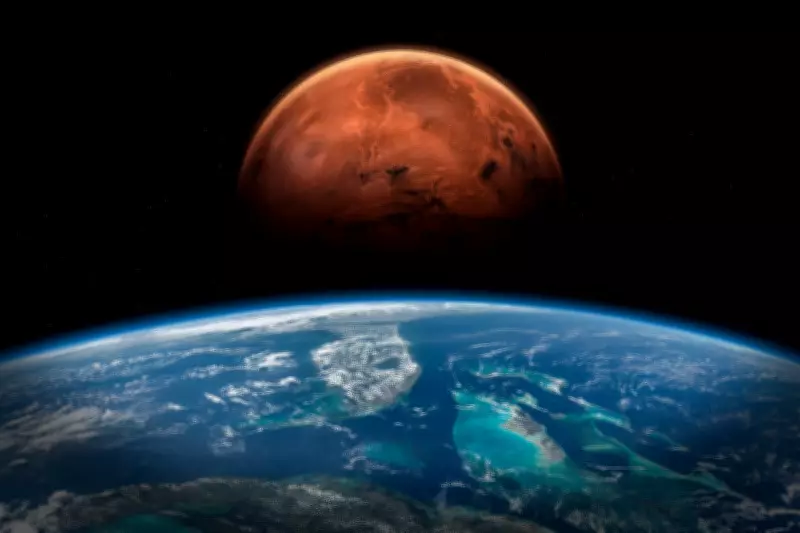
Mars Was Warm and Wet, Not Icy, New Study Reveals, Boosting Habitability Prospects
A groundbreaking study has challenged long-held theories about the early climate of Mars, suggesting the Red Planet was warm and wet billions of years ago rather than cold and icy. This finding, based on data from NASA's Perseverance rover, significantly enhances the possibility that Mars was once habitable for lifeforms.
The research focuses on the Noachian epoch, a period from approximately 4.1 to 3.7 billion years ago, during the Late Heavy Bombardment when meteorite impacts scarred the solar system. Evidence of water-carved landforms from this era, such as dried river valleys and lake beds, has long hinted at a potentially hospitable environment.
Climatic Debate: Warm and Wet vs. Cold and Icy
For decades, scientists have debated the prevailing conditions of Mars' Noachian epoch. Two primary scenarios have emerged: one positing a cold, icy climate with occasional melting from impacts or volcanism, and the other suggesting a warm, wet, and largely ice-free environment.

Given that the Sun was about 30% dimmer during this time, sustaining a warm climate would have required a thick atmosphere rich in greenhouse gases like CO2. However, high atmospheric pressure can cause CO2 to condense, reducing its greenhouse effect, which made the cold, icy theory more plausible to many researchers.
Perseverance Rover's Crucial Findings
The Mars 2020 Perseverance Rover, which landed in Jezero Crater in February 2021, was specifically tasked with investigating these climatic theories. Jezero Crater was chosen as a landing site due to its history as an ancient lake, with orbital images revealing fan-shaped deposits and water-carved channels.
In a new paper, scientists analyzed aluminium-rich clay pebbles, known as kaolinite, found within these ancient flow channels. These pebbles showed signs of intense weathering and chemical alteration by water during the Noachian epoch.
Key Chemical Evidence Points to Persistent Rainfall
What makes this discovery particularly significant is the chemical composition of the clay pebbles. They are depleted in iron and magnesium while enriched in titanium and aluminium, indicating they were not altered in a hydrothermal environment from temporary ice melting.
Instead, the alteration likely occurred under modest temperatures and persistent heavy rainfall. The authors noted strong similarities between these Martian clays and those on Earth from periods of warmer, wetter climates.
The paper concludes that these kaolinite pebbles were altered under high rainfall conditions comparable to past greenhouse climates on Earth, representing some of the wettest and potentially most habitable intervals in Mars' history.
Implications for Life and Future Missions
This research aligns with Perseverance's recent discovery of possible biosignatures in samples collected from Jezero Crater. These samples have been cached for a future Mars sample return mission, though NASA's recent cancellation of such a mission delays Earth-based analysis.
Astrobiologist Andrew Knoll's criterion states that for something to be evidence of life, it must be inexplicable without biology. Whether these Martian samples meet this standard remains unknown until they can be studied in terrestrial laboratories.
Nevertheless, the study paints a striking picture of Mars billions of years ago: a tropical climate with persistent rainfall, possibly hosting a living ecosystem in what is now the desolate landscape of Jezero Crater. This warm, wet era likely represents the planet's most habitable period, offering new avenues for understanding the potential for life beyond Earth.