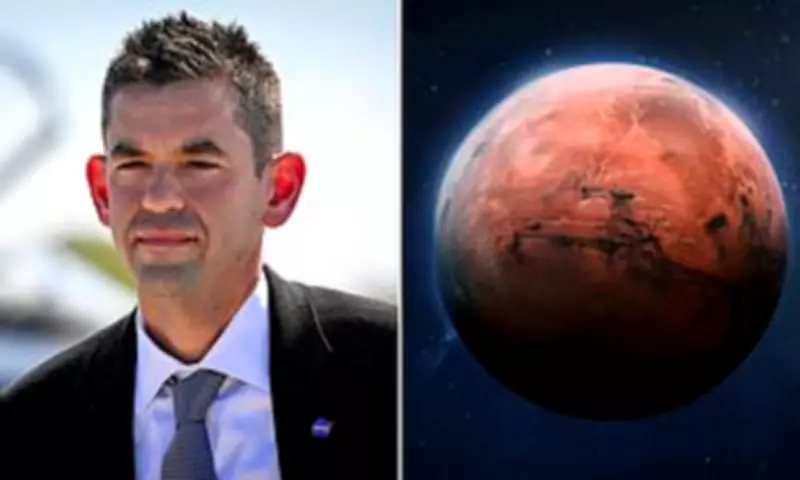
NASA Administrator Makes Bold Prediction About Martian Life
In a groundbreaking interview, NASA's newly appointed administrator Jared Isaacman has declared there is a 90 percent probability that scientists will discover evidence of ancient microbial life on Mars through sample return missions. Speaking with conservative commentator Benny Johnson, Isaacman presented a compelling case for extraterrestrial existence based on cosmic statistics.
Cosmic Perspective on Life Beyond Earth
Isaacman emphasized the astronomical scale of the universe, noting approximately two trillion galaxies each containing countless stars and planets. "I would say there could be life everywhere," he stated. "It doesn't mean it looks like us. It doesn't mean it has the tentacles you have in movies." This perspective challenges the notion that Earth is uniquely privileged in hosting biological organisms.
Artemis II Launch Preparations Underway
The revelation comes as NASA prepares for today's historic Artemis II launch, marking the agency's return to lunar exploration after more than five decades. Weather conditions appear favorable with an strong>80 percent chance of acceptable launch weather. The mission will utilize the powerful Space Launch System rocket generating 8.8 million pounds of thrust to propel four astronauts farther into space than any previous human mission.

"We are going back to the moon," Isaacman declared, describing how the Orion capsule will carry NASA astronauts Reid Wiseman, Victor Glover, and Christina Koch alongside Canadian Space Agency astronaut Jeremy Hansen on a 10-day lunar flyby. The mission represents a critical step toward establishing sustainable lunar exploration capabilities.
Mission Profile and Future Objectives
The Artemis II mission will begin with initial operations in low Earth orbit, where engineers will spend 24 hours verifying spacecraft systems. Astronauts will remain within quick-return distance during this crucial phase. Following a translunar injection burn, the spacecraft will journey past the moon, utilizing lunar gravity to slingshot back toward Earth before splashing down in the Pacific Ocean.
Isaacman outlined the ambitious timeline for subsequent missions: "Hopefully, we have learned enough about that vehicle to set us up for Artemis III in 2027. That's where we will test the Orion spacecraft with landers in Earth orbit. Then in 2028, before President Trump's term, Artemis IV will put American boots back on the lunar surface."
Evidence from Martian Exploration
Supporting Isaacman's prediction, previous NASA discoveries have pointed toward potential biological signatures on Mars. In 2025, acting NASA Administrator Sean Duffy announced findings from the Perseverance rover that revealed what scientists called the 'clearest sign of life' on the Red Planet. NASA Associate Administrator Nicky Fox described the signature as "the kind we would see that was made by something biological."
Researchers identified unusual features in ancient Martian rocks from Neretva Vallis within Jezero crater, where a river existed billions of years ago. These formations, nicknamed 'poppy seeds' and 'leopard spots,' displayed characteristics suggesting possible microscopic life forms. Scientist Joel Hurowitz explained how these signatures indicated life might have existed on Mars long before most organisms emerged on Earth.
Government Transparency and UFO Inquiries
While expressing confidence about Martian life, Isaacman clarified he has not seen classified documents supporting alien visits to Earth. This statement followed President Trump's February 19 order to release government files concerning UFOs and extraterrestrial phenomena. NASA press secretary Bethany Stevens responded that the agency continues making all data publicly available and welcomes public participation.
Stevens noted: "As the NASA Administrator has said, there are certainly things he's come across in the job that he can't explain... but they relate more to unnecessarily costly programs than they do to extraterrestrial life." This distinction separates scientific exploration from speculative theories about alien visitation.

The convergence of these developments—from bold predictions about Martian life to imminent lunar missions—signals a transformative period in space exploration, with NASA positioned to potentially answer humanity's most profound question: Are we alone in the universe?