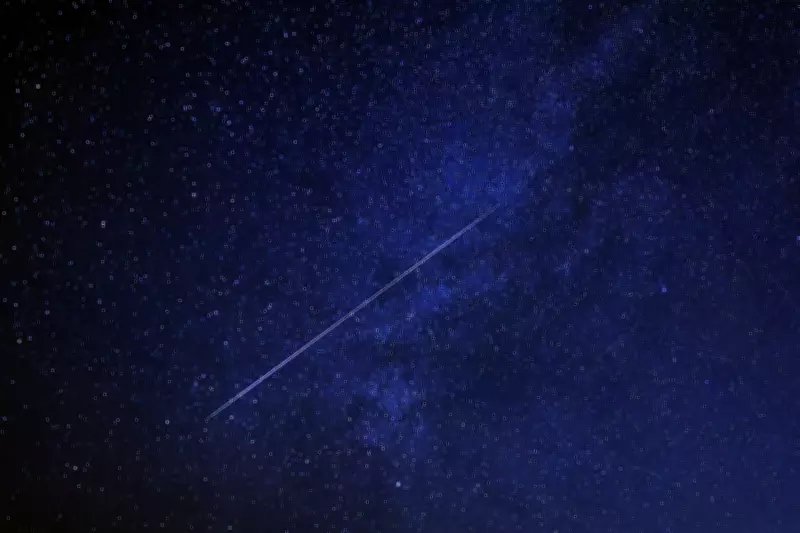
NASA Confirms Daytime Fireball Over Northeast US Was a Meteor
A rare and striking daytime fireball that blazed across the skies over parts of the northeastern United States on Tuesday afternoon has been officially identified as a meteor by NASA. The event, which captivated hundreds of observers, was particularly notable because fireballs are common but seldom witnessed during daylight hours, making this sighting especially remarkable.
Tracking the Meteor's Path
More than 200 eyewitness reports were submitted to the American Meteor Society from states including Pennsylvania, Delaware, New York, and Connecticut. These accounts, combined with data from publicly accessible cameras, enabled NASA analysts to meticulously reconstruct the meteor's trajectory.
The space agency determined that the meteor first became visible approximately 48 miles above the Atlantic Ocean, near Long Island. Traveling southwest at an astonishing speed of roughly 30,000 miles per hour, it covered about 117 miles before disintegrating around 27 miles above Galloway, New Jersey, just north of Atlantic City.

Eyewitness Accounts and Social Media Evidence
The event unfolded between 2:30 p.m. and 2:45 p.m., with most witnesses reporting a bright flash between 2:35 and 2:40 p.m. Many described seeing multiple green fragments streaking across the sky for several seconds, adding to the spectacle.
In Phillipsburg, New Jersey, observer Leslie Galloza captured an image of the object at around 2:34 p.m. and shared it with NBC Philadelphia. Meanwhile, another New Jersey resident, Nick Brucato, recorded the fireball on video and posted it in the public Pine Barrens Facebook Group.
"Here's what looks like to be the meteor everyone's talking about. Took this video as fast as I could today in Whiting at 2:34 PM. Heard the loud boom minutes later," Brucato wrote. Comments on the post included reports of a "very loud boom" in Batsto and notes that the noise startled pets, such as one user's dog.
Regional Sightings and Descriptions
Witnesses from Maryland, North Carolina, Virginia, and Washington, D.C., also reported sightings, highlighting the event's wide visibility. A resident of Heathsville, Virginia, told NJ.com that the fireball was "insanely cool to see," moving "from up left to down right" and accompanied by a "muffled boom."
A woman from Falls Church, Virginia, added, "The fireball flashed brightly after two to three seconds of watching it streak across the sky from left to right. As the fireball flashed, I saw one or two smaller bright pieces break away before it faded away."
Context and Rarity of the Event
While meteors are a common occurrence, many go unnoticed because they appear over oceans, remote areas, or during daylight, making them difficult to spot. Therefore, widely observed events like Tuesday's are relatively rare, according to NASA.
This latest sighting comes mere weeks after a separate meteor event on March 17, when a 7-ton meteorite exploded over Medina County, Ohio, creating a sonic boom. That was followed days later by another unrelated meteor event in Texas, underscoring the ongoing activity in our skies.
The combination of eyewitness reports, social media sharing, and NASA's analytical capabilities has provided a detailed understanding of this fascinating celestial phenomenon, reminding us of the dynamic nature of our atmosphere and the wonders it occasionally reveals.