NASA's Artemis II Mission Set for Historic Moon Launch After 50-Year Hiatus
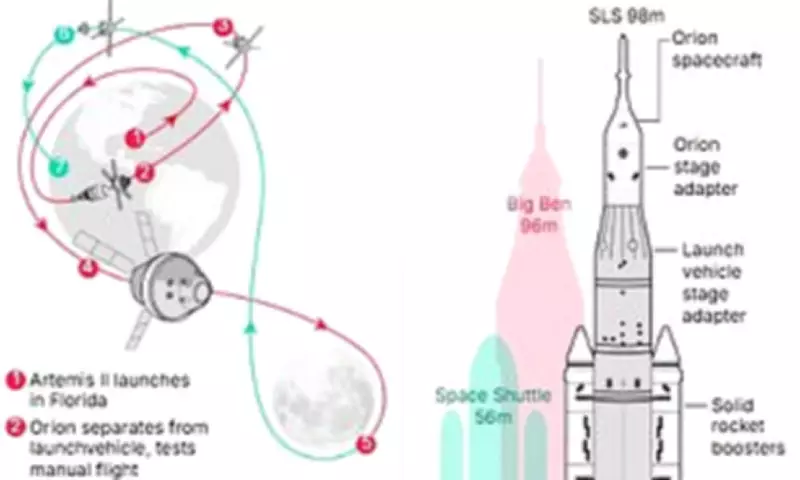
The Artemis II mission has received official clearance for launch, propelling four astronauts toward the moon in a monumental journey that breaks a five-decade absence of human lunar exploration. The towering 32-storey Space Launch System (SLS) rocket is scheduled to lift off from the Kennedy Space Centre in Florida, embarking on a 10-day, 685,000-mile (1.1 million km) voyage around the moon and back to Earth.
Mission Readiness and Crew Details
During a recent briefing, NASA officials expressed unwavering confidence in the mission's preparedness. Amit Kshatriya, NASA's associate administrator, stated, 'As we enter the pre-launch phase, the teams are in a strong posture, and the mission remains on track. The vehicle is ready. The system is ready. The crew is ready. I have complete confidence in this team.' The crew comprises Commander Reid Wiseman, Pilot Victor Glover, and Mission Specialists Christina Koch and Jeremy Hansen, marking a historic inclusion of the first woman and first Black person on a lunar mission.
Launch and Mission Timeline
The launch window opens on April 1, with multiple backup opportunities available in subsequent days, contingent on weather conditions, technical readiness, and range availability. The mission stages include:

- Launch from Kennedy Space Centre Launch Pad 39B.
- Manoeuvres in orbit to adjust trajectory using the Cryogenic Propulsion Stage.
- Trans-lunar injection to propel the spacecraft toward the moon.
- A lunar flyby at a maximum altitude of 5,523 miles (8,889 km) above the moon's surface.
- Return to Earth over four days, culminating in a Pacific Ocean splashdown.
During take-off, the SLS rocket's four RS-25 engines will fire continuously for 8.5 minutes, generating 8.8 million pounds of thrust alongside two boosters—surpassing any previous rocket in history.
Orion Capsule Specifications and Crew Life
The Orion crew capsule, designed for deep-space travel, features several advanced systems:
- It can support four astronauts for up to 21 days.
- Equipped with a built-in escape rocket for launch emergencies.
- Boasts the largest heat shield ever constructed for a human spacecraft.
- Provides approximately 330 cubic feet of living space, akin to two minivans.
- Includes sleeping bags strapped to walls for rest and a compact flywheel exercise device for fitness.
After launch, the Orion capsule will separate from the rocket's upper stage, entering a highly elliptical Earth orbit. The crew will conduct extensive systems checks on life-support, propulsion, navigation, and communications before initiating the trans-lunar injection burn.
Lunar Flyby and Return Journey
Orion will follow a 'free-return' trajectory, passing behind the moon and naturally swinging back toward Earth without additional propulsion. This phase will see the spacecraft reach its greatest distance from Earth, with the crew photographing and analysing the lunar surface. Upon re-entry, Orion will separate key components and plunge into the atmosphere at speeds around 25,000 miles per hour (40,233 kph), testing the heat shield—a primary and perilous objective.
Historical Context and Future Implications
This mission represents the first human return to the moon's vicinity since Apollo 17 in 1972, despite delays from hydrogen fuel leaks and a clogged helium pressurization line earlier this year. With an estimated total cost of $44 billion (£32.5 billion), Artemis II paves the way for a planned lunar landing in 2028 and informs future missions to Mars. British astronaut Major Tim Peake highlighted Europe's involvement, noting contributions like the European service module, and expressed hope for inspiring UK youth toward space careers. Tracking support will come from Goonhilly Earth Station in Cornwall.