Replacement Crew Rockets to ISS After Unprecedented Medical Evacuation
A fresh crew of astronauts has successfully launched toward the International Space Station, stepping in to replace colleagues who were forced to return to Earth early in a landmark medical evacuation. This urgent mission, initiated at NASA's request, marks a significant moment in the history of human spaceflight.
Urgent Launch Follows Historic Return
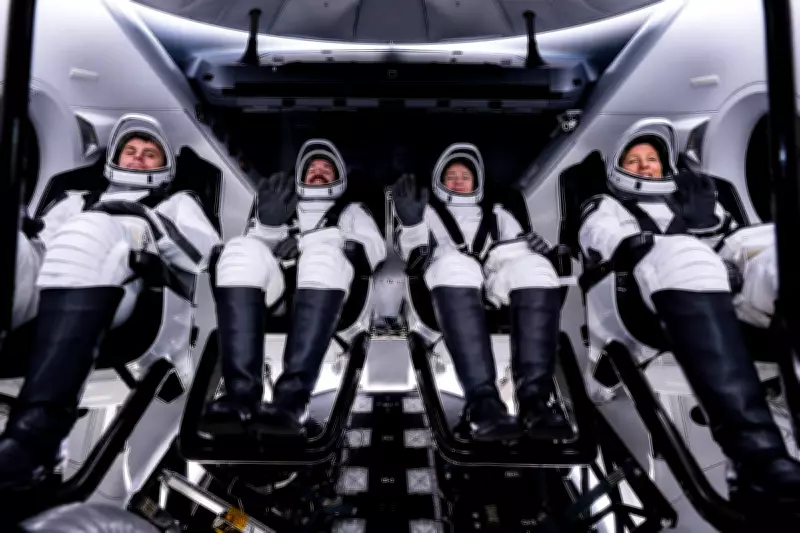
On Friday, February 13, 2026, SpaceX launched the replacement astronauts from Cape Canaveral Space Force Station. The crew, comprising NASA's Jessica Meir and Jack Hathaway, France's Sophie Adenot, and Russia's Andrei Fedyaev, is embarking on an anticipated eight- to nine-month mission that will extend into the autumn months. Their arrival at the orbiting laboratory the following day will restore the space station to its full operational complement, filling the vacancies created last month when their predecessors were evacuated.
This evacuation represented the first time in NASA's 65-year history of human spaceflight that a mission was shortened specifically for medical reasons. The identities of the ill astronaut and the precise nature of the health issue remain confidential. Following their splashdown in the Pacific Ocean near San Diego, all four returning astronauts were transported directly to a hospital for evaluation and care.

Maintaining Operations Amid the Vacancy
During the past month, with the station understaffed, NASA was compelled to postpone scheduled spacewalks and defer various other duties. Operations were maintained by the remaining crew of three astronauts—one American and two Russians—who kept the station functioning. Notably, NASA did not implement additional medical checkups for the new crew prior to launch, nor was any new diagnostic equipment packed, as the agency expressed confidence in the existing medical protocols.
An ultrasound machine already aboard the station for research purposes was repurposed on January 7 to examine the ailing crew member, demonstrating the adaptability of onboard resources. Dina Contella, deputy program manager, emphasized that while NASA continuously evaluates upgrades to the station's medical equipment, particularly as missions grow longer, practical limitations often necessitate bringing astronauts home. "There are a lot of things that are just not practical and so that's when you need to bring astronauts home from space," she stated earlier in the week.
Pioneering Medical and Lunar Research
The newly arrived crew will engage in several critical experiments and demonstrations during their stay. In preparation for future, more challenging missions to the Moon and Mars, they will test innovative medical technologies. These include:
- A specialized filter designed to convert drinking water into emergency intravenous fluid.
- An advanced ultrasound system that utilizes artificial intelligence and augmented reality, reducing reliance on ground-based experts.
- Ultrasound scans of their jugular veins as part of an ongoing study on blood clots in microgravity.
Additionally, the astronauts will demonstrate their lunar-landing capabilities through a simulated test, contributing to the Artemis program's objectives.
Notable Crew Members and Connections
This mission holds special significance for several crew members. Sophie Adenot becomes only the second French woman to travel to space, inspired by Claudie Haignere's 1996 mission to Russia's Mir space station when Adenot was just 14 years old. Haignere traveled to Cape Canaveral to witness the launch in person.
For Jessica Meir and Andrei Fedyaev, this journey marks their second trip to the space station. Meir, who participated in the first all-female spacewalk in 2019, expressed excitement about the concurrent Artemis II mission. "Now we're right here on the precipice of the Artemis II mission," she remarked before liftoff. "The fact that they will be in space at the same time as us … it's so cool to be an astronaut now, it's so exciting." A planned radio linkup between the ISS crew and the Artemis II astronauts, who are scheduled to fly around the Moon as early as March, will further highlight this historic overlap.

Meanwhile, SpaceX is preparing its adjacent Kennedy Space Center launch pad for the super-sized Starship vehicles, which are essential for NASA's planned lunar landings. This launch underscores the ongoing collaboration between NASA and commercial partners in advancing human space exploration.