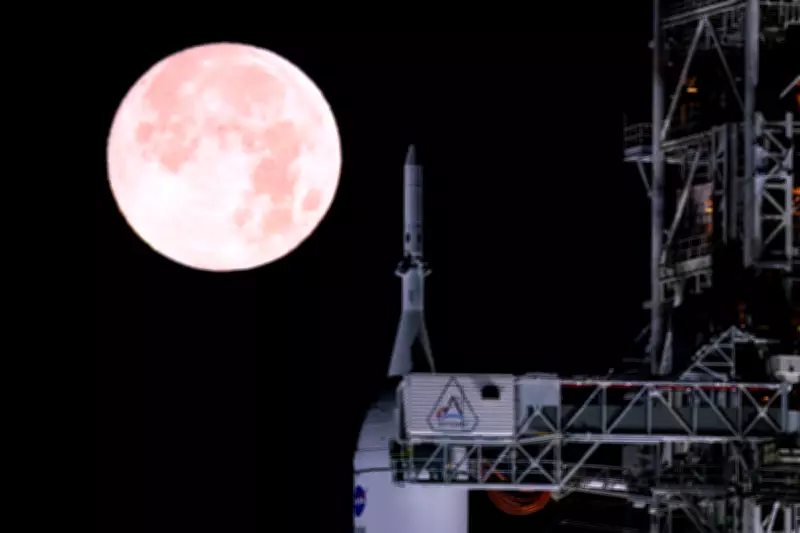
This Thursday, a celestial spectacle will unfold as the full Pink Moon peaks in the night sky, coinciding with NASA's historic Artemis II mission launch. The lunar event will reach its maximum illumination less than four hours after astronauts blast off on their groundbreaking journey to orbit the Moon.
Historic Timing for Space Exploration
The Pink Moon, named for the spring flowers that bloom during this period, will appear at 3:12 AM BST on Thursday, 2 April 2026. NASA's Artemis II launch is scheduled for 6:24 PM EDT on Wednesday, 1 April 2026, from the Kennedy Space Center in Florida. This timing means the four-person crew will already be aboard the Orion spacecraft, propelled by the powerful Space Launch System rocket, when the Moon reaches its peak brightness.
A Journey Beyond Previous Limits
The Artemis II mission represents a monumental step in human space exploration, marking the first crewed lunar mission in more than five decades. During their 10-day voyage, the astronauts will travel further from Earth than any humans in history. This extended distance is possible because the Moon's orbital position in early April 2026 places it slightly farther from Earth than during the Apollo 13 mission in 1970, which followed a similar high-altitude trajectory.

While the Orion spacecraft will not be visible to the naked eye during flight, NASA will provide a live feed of its position on their official website, allowing space enthusiasts worldwide to follow the mission in real-time.
Viewing Conditions Across the UK
According to the latest Met Office forecasts, the full Pink Moon will be visible across large portions of the United Kingdom. However, cloud cover may obscure the view for observers in southeastern and northeastern England. The Moon will continue to appear full throughout Thursday night, offering additional opportunities to witness this astronomical event.
What to Expect from the Pink Moon
Despite its name, the Moon will not actually appear pink in colour. The designation comes from traditional Native American and colonial American names for April's full moon, referencing the pink wildflowers that typically bloom during this season. The Moon may occasionally take on a pinkish hue when it is near the horizon due to atmospheric scattering of light, but this is a coincidental effect rather than a permanent characteristic.
On Wednesday evening, the Moon will rise in the southeastern sky shortly after sunset, gradually becoming more prominent throughout the night. This celestial event precedes the next full moon, known as the Flower Moon, which will occur at 6:23 PM BST on Friday, 1 May 2026.
The simultaneous occurrence of the Pink Moon's peak and the Artemis II launch creates a rare astronomical alignment, symbolizing both natural celestial cycles and humanity's ambitious efforts to explore beyond our planet. This convergence highlights the ongoing relationship between Earth's lunar companion and our species' enduring fascination with space exploration.