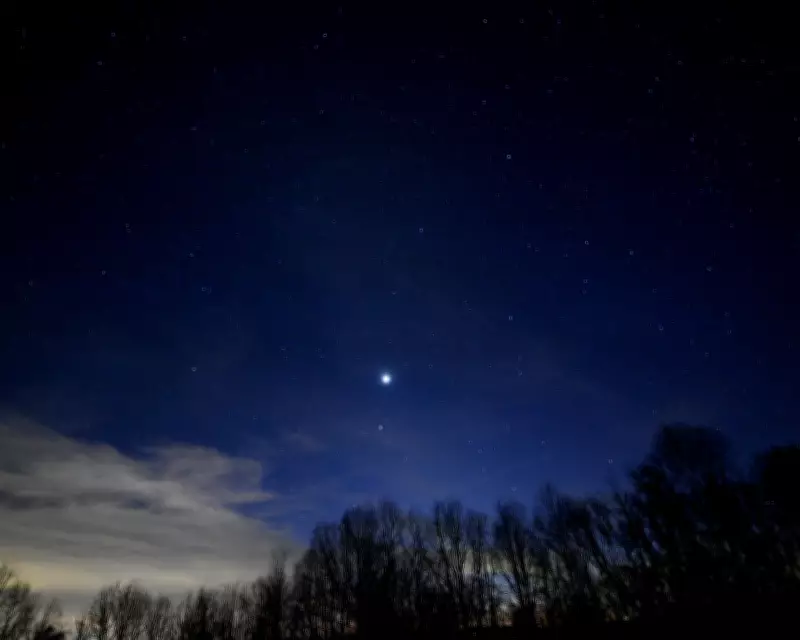
Six Planets to Align in Rare Celestial Parade Visible Worldwide This Month
Space enthusiasts and amateur astronomers are set for a breathtaking celestial spectacle this month as six planets align in a rare planetary parade visible across the globe. The phenomenon, which will be at its most impressive on 28 February, will feature Mercury, Venus, Jupiter, Saturn, Uranus, and Neptune appearing closely together in the night sky.
What is a Planetary Parade?
According to NASA, a planet parade or planetary alignment occurs when at least four or five planets can be observed simultaneously from Earth. This event happens because all planets orbit the sun within roughly the same flat plane, known as the ecliptic plane. Although each planet travels at different speeds and distances, there are moments when several appear to line up from our perspective.
It is important to note that this alignment is purely a visual effect. In reality, the planets remain separated by millions to billions of kilometres, but their positions create a stunning illusion of proximity in the sky.

Historical Context and Rarity
Planetary alignments are not entirely uncommon, with groups of three to five planets visible regularly throughout the year. However, alignments involving six or more planets are far more rare due to the precise conditions required.
For instance, on 27 February 2025, a remarkable alignment of seven planets—Mercury, Venus, Mars, Jupiter, Saturn, Uranus, and Neptune—occurred, an event that will not be seen again until 2040. As Greg Brown, an astronomer at the Royal Observatory Greenwich, explained to PA Media, "The more planets are involved, the more things need to be aligned to be visible at once. This makes full seven-planet parades fairly rare."
Viewing Details and Recommendations
The alignment will be visible for several weeks, with planetary movements being slow and gradual. Some observers may catch glimpses as early as this weekend, but 28 February is particularly notable because the planets will be most tightly grouped and multiple planets can be seen together in the evening sky.
Optimal viewing time is about 30 minutes after local sunset. Star Walk recommends looking low in the western sky with an unobstructed view and clear weather conditions. NASA advises that for a planet to be visible without optical aid, it should be at least a few degrees above the horizon, with 10 degrees or higher being ideal. "This is crucial because Earth’s atmosphere near the ground dims celestial objects as they rise or set," NASA states, adding that even bright planets become difficult to spot when too low due to light scattering and absorption.
Which Planets Will Be Visible?
Four planets—Mercury, Venus, Mars, and Jupiter—will be visible to the naked eye. However, Uranus and Neptune, which orbit in the cold, distant outer regions of the solar system, will require binoculars or a telescope to be seen. Mercury may occasionally be challenging to spot due to its low position near the horizon.
Global Visibility and Timing Variations
The alignment will be observable to people all around the world, but because 28 February serves as a median date, viewers in different regions may experience the parade a few days before or after. According to Star Walk:
- Best view on 25 February for São Paulo
- Best view on 28 February for Athens, New York, Mexico City, and Tokyo
- Best view on 1 March for Beijing, Berlin, London, and Mumbai
- Best view on 2 March from Reykjavik
This celestial event offers a unique opportunity for stargazers to witness a rare astronomical phenomenon, highlighting the wonders of our solar system and the beauty of the night sky.