Middle East Conflict Squeezes UK Household Finances Across Multiple Fronts
While war rages 3,000 miles away in the Middle East, the month-long conflict is already exerting a noticeable and severe impact on household budgets across the United Kingdom. British families are confronting mounting financial pressures driven by elevated mortgage rates, surging petrol and diesel prices, and forecasts of further jumps in energy and food costs. Oil prices, which critically influence wholesale fuel expenses, have soared in response to Iran's stranglehold on tankers navigating the vital Strait of Hormuz. The Daily Mail has examined in detail six of the most significant ways finances are being affected since the US-Israeli military actions against Iran commenced on February 28.
Petrol and Diesel: Breaching the £100 Mark to Fill a Family Car
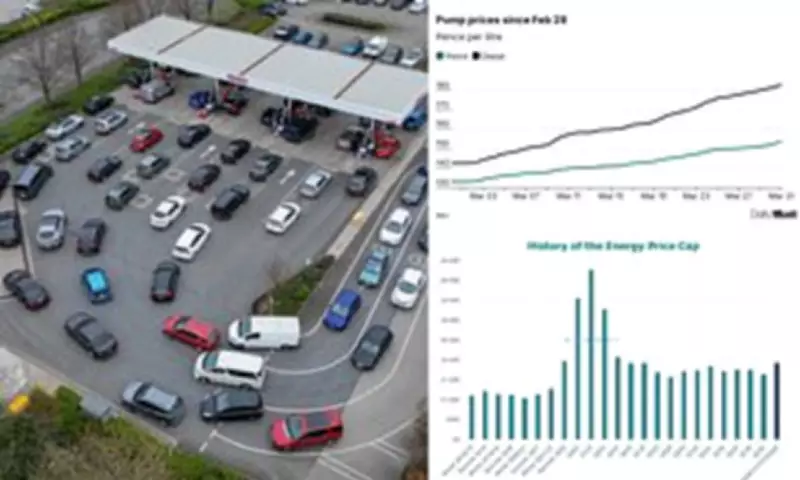
One of the most pronounced inflationary pressures on UK consumers is the escalating cost of petrol and diesel, stemming from disrupted supplies from the Middle East. The average pump price for a litre of unleaded petrol reached 148.8p on Monday, marking a 4.6p weekly increase and a substantial jump of 16.6p, or 13 per cent, since March 2. This represents the highest price for unleaded since May 2024, according to data from the Department for Energy Security and Net Zero (DESNZ). Unleaded previously peaked at 191.6p per litre in July 2022, following Russia's invasion of Ukraine.
DESNZ reported the average price for a litre of diesel stood at 176.5p on Monday, up 9.6p week-on-week and a sharp rise of 34.4p, or 24 per cent, since March 2. This is the highest diesel price since December 2022, with a prior peak of 199.2p per litre in July 2022. Separate daily estimates from the RAC indicate the average price for unleaded petrol as of Tuesday was 152.8p, a 20p increase since the conflict began. Average diesel prices on Tuesday reached 182.8p per litre, up 40p since February 28, pushing the cost to fill a 55-litre family car to £100.52—breaching the £100 threshold for the first time since December 2022.

The RAC Foundation estimates that rising road fuel prices have cost motorists an additional cumulative £544 million for petrol and diesel since the conflict started, comprising £409 million for diesel and £135 million for petrol. These figures calculate the extra expenditure compared to spending levels if prices had remained at February 27 levels, based on 2025 fuel consumption rates.
Electricity and Gas Bills: Potential £300 Increase by Summer
Household energy bills could surge by £288 annually in July as soaring wholesale costs are projected to elevate Ofgem's price cap, according to the latest forecasts from Cornwall Insight. The consultancy predicts the price cap from July to September will stand at £1,929 for a typical dual-fuel household. This represents an increase of £288, or 18 per cent, compared to April's cap, though it is a slight decrease from earlier forecasts this month which anticipated a surge to £1,973 in July.
Experts cited a "partial steadying in wholesale markets after a pause in energy infrastructure strikes and signals of a potential ceasefire in the Middle East conflict." However, Cornwall Insight warned that a July cap rise is "effectively unavoidable," with rocketing wholesale prices in March now locked into calculations and little chance they will fall below pre-war levels in the coming weeks. The price most households pay under the cap fell by 7 per cent from April 1, or £117 annually to £1,641—a reduction of around £10 monthly for the average household. This marks an 11 per cent year-on-year decrease but remains £600 higher than bills during the winter of 2020 to 2021.

The prospect of a significant jump in gas and electricity costs when the cap is next updated in July has prompted the Government to consider further targeted support as part of contingency planning. Ofgem will confirm its next price cap level by May 27. Wholesale energy costs are not expected to return to pre-war levels until after Iran releases its hold on the Strait of Hormuz, through which a fifth of the world's oil and seaborne gas is transported. Its blockage, combined with attacks on energy infrastructure across the Middle East, has sent gas prices soaring and crude oil costs surging past $100 a barrel since the conflict began on February 28. The Conservatives have urged the Government to take urgent action by cutting VAT, taxes, and levies on energy bills to support all households and businesses.
Food: Prices of Tuna, Cucumber, and Milk Could Soar
Supermarket experts warn that grocery price inflation is "likely to increase" as the Middle East conflict continues, despite the rate holding steady at 4.3 per cent in March. Worldpanel by Numerator noted that conditions making shoppers feel vulnerable are "only intensifying," pointing out that each additional 1 per cent on the inflation rate could add over £50 to the annual supermarket bill for the average household. The average price paid for an Easter egg in March was 9 per cent higher than last year, rising to £3.27, with annual chocolate price inflation currently at 8 per cent.
Researchers indicated prices are rising fastest for products like fresh unprocessed meat, chilled meal solutions such as ready meals, and coffee, while falling fastest for chilled butter and spreads, sugar confectionery like sweets, and household paper. Princes, the tinned tuna manufacturer, has suggested it may increase prices due to the conflict exacerbating inflationary pressures on transport and logistics. AG Barr, owner of drinks brands including Irn-Bru, Boost, and Rubicon, reported a direct impact from "energy cost spikes" caused by the war.
The National Farmers' Union stated that prices for cucumbers, peppers, and tomatoes grown in glasshouses heated with natural gas could rise over the next six weeks. Costs for other crops and milk may increase within three to six months, with farmers also impacted by fertiliser prices reportedly doubling. UK retail food prices are already 38 per cent higher than pre-Covid levels, and experts fear further significant increases if disruption from the conflict persists. The Institute of Grocery Distribution (IGD) warned earlier this month that UK households could face food inflation above 8 per cent within months if war-related disruption continues, potentially more than doubling by summer. However, the British Retail Consortium has dismissed claims of rising supermarket prices this month, citing data suggesting food prices were flat in March.
Heating Oil: Households Exposed to Market Volatility
The price of heating oil has soared in recent weeks due to volatility in the Middle East, compounded by Iran's warnings to vessels avoiding the Strait of Hormuz. Kerosene, the fuel used for heating oil, has been especially affected, rising faster than other fuels like petrol and gas, largely because distributors hold minimal stocks, leaving them exposed to sudden market volatility. Unlike gas and electricity customers, those using heating oil are not covered by Ofgem's price cap, making them vulnerable to immediate cost spikes.
The Department for Energy Security and Net Zero publishes monthly figures on heating oil prices. The latest data, released on Tuesday, shows the average price per litre of standard grade burning oil stood at 104.1p in March—nearly double February's average of 53.5p and the highest monthly figure since records began in 1989. The previous peak was 99.3p in June 2022. Home heating oil is used by approximately 1.5 million mainly rural households in the UK, with the problem particularly acute in Northern Ireland, where 62.5 per cent of homes rely on it, compared to the UK average of just over 5 per cent.
Sir Keir Starmer announced on March 16 that £50 million would be made available to help low-income families using heating oil, with allocations of £17 million to Northern Ireland, £27 million to England, £4.6 million to Scotland, and £3.8 million to Wales. The average price per litre of gas oil, often used for commercial and agricultural heating, stood at 99.5p in March, up 51 per cent from 66.0p in February and the highest monthly figure since 2022. Meanwhile, the Competition and Markets Authority (CMA) launched a market study on March 20 into the supply of heating oil to assess its impact on consumers and potential need for intervention, with views requested by April 8.
Flights: Jet Fuel Supply Crunch Sees Holiday Costs Soar
British families are already witnessing increased flight costs, primarily due to soaring jet fuel prices following the closure of the Strait of Hormuz. Jet fuel was $4.24 (£3.21) a gallon last Thursday, compared to $2.50 (£1.89) just before the initial US-Israeli strikes on Iran, according to the Airlines for America group. Donald Trump has indicated a willingness to walk away from the war without securing the reopening of this vital maritime chokepoint, warning the UK and other non-participating countries to secure the Strait themselves. He claimed the UK was among several nations unable to obtain jet fuel ahead of the Easter bank holiday weekend, though industry body Airlines UK denied this.
The European Commission in Brussels has suggested governments consider "voluntary demand saving measures," including encouraging citizens to fly less to conserve fuel. The last known shipment of jet fuel to the UK from the Middle East is due from Saudi Arabia on Thursday, amid claims a shortage is "less than a week away." The UK currently sources at least half its jet fuel from the Middle East due to reduced domestic refining and halted Russian imports since the 2022 Ukraine invasion. Approximately 40 per cent of Europe's jet fuel transits the nearly closed Strait of Hormuz, with the UK receiving supplies directly and indirectly via countries like Belgium and the Netherlands.
Aviation analyst Alex Macheras noted the US Jet Fuel Index rose 72 per cent in one month since the war began, "massively outpacing even Brent crude's rise." He cited United Airlines reporting jet fuel prices more than doubling in three weeks, which could push its annual fuel bill to $11 billion—more than double its best-ever annual profit. Macheras also highlighted New York to London fares increasing 177 per cent in a week, tweeting about a potential "serious jet fuel shortage" across multiple markets. Business Secretary Peter Kyle assured Times Radio that there are "no supply chain issues at this moment," while Airlines UK confirmed no current disruption to jet fuel supply.
Reform UK's Nigel Farage has vowed to scrap air passenger duty for short-haul trips in his first Budget if elected, potentially saving a family of four £45 to £48. Ryanair CEO Michael O'Leary warned jet fuel supply to Europe could be disrupted from May, risking 25 per cent of Ryanair's supplies through May and June. Air France-KLM plans to increase long-haul ticket prices by 50 euros per round trip, Cathy Pacific will hike fuel surcharges by 34 per cent from Wednesday, and easyJet CEO Kenton Jarvis indicated European consumers should expect higher ticket prices towards late summer.
Mortgages: Two-Year Rates Higher Than Five-Year Deals
Banks have significantly increased mortgage rates and withdrawn hundreds of products in recent weeks amid expectations of higher inflation. Rates on some short-term fixed-rate mortgages have now surpassed their longer-term counterparts, according to financial information website Moneyfacts. Researchers found the average rate on a two-year fixed homeowner mortgage is now higher than the average five-year fixed-rate deal. The average two-year fixed residential mortgage was 5.84 per cent on Wednesday—up from 4.83 per cent at the start of March and the highest level since July 2024. The average five-year fixed residential mortgage rate stands at 5.75 per cent, up from 4.95 per cent at March's start and at its highest since November 2023.
Caitlyn Eastell from Moneyfacts stated: "Since the beginning of the conflict, almost £1,800 a year has been added onto the average two-year fixed rate—that's over £3,500 for the full term based on the typical £250,000 loan over 25 years." The Bank of England warned around 1.3 million more UK households face increased mortgage costs following the economic "shock" from the conflict. Last month, the Bank's monetary policy committee held the UK interest rate at 3.75 per cent but hinted at future rises due to inflationary pressures. Current rates suggest about 5.2 million UK mortgage holders could see repayment increases by the final quarter of 2028, up from a pre-war prediction of 3.9 million. The Bank also noted the total number of mortgage products in the UK fell from 8,500 to 7,000, though this remains higher than during the Covid-19 period and the 2022 mini-budget crisis.