

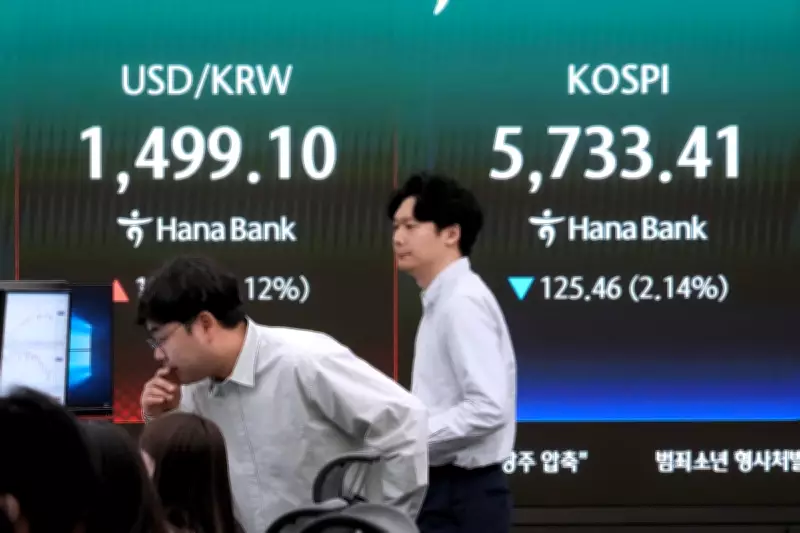
Oil Prices Surge and Asian Markets Tumble Amid US Strait of Hormuz Blockade
Oil prices resumed their sharp climb and Asian markets mostly declined on Monday as the United States military prepared to implement a blockade of ships entering or leaving the strategically vital Strait of Hormuz. This critical maritime chokepoint has seen most shipping stalled by Iran since the onset of the conflict in late February, severely disrupting global energy supplies.
Escalating Tensions and Market Reactions
Former US President Donald Trump announced the planned naval blockade after ceasefire negotiations between the United States and Iran, held in Pakistan, concluded without reaching any agreement. The US military confirmed that the blockade, which will involve all Iranian ports, is scheduled to commence on Monday at 5:30 pm local time in Iran.
The immediate financial repercussions were stark and widespread. Benchmark US crude oil jumped by a significant 8.7 percent to reach $104.95 per barrel. Meanwhile, Brent crude, the international pricing standard, rose by $7.00, or 7.4 percent, to settle at $102.23 per barrel. This surge continues a trend that has seen Brent crude escalate from approximately $70 per barrel before the war to over $119 at various points.

Asian Market Declines and Analyst Concerns
Across Asia, stock markets reacted negatively to the heightened geopolitical instability and the prospect of prolonged oil supply disruptions.
- Japan's benchmark Nikkei 225 index lost 1.0 percent in morning trading, falling to 56,357.40.
- Australia's S&P/ASX 200 shed 0.5 percent to 8,913.50.
- South Korea's Kospi dipped 1.1 percent to 5,795.15.
- Hong Kong's Hang Seng index slipped nearly 1.5 percent to 25,513.42.
- The Shanghai Composite in China fell a more modest 0.2 percent to 3,976.57.
Financial analysts warned that global trading conditions are expected to remain turbulent for the foreseeable future. "The outcome of the talks was not really what people were hoping for, that's for certain," stated Neil Newman, Managing Director and Head of Strategy at Astris Advisory Japan, speaking from Hong Kong. "As we stand here at the moment, it doesn't look very nice. Certainly, the oil prices are a big concern."
Broader Financial Context and Currency Movements
The developments shattered the cautious optimism that had buoyed Wall Street at the end of the previous week, which had seen a second consecutive weekly gain. On Friday, the S&P 500 inched 0.1 percent lower after a day of volatile trading, closing at 6,816.89 after a drop of 7.77 points. The Dow Jones Industrial Average fell 0.6 percent, or 269.23 points, to 47,916.57. The Nasdaq composite managed a gain of 0.4 percent, adding 80.48 points to close at 22,902.89.
In the bond market, the yield on the benchmark 10-year US Treasury note climbed to 4.32 percent last Friday, up from 4.29 percent late on Thursday.
Currency markets also reflected the flight to safety and uncertainty. The US dollar strengthened against the Japanese yen, rising to 159.74 yen from 159.25 yen. The euro weakened against the dollar, trading at $1.1687, down from $1.1729.
The situation underscores the fragile state of global markets, which are now bracing for further volatility as the US blockade in the Strait of Hormuz threatens to exacerbate an already tense geopolitical and economic landscape.






