

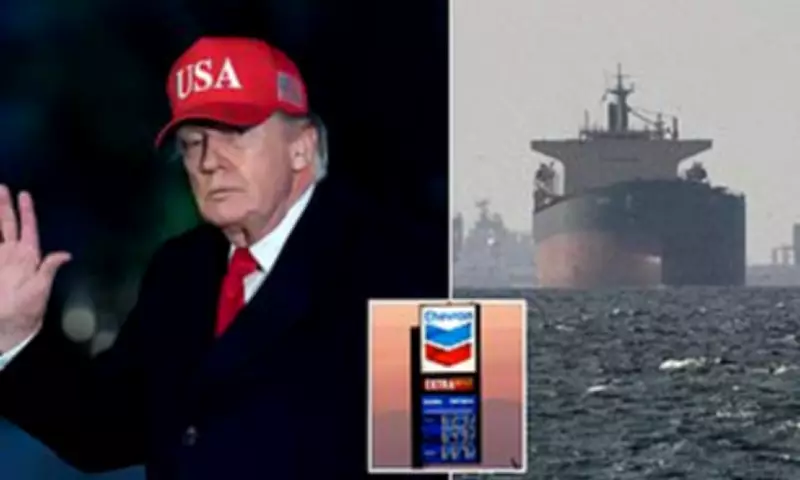
Oil Prices Rocket Past $100 Mark Following Trump's Strait of Hormuz Blockade
Global oil markets have experienced a severe shock, with prices surging back above $100 a barrel as traders reacted to former President Donald Trump's declaration of a United States Navy blockade targeting Iranian-bound vessels in the strategically vital Strait of Hormuz. This aggressive American move superimposes itself upon a pre-existing blockade enforced by Iran, dramatically escalating regional tensions in the wake of a collapsed 21-hour peace negotiation held over the weekend.
Market Turbulence and Price Spikes
On Monday, benchmark US crude oil witnessed a staggering increase of $8.38, representing an 8.7 percent jump to settle at $104.95 per barrel. Concurrently, Brent crude, the international pricing standard, rose by $7.00, or 7.4 percent, reaching $102.23 per barrel. This surge continues a worrying trend; oil prices have been climbing steadily since late February when shipping traffic through the narrow strait began to essentially stall. Brent crude has skyrocketed from approximately $70 per barrel before the conflict erupted to peaks exceeding $119 at various points.
Analysts warn the situation is dire. "Not only does this restrain exports from Persian Gulf oil producers, it will restrict Iran's ability to export oil and will exacerbate the supply disruptions the market is experiencing," stated ANZ Bank. Neil Newman, Managing Director and Head of Strategy at Astris Advisory Japan, echoed the concern from Hong Kong, noting, "As we stand here at the moment, it doesn't look very nice. Certainly, the oil prices are a big concern."

Trump's NATO Criticism and Broader Geopolitical Rift
Speaking to the press at Joint Base Andrews on Sunday night, Trump launched a fierce critique of NATO, blaming the alliance for failing to support the United States against Iran. "I'm very disappointed in NATO. They weren't there for us. We pay trillions of dollars for NATO and they weren't there for us," he declared. He further threatened the US commitment to the alliance, a relationship strained since his 2017 inauguration, suggesting its future would be under "very serious examination."
In a separate Fox News appearance, Trump claimed NATO would only "begrudgingly" support US efforts to secure the strait, labelling the alliance "shameful." He also directed criticism at the United Kingdom, comparing Prime Minister Sir Keir Starmer to infamous pre-World War II appeaser Neville Chamberlain after Starmer's reported statement about sending equipment "after the war is over."
A UK government spokesperson firmly rejected Trump's characterisation, asserting, "We continue to support freedom of navigation and the opening of the Strait of Hormuz, which is urgently needed to support the global economy and the cost of living back home," and clarified the UK would not participate in the blockade.
Impact on Consumers and Global Supply
The economic pain is most acutely felt by consumers at the gasoline pump, where average US prices have hit $4.20 per gallon—an increase of more than one dollar since the war began—intensifying political pressure on Trump to resolve the conflict. The Strait of Hormuz is a critical global chokepoint, with roughly one-fifth of the world's seaborne crude oil typically transiting through it daily, making nations in Asia and beyond heavily reliant on its openness.
When pressed by Fox News anchor Maria Bartiromo on whether gas prices might fall before the crucial November midterm elections, Trump offered little reassurance, stating, "It could be the same or maybe a little bit higher, but it should be around the same." He added that he believed the war would not last much longer and that Iran was "wiped out," while criticising US media for its coverage.
Iranian Response and Failed Diplomacy
Iranian Parliament Speaker Mohammad Bagher Ghalibaf, who led negotiations with US Vice President JD Vance, issued a stark warning to Americans, suggesting via The New York Times that "soon you'll be nostalgic for $4-$5 gas." This followed the complete breakdown of peace talks in Pakistan, which Vance returned from empty-handed.

Trump announced the blockade on his Truth Social platform, writing, "Effective immediately, the United States Navy, the Finest in the World, will begin the process of BLOCKADING any and all Ships trying to enter, or leave, the Strait of Hormuz." He accused Iran of being "unwilling to give up its nuclear ambitions" and issued a severe warning: "Any Iranian who fires at us, or at peaceful vessels, will be BLOWN TO HELL!"
US Central Command confirmed the blockade of "all maritime traffic entering and exiting Iranian ports" would commence on Monday, though vessels travelling to non-Iranian ports would not be impeded. The Department of Justice, via Acting Attorney General Todd Blanche, pledged to prosecute anyone trading in sanctioned Iranian oil.
Strategic Stalemate and Military Risks
In response, Iranian Supreme Leader Mojtaba Khamenei promised Iran possesses "large, untouched levers" to retaliate, dismissing external pressure from "tweets and imaginary plans." Experts caution that while much of Iran's larger naval assets have been degraded, smaller Islamic Revolutionary Guard Corps boats that effectively control the strait remain operational, posing a significant threat to US forces in the narrow, 35-kilometer-wide waterway.
Rachel Ziemba of the Center for a New American Progress indicated the diplomatic window may have closed, telling The Wall Street Journal, "The de-escalation window for the global economy, such as it was, is over for now. Iran is betting they can hold out longer than the US and the global economy."
The future remains highly uncertain, with neither side indicating next steps after the current 14-day ceasefire expires on April 22, despite urgings from Pakistani mediators to maintain it. Global trading is expected to remain turbulent for the foreseeable future as the standoff over one of the world's most crucial energy corridors intensifies.





