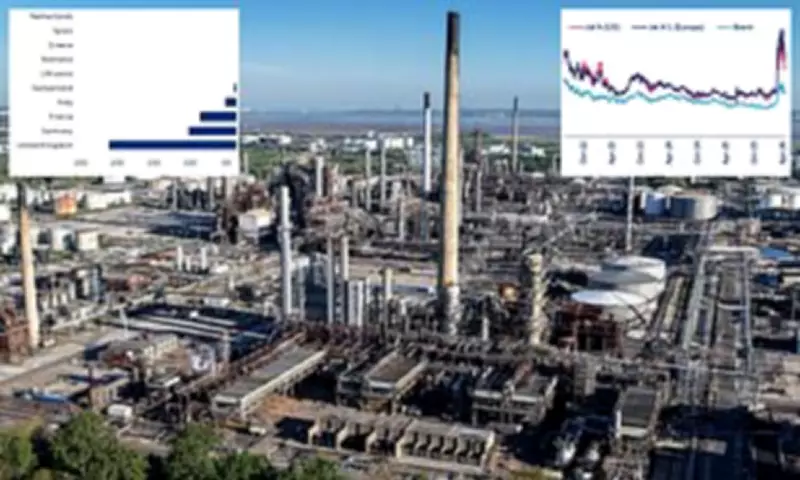
Britain is more exposed to the jet fuel crisis than other European countries during the Iran war because of its lower capacity for oil refining, experts have warned. The UK has the biggest deficit – when imported fuel is subtracted from the amount made at home – of any major economy across the continent, according to Allianz.
UK's Refining Deficit
Researchers found the country's deficit of about 200,000 barrels per day last year is twice as great as any other European nation, showing its reliance on external supply. Germany, France, Italy and Switzerland had smaller shortfalls too which also put them in negative territory, where consumption outweighs domestic refinery output. Netherlands, Spain and Greece had the biggest surpluses, but experts pointed out that these were only 'modest' figures for the traditionally well-refined economies. Romania and Lithuania both had small surpluses – indicating their limited regional capacity to offset the gap, according to the firm's 'Staycation Summer?' report.
Impact on Air Travel
The study also found plane tickets have already increased by 5 to 15 per cent on international flights – and could rise a further 10 to 15 per cent if 'conditions worsen'. It comes after Energy Minister Michael Shanks said the Government had asked UK refineries to maximise jet fuel supply as it continues to plan for contingencies. Britain now only has four operating oil refineries – Fawley in Hampshire, Stanlow in Cheshire, Humber in Lincolnshire and Pembroke in Wales – after the closure of Grangemouth in Scotland in April 2025 and Lindsey in Lincolnshire in August.

Geopolitical Disruptions
The US-Israeli war on Iran has disrupted the jet fuel supply route via the Strait of Hormuz, with some airlines now hiking prices and adapting schedules as a result. Experts fear jet fuel shortages within weeks and some consumers are holding off booking holidays or flights in case they are cancelled over the coming months.

Airline Responses
- Aegean Airlines: The Greek airline expects suspended Middle East flights and a spike in fuel prices to have a 'notable impact' on its first-quarter results.
- Air France-KLM: The airline group said it planned to increase long-haul ticket prices to address surging fuel costs, with cabin fares set to rise by €50 (£43) per round trip. Dutch arm KLM said on April 16 it would cancel 160 flights in Europe in the coming month due to rising fuel costs.
- EasyJet: EasyJet warned of a bigger half-year pre-tax loss of between £540million to £560million, including £25million in extra fuel costs in March.
- IAG: British Airways-owner IAG said it would raise ticket prices to reflect higher jet fuel costs, as, despite its fuel hedges, it was 'not immune' to the broader fallout from fuel cost volatility.
- Lufthansa: The German airline group unveiled a new 'Economy Basic' low-cost fare option for short- and medium-haul flights, which will limit free carry-on bags to only a 'laptop bag or a small backpack'. The group previously said 20,000 short-haul flights would be removed from its schedule through October, equivalent to about 40,000 metric tons of jet fuel.
- Ryanair: Ryanair boss CEO Michael O'Leary said the risk of a jet fuel supply shortage in Europe is receding, but it had lowered some fares for flights between June and September to stimulate demand which had been 'a little bit weaker' than for April and May.
- SAS: The Scandinavian airline said it would cancel 1,000 flights in April because of high jet fuel prices, after canceling a few hundred in March.
- TAP: The Portuguese airline said price hikes would partially mitigate impacts of fuel price changes on its revenue.
- TUI: The European airline and tour operator cut its full-year underlying profit outlook and suspended revenue guidance, saying it had incurred about €40million (£35million) in extra costs due to the war in March, including repatriation efforts and operational disruptions.
- Turkish Airlines, Lufthansa: SunExpress, a joint venture between Turkish Airlines and Lufthansa, said it would impose a temporary fuel surcharge of €10 (£9) per passenger from May 1 on routes between Turkey and mainland Europe. The surcharge will apply to bookings made on or after April 1 for departures on or after May 1.
- Virgin Atlantic: The airline is adding fuel surcharges to fares but will still struggle to return to profitability this year, its CEO Corneel Koster said.
- Volotea: The Spanish low-cost airline introduced a new pricing policy linking ticket prices to fuel costs, which could potentially add a post-purchase surcharge of up to €14 (£12) per passenger, per flight.
The jet fuel price increased from about $99 (£73) per barrel at the end of February to as high as $209 (£155) at the start of April – although it has fallen in recent weeks to $179 (£132), according to the latest International Air Transport Association data.
Structural Vulnerability
The Allianz report said: 'Europe's kerosene market is structurally vulnerable, with most major economies running persistent deficits. The UK, Germany, France and Italy show the largest shortfalls, underscoring their reliance on external supply to meet aviation demand. Even traditionally well-refined economies like the Netherlands and Spain were only modestly in surplus last year, while several smaller markets remain balanced or slightly positive, indicating limited regional capacity to offset the gap. This imbalance effectively positions Europe as a net structural importer of kerosene. As a result, European aviation activity is indirectly exposed not only to global oil price dynamics but also to geopolitical and logistical risks along key supply routes, reinforcing the region's dependence on external refining hubs for a fuel that is essential to long-haul connectivity.'
US as Key Supplier
Experts also pointed out that the US is becoming a 'key marginal supplier' to Europe's jet fuel market, after flows from the Middle East to north-west Europe fell by 90 per cent in March compared to February, while no shipments departed in April. However shipments from the US soared in March, up 782 per cent on February, which reflected a 'sharp but likely temporary reorientation of regional supply flows'. Researchers believe that replacing Middle Eastern jet fuel with supply from the US 'enhances Europe's resilience' in the short term, but the shift 'carries structural costs' such as 'longer transatlantic routes and increased transport expenses and emissions'. They added: 'Moreover, US crude yields less jet fuel per barrel – tightening refining economics – and dependence is not eliminated but redirected, concentrating risk in transatlantic supply chains and increasing President Trump's bargaining power, while heightening exposure to price volatility, making the arrangement a stabilizing stopgap rather than a durable solution.'
Supply Shortfall Risk
The report also says: 'More worryingly, even after accounting for increased inflows from the US, total kerosene imports into Northwest Europe continue to decline.' Experts said that when combining supplies from both the US and the Middle East, shipments in April were down by 82 per cent on March, 'pointing to a material tightening of physical availability and raising the likelihood of an outright supply shortfall by late May if the trend persists'. Two mitigating factors were cited to provide temporary relief – firstly, that Europe still produces roughly half of its kerosene demand domestically; and second, that jet fuel cargoes dispatched in April will 'continue to arrive with a lag into May, smoothing the abrupt impact'. But the study warned: 'These buffers are finite, and with inventories already under pressure and logistics stretched, they primarily delay rather than eliminate the risk of fuel disruption.'
Fare Increases and Capacity Cuts
The researchers also looked at the impact of war on plane tickets, with fare increases of 5 to 15 per cent already imposed on international routes – along with schedule cuts in Europe of 2 to 5 per cent. Some carriers are also adding surcharges of between $20 to $60 on short and medium-haul routes and $80 to $150 on long-haul tickets. The study added: 'If conditions worsen, further fare increases of 10 to 15 per cent are likely. In Europe, announced capacity reductions remain selective, concentrated on lower-yield short-haul routes and secondary airports. Low-cost carriers are especially vulnerable because of thin margins, short-haul concentration and strong competition from high-speed rail alternatives.'
Broader Industry Impact
The latest airline to announce the impact on operations is Air Canada, which yesterday suspended its 2026 forecast as higher jet fuel prices created uncertainty over costs, even as travel demand remained robust. Air Canada said it has implemented multiple rounds of fare increases along with a hike in ancillary services fee. It is also trimming less profitable routes and reducing the number of flights where demand is weaker. Also yesterday, Canadian business jet maker Bombardier beat Wall Street estimates for first-quarter profit, lifted by strong demand for repair and maintenance services and increased private flying despite higher jet fuel prices. Private aviation, used primarily by affluent consumers, has remained resilient even as higher jet fuel prices have forced commercial airlines to trim flights. Benchmark Brent crude oil futures have jumped by about $50 a barrel since the Iran war began on February 28, raising prices of petrol, diesel and jet fuel. The International Energy Agency has called it the world's largest oil output disruption and warned on April 16 that Europe had six weeks of jet fuel left before shortages begin.