Scientists Identify 45 Earth-Like Planets That Could Host Alien Life
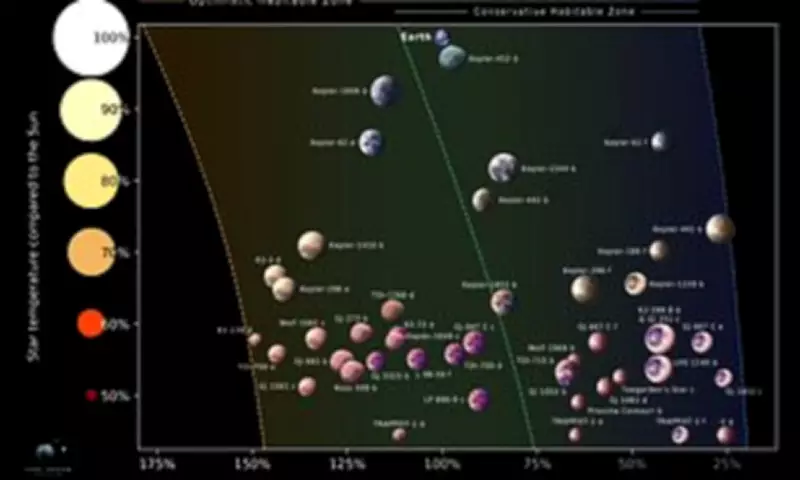
One of the most profound mysteries in science—whether aliens exist and where they might be found—has taken a significant step toward resolution. Experts from the Carl Sagan Institute at Cornell University have identified 45 Earth-like planets that could possess perfect conditions for alien life, marking a major advancement in the search for extraterrestrial intelligence.
Habitable Zones and the Search for Life
These planets are all situated within what is known as the habitable zone, a region around a star where temperatures are neither too hot nor too cold, allowing for the potential presence of liquid water on the surface. Water is considered a critical ingredient for life as we understand it, making these discoveries particularly exciting. Some of these worlds are located just tens of light-years from Earth, raising the possibility that future space missions could one day reach them.
Professor Lisa Kaltenegger, an author of the study, emphasized the importance of this research: 'Life might be much more versatile than we currently imagine, so figuring out which of the 6,000 known exoplanets would be most likely to host extraterrestrials could prove critical. Our paper reveals where you should travel to find life.'

Key Discoveries and Planetary Details
While over 6,000 exoplanets have been discovered to date, determining which ones have the potential to support life has remained a challenge. In this new study, the team not only identified 45 planets in the habitable zone but also highlighted an additional 24 in a narrower 3D habitable zone. Among the notable planets are:
- Proxima Centauri b
- TRAPPIST-1f
- Kepler 186f
- TOI-715 b, discovered just three years ago and located 137 light-years away
The researchers pointed to the TRAPPIST-1 system, specifically planets d, e, f, and g, as particularly interesting due to their proximity of just 40 light-years from Earth. However, current technology would require at least 800,000 years to reach this system. Advances such as nuclear pulse propulsion could potentially reduce travel time to a few centuries in the future.
Observational Techniques and Future Prospects
The study also outlined the best techniques for observing these 45 planets, including:
- The James Webb Space Telescope
- The Nancy Grace Roman Space Telescope, set to launch in 2027
- The Extremely Large Telescope, expected to see first light in 2029
According to study author Gillis Lowry, 'While it's hard to say what makes something more likely to have life, identifying where to look is the first key step. So the goal of our project was to say "here are the best targets for observation."'
Beyond Exoplanets: Life in Our Solar System
While this research focuses on exoplanets, scientists have also suggested that alien life could exist within our own solar system. Dr. David Armstrong, an exoplanet detection expert from the University of Warwick, noted that life on Earth is found wherever liquid water exists, making subsurface oceans on moons like Saturn's Enceladus and Titan promising candidates for extraterrestrial life.
Enceladus, in particular, is considered a strong candidate due to plumes of liquid water erupting from its South Pole. Titan, another moon of Saturn, has also been highlighted as a potential habitat for life.
List of the 45 Earth-Like Planets
The full list of planets identified in the study includes:

- GJ 1002 b
- GJ 1002 c
- GJ 1061 c
- GJ 1061 d
- GJ 251 c
- GJ 273 b
- GJ 3323 b
- GJ 667 C c
- GJ 667 C e
- GJ 667 C f
- GJ 682 b
- K2-239 d
- K2-288 B b
- K2-3 d
- K2-72 e
- Kepler-1229 b
- Kepler-1410 b
- Kepler-1544 b
- Kepler-1606 b
- Kepler-1649 c
- Kepler-1652 b
- Kepler-186 f
- Kepler-296 e
- Kepler-296 f
- Kepler-441 b
- Kepler-442 b
- Kepler-452 b
- Kepler-62 e
- Kepler-62 f
- L 98-59 f
- LHS 1140 b
- LP 890-9 c
- Proxima Centauri b
- Ross 508 b
- TOI-1266 d
- TOI-700 d
- TOI-700 e
- TOI-715 b
- TRAPPIST-1 d
- TRAPPIST-1 e
- TRAPPIST-1 f
- TRAPPIST-1 g
- Teegarden's Star c
- Wolf 1061 c
- Wolf 1069 b
This groundbreaking research not only narrows down the search for alien life but also sets the stage for future explorations that could one day answer the age-old question of whether we are alone in the universe.