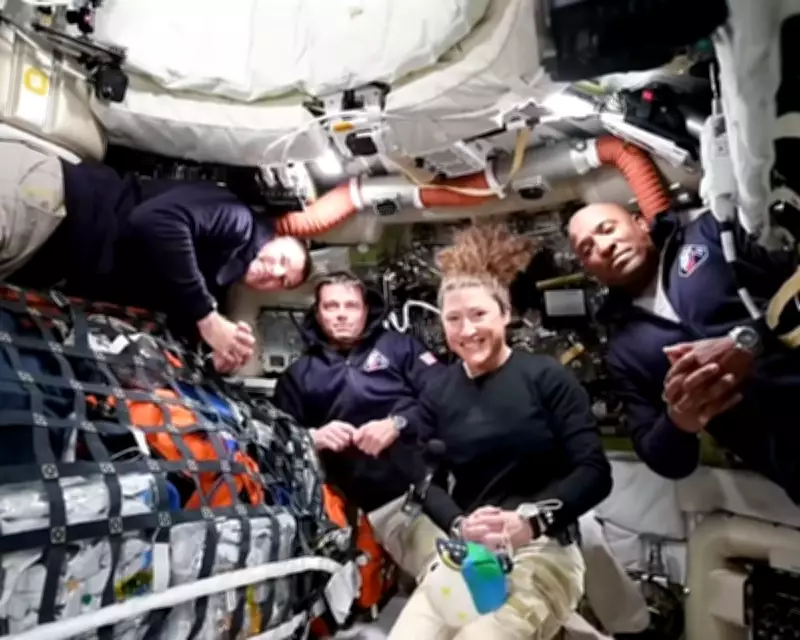
Artemis II Astronauts Rocket Towards the Moon After Breaking Free of Earth's Orbit
The four astronauts of NASA's Artemis II mission have achieved a critical milestone by firing up their spacecraft's engine to break away from Earth's orbit, propelling them on a trajectory towards the moon. This momentous event commits NASA to the first crewed lunar flyby in more than half a century, reviving humanity's deep space ambitions with a blend of patriotism and global promise.
Engine Burn Propels Crew on Three-Day Voyage
On Thursday, the Orion capsule's engine ignited with enough thrust to accelerate a stationary car to highway speed in under three seconds. The burn, lasting just under six minutes, successfully launched the astronauts—Americans Reid Wiseman, Victor Glover, and Christina Koch, along with Canadian Jeremy Hansen—on their three-day voyage towards Earth's natural satellite. Mission control in Houston confirmed the operation, stating, "Looks like a good burn, we're confirming." Astronaut Jeremy Hansen expressed the crew's enthusiasm, remarking, "Humanity has once again shown what we are capable of."
Historic Launch and Mission Details
The engine burn followed a flawless launch from Kennedy Space Center in Florida, where the enormous orange and white Space Launch System (SLS) rocket carried the Orion capsule into space. Now moonbound, the astronauts are on a "free return" trajectory, utilizing the moon's gravity to slingshot around it before heading back to Earth without additional propulsion. This 10-day Artemis 2 mission aims to pave the way for a planned moon landing in 2028, featuring historic firsts: the first person of colour, the first woman, and the first non-American on a lunar mission. If all proceeds smoothly, the crew will set a record by venturing more than 250,000 miles from Earth, further than any human before.

Challenges and Preparations in Space
During their initial hours in space, the astronauts conducted checks and addressed minor issues on the spacecraft, which has never carried humans previously. These included troubleshooting a communications problem and fixing a malfunctioning toilet. To maintain health in microgravity, each astronaut dedicates 30 minutes daily to workouts on the spacecraft's "flywheel exercise device" to combat muscle and bone loss. The crew also enjoyed musical moments, playing Green Light by John Legend and Andre 3000 as a reference to the go signal for their engine burn.
Broader Context and Future Implications
Artemis II marks the inaugural crewed flight of the SLS rocket, designed to enable repeated U.S. returns to the moon with the goal of establishing a permanent base for further exploration. The mission has faced years of delays and cost overruns, with setbacks necessitating repairs. In a post-launch briefing, NASA administrator Jared Isaacman highlighted the competitive aspect, noting that competition with China, which aims to land humans on the moon by 2030, can mobilize national resources. The Artemis program has also faced political pressure to accelerate its timeline, with some experts questioning the feasibility of the 2028 landing date due to reliance on private sector advancements.
Reflecting on the mission's significance, Commander Reid Wiseman described the awe-inspiring view of Earth from space: "You can see the entire globe from pole to pole, you can see Africa, Europe, and if you look closely, the northern lights. It was the most spectacular moment and it paused all four of us in our tracks." As the Artemis II crew continues their journey, they carry the hopes of a new era in space exploration, blending technological innovation with human ambition.