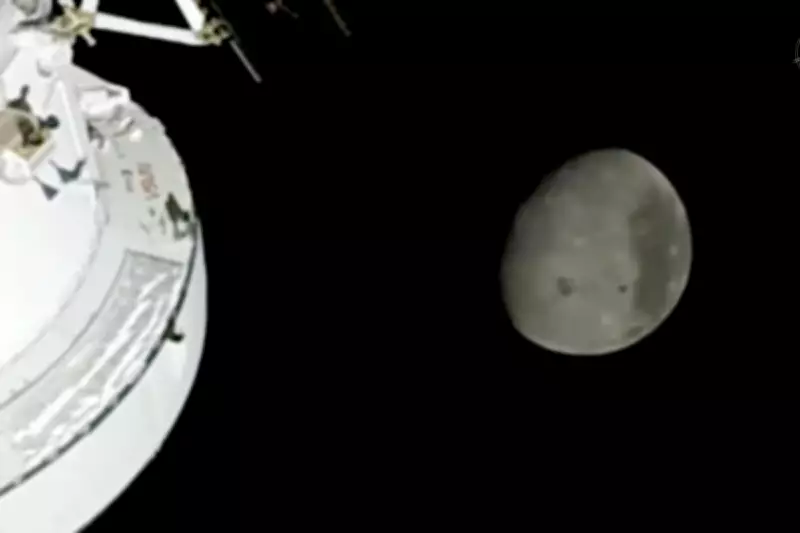
In a monumental achievement for space exploration, NASA's Artemis II mission has officially broken the deep space distance record that stood unchallenged for 56 years. The four-member crew, comprising three Americans and one Canadian, has traveled further from Earth than any humans in history during their lunar flyby.
A Historic Milestone in Human Spaceflight
The Artemis II astronauts surpassed the previous record of 248,655 miles (400,171 kilometers) set by the Apollo 13 crew back in 1970. They are projected to reach an ultimate distance of approximately 252,760 miles (406,778 kilometers) from Earth, smashing the old benchmark by around 4,100 miles (6,600 kilometers). This significant leap forward marks the first time humans have ventured so far into the cosmos in over half a century.
The Far Side Experience and Communications Blackout
During their trajectory, the crew passed on the far side of the Moon, a region not visible from Earth. This maneuver plunged them into complete darkness and resulted in a temporary communications blackout with mission control in Florida. For a short period, the astronauts were entirely cut off from all contact with our planet, experiencing the profound isolation of deep space.

The Orion spacecraft, carrying the historic crew, was awakened on the sixth day of the mission with a poignant recorded message from the late Apollo 8 and Apollo 13 astronaut Jim Lovell. The former commander, who passed away last year at age 97, welcomed them to his "old neighbourhood" and encouraged them to savor the extraordinary view.
Scientific Observations and Mission Details
While on the far side of the Moon, the Artemis II crew utilized professional cameras to capture detailed photographs of lunar surfaces typically hidden from Earth's view. They also enjoyed the rare spectacle of observing their distant home planet from this unprecedented vantage point.
Interestingly, Artemis II employed the same gravitational slingshot maneuver that Apollo 13 used after its famous "Houston, we've had a problem" incident. That mission, which involved an oxygen tank explosion that prevented a Moon landing, became a dramatic fight for survival. The current capsule is following a trajectory that will take it around the Moon before utilizing lunar gravity for a "free" return journey to Earth.
Support Systems and Future Implications
The Goonhilly Earth Station near Helston in Cornwall has played a crucial role in tracking the spacecraft's flight path. Although the Artemis II astronauts will not actually land on the lunar surface, their mission serves as a critical stepping stone toward future Moon landings. Furthermore, it establishes essential foundations for eventual crewed missions to Mars.
This launch faced previous delays of two months due to technical issues including hydrogen fuel leaks and clogged helium lines. The last time NASA sent astronauts to the Moon was during the Apollo 17 mission in 1972. The space agency now aims to return a crew to the lunar surface by 2028, ahead of China's projected timeline of around 2030.
The return journey is expected to take four days, culminating in a Pacific Ocean splashdown on Friday. This record-breaking mission not only honors the legacy of Apollo but propels humanity toward new frontiers in space exploration.