Artemis II Mission Showcases Humanity's Dual Nature
This week, humanity demonstrated its stark contrasts: the Artemis II lunar mission embodied our highest aspirations, while ongoing conflicts and military spending reflected our darkest impulses. As astronauts floated in deep space, they beamed messages from the past and honored loved ones, even as Earth below tallied casualties and debated war budgets. The question remains: which path will we choose to fund, name, and ultimately become?
A Voice from the Past Echoes in Space
Four astronauts slept 19,000 miles from the moon when the voice of Apollo 13 commander Jim Lovell reached them. Recorded before his death at age 97, Lovell's message welcomed the crew to his "old neighborhood," referencing his 1968 lunar orbit and harrowing 1970 mission. On April 6, mission control transmitted this recording, and Reid Wiseman awoke to hear it, holding up a silk Apollo 8 mission patch flown in 1968, gifted by Lovell's son. Lovell's final words, "Good luck and Godspeed from all of us here on the good Earth," symbolized continuity across generations.
At the launch pad, Charlie Blackwell-Thompson, the launch director, polled her team and received a unanimous go-ahead. This moment captured what it means to be human in 2026: sending the voices of the dead into space as an act of care, while on Earth, we count bodies and allocate resources. The Artemis II mission, with its $24.4 billion budget, stands in sharp contrast to the proposed $1.5 trillion defense budget, including $200 billion earmarked for Iran operations.

Astronauts Reflect on Humility and Legacy
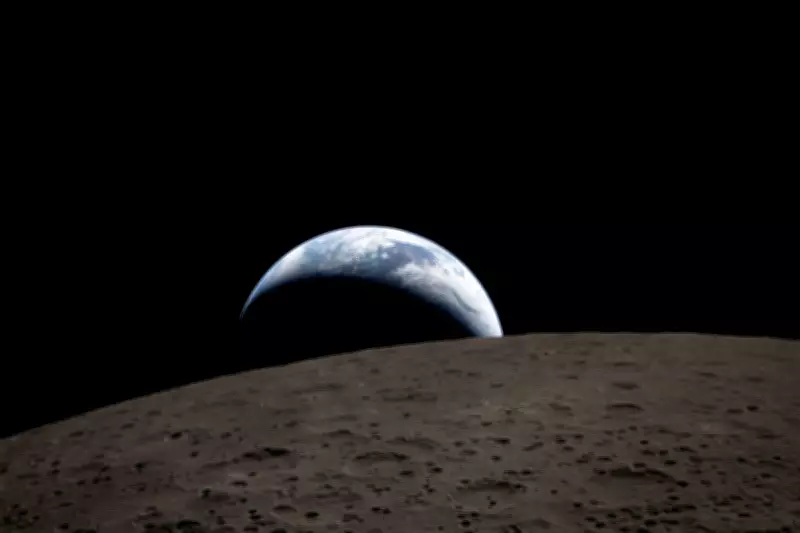
Victor Glover, the first Black man to travel into deep space, gazed out the window at Earth, describing it as an oasis in the emptiness of the universe. Christina Koch, the first woman to orbit the moon, joined him, and together they formed heart shapes with their hands against the backdrop of our blue planet. When asked to summarize the mission in one word, Koch chose "humility," acknowledging predecessors like Neil Armstrong, Katherine Johnson, and civil rights leaders. Johnson, the mathematician whose calculations were crucial for Apollo, was initially overlooked until public remembrance corrected the record.
Reid Wiseman watched the entire globe fill his window, noting Africa, Europe, and the northern lights, which paused the crew in awe. Jeremy Hansen, breaking the distance record held by Apollo 13 for 56 years, requested to name a lunar feature in memory of a loved one named Carroll, spouse of Reid and mother to Katie and Ellie. Mission control approved, and a bright spot on the moon now bears her name, a lasting tribute visible to her children and future generations.
Contrasts with Earthly Conflicts and Budgets
While NASA coordinates wonders, military ledgers from conflicts like Iraq in 2006 show kill counts and phrases like "Let the bodies hit the floor." Decades later, Pentagon officials have promised "death and destruction from the sky" to Iran, using language that legal experts warn may constitute war crimes. Operation Epic Fury and massive defense budgets highlight a focus on conflict, even as space exploration offers a different narrative.
Christina Koch radioed down as the spacecraft entered the moon's gravitational pull at 12:37 AM, stating, "We are now falling to the moon rather than rising away from Earth." This poetic moment underscored the mission's symbolic journey toward discovery and away from terrestrial strife. Four years prior, the James Webb Space Telescope aimed humanity's finest inventions outward to explore cosmic origins, and now Artemis carries us physically to the moon, with the spacecraft named Integrity.
Cultural and Mythological Significance
Apollo missions planted flags now bleached by radiation, while Artemis, named for the huntress goddess who protected the untamed, represents a new era. In Chinese tradition, Chang'e stole immortality and fled to the moon, residing there still. Jeremy Hansen carried the Seven Sacred Teachings of the Anishinaabe people—respect, love, courage, humility, honesty, wisdom, truth—on his mission patch, designed by Henry Guimond of Sagkeeng First Nation, who never imagined his work would travel so far.

Carl Sagan's words resonate: "We are made of star-stuff. We are a way for the cosmos to know itself." This mission reminds us that we are not mere observers or inheritors but something more fragile and awake—awake enough to beam a dead commander's voice across the void, name craters for loved ones, and photograph all of humanity in a single frame. Yet, as body counts rise on Earth, we maintain both kill boards and star maps in the same week, a pattern as old as history.
Small men continue to wage wars in the background, but the huntress Artemis proceeds, carrying what remains of us that has not forgotten to look up. This duality defines our species, balancing aspiration against conflict, care against destruction, in an ongoing struggle for identity.