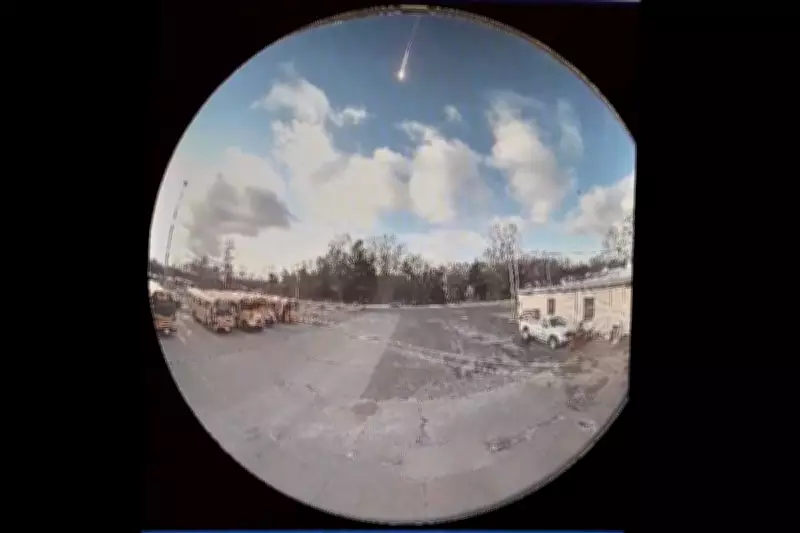
Fireballs Streaking Across the Sky: How Common Are These Celestial Events?
Rocks from outer space are perpetually hurtling toward Earth, slamming into the atmosphere and often exploding into brilliant fireballs that captivate and sometimes alarm observers. The Associated Press reported on Wednesday, 18 March 2026, at 16:45 GMT, highlighting the frequency of these spectacular displays. While it may seem like an assault from above, the vast majority of these space rocks cause no damage, as they are pulverized into dust or small fragments during their fiery descent.
Recent Fireball Event Near Cleveland
This week, a dramatic fireball streaked across the sky near Cleveland, Ohio, believed to be caused by a space rock nearly 6 feet (1.8 meters) in diameter and weighing an estimated 7 tons. According to the American Meteor Society, the event was visible from Wisconsin to Maryland, covering a wide swath of the United States. NASA data indicates that the object traveled more than 34 miles (55 kilometers) through the upper atmosphere before disintegrating. As of now, no fragments have been recovered from the ground, but such occurrences are surprisingly common.
Understanding Space Terminology
What is the difference between a meteor and an asteroid? An asteroid is a chunk of rock, ice, or metal leftover from the solar system's formation 4.6 billion years ago. A meteoroid is a smaller fragment derived from a larger space rock, such as an asteroid or comet. When a meteoroid or asteroid enters Earth's atmosphere and burns up, it produces a streak of light known as a meteor. If this meteor is brighter than the planet Venus in the morning or evening sky, it is classified as a fireball. Should any piece survive the journey and land on Earth, it is termed a meteorite.

Frequency of Meteors and Fireballs
How common are meteors? Flashes of light from meteoroids are incredibly frequent, with meteor showers allowing observers to see them every few minutes under clear skies. The Perseids meteor shower, occurring annually in mid-August, is renowned as one of the best displays, according to NASA.
How common are fireballs? The American Meteor Society estimates that "several thousand" meteors qualify as fireballs in Earth's atmosphere each day. However, most go unnoticed because they occur over oceans, uninhabited areas, or during daylight when the sun's brightness obscures them. Despite this, many fireballs are witnessed by people, and organizations like the American Meteor Society and the International Meteor Organization encourage public reports to track and study these events. In 2026 alone, 10 fireballs have garnered over 100 reports each, averaging nearly one per week.
Why Meteoroids Break Up Before Landing
Meteoroids travel through space at extraordinary speeds, ranging from 25,000 mph (40,233 kph) to as high as 160,000 mph (257,495 kph). When they abruptly encounter Earth's atmospheric gases, they experience immense stress, compressing the air in front of them. This compression generates intense heat, causing the object to melt and fragment before it can reach the surface, ensuring most pose no threat to life or property.
The Associated Press Health and Science Department receives support from the Howard Hughes Medical Institute’s Department of Science Education and the Robert Wood Johnson Foundation. The AP is solely responsible for all content.