Astronomers Detect Mysterious 'Mega-Laser' Signal from 8 Billion Light-Years Away
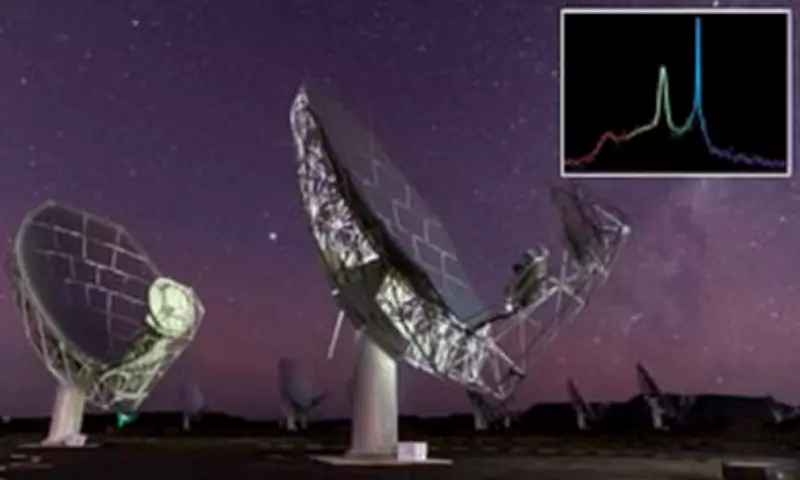
Humanity has intercepted a mysterious signal described as a 'mega-laser' beam, originating from a violently merging galaxy located more than 8 billion light-years from Earth. This extraordinary discovery, made using the MeerKAT radio telescope in South Africa, represents the most distant hydroxyl megamaser ever detected by astronomers.
What Is a Hydroxyl Megamaser?
A hydroxyl megamaser is essentially a giant natural laser in space. When galaxies rich in gas collide, molecules known as hydroxyl smash together, releasing incredibly powerful radio waves. These waves behave similarly to a laser, but instead of producing visible light, they generate radio signals that can be detected by specialised telescopes like MeerKAT.
Due to their extreme brightness, these signals can be observed from vast distances across the cosmos. In this particular case, the object is so immensely powerful that scientists speculate it might actually qualify as a 'gigamaser', an even more potent phenomenon than a standard megamaser.

A Cosmic Discovery Amplified by Gravity
The system, catalogued as HATLAS J142935.3–002836, is so remote that we are witnessing it as it appeared over 8 billion years ago, when the universe was less than half its current age. Dr Thato Manamela, a SARAO-funded postdoctoral researcher at the University of Pretoria and lead author of the study, remarked, 'This system is truly extraordinary. We are seeing the radio equivalent of a laser halfway across the universe.'
Manamela further explained that as the radio waves journeyed toward Earth, they were significantly strengthened by a separate galaxy positioned directly along the line of sight. 'This galaxy acts as a lens, the way a water droplet on a window pane would, because its mass curves the local space-time,' he said. 'So we have a radio laser passing through a cosmic telescope before being detected by the powerful MeerKAT radio telescope – all together enabling a wonderfully serendipitous discovery.'
The Role of Gravitational Lensing
The radio signal comprised four distinct components, indicating it emanates from multiple regions within the galaxy system. At least two of these areas appear to be strongly magnified by gravitational lensing, a phenomenon predicted by Albert Einstein, which enhances the signal's brightness more than tenfold compared to its natural state.
In this instance, a massive foreground galaxy lies between Earth and the distant system. Its immense gravity bends space-time, functioning as a cosmic magnifying glass that amplifies the radio emission. This gravitational boost allowed the MeerKAT telescope, equipped with 64 antennas, to detect the signal despite the source being over 8 billion light-years away.
Normally, signals from such distant objects are too faint for telescopes to capture. However, the rare effect of gravitational lensing made this detection possible. From Earth, this phenomenon can sometimes create a ring-shaped halo of light around the foreground object, known as an Einstein ring, named after the renowned physicist. The same effect magnifies the distant source, in this case a radio or microwave signal, enabling astronomers to study objects that would otherwise remain undetectable.
This groundbreaking discovery not only sheds light on the violent processes of galaxy mergers in the early universe but also demonstrates the powerful synergy between advanced telescopic technology and fundamental cosmic principles like gravitational lensing.