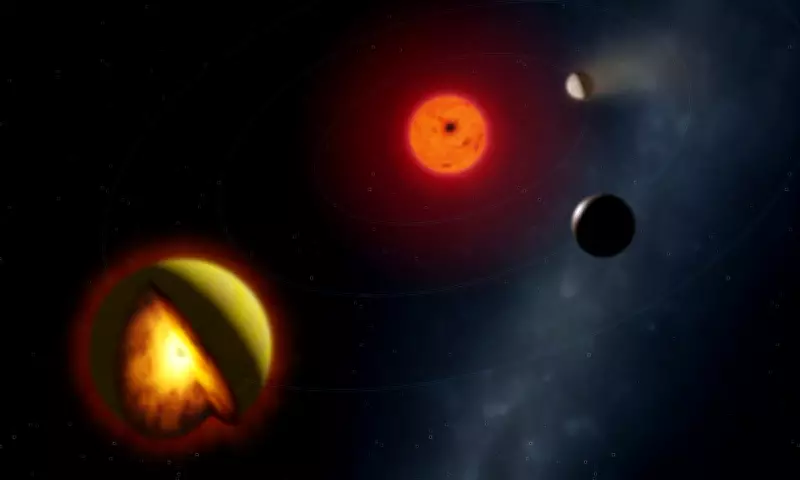
Astronomers Discover New Planet Type with Permanent Magma Oceans
Scientists have uncovered an entirely new category of planets, characterised by permanent magma oceans that store substantial amounts of sulphur. This groundbreaking discovery indicates that planetary diversity across the galaxy may be far more extensive than previously understood, with potential implications for the search for extraterrestrial life.
L 98-59 d: A World Unlike Any Other
The specific exoplanet identified in this study, known as L 98-59 d, orbits a star approximately 35 light-years from Earth. Observations from the James Webb Space Telescope, combined with data from terrestrial observatories, reveal that this planet is about 1.6 times the size of Earth and possesses a surprisingly low density. Crucially, its atmosphere contains significant quantities of hydrogen sulphide.
Previously, astronomers would have classified such a world into one of two established categories: a "gas-dwarf" composed of rock with a hydrogen-rich atmosphere, or a water world featuring ice and deep oceans. However, the new research definitively shows that L 98-59 d represents something entirely different—a novel planetary type dominated by heavy sulphur molecules.

Revealing the Planet's Internal Structure
To unravel the mysteries of L 98-59 d, researchers employed sophisticated computer simulations to model its evolution from its formation around five million years ago to the present day. This approach allowed them to interpret the telescope data and infer the planet's internal composition.
The findings are extraordinary. The planet's mantle consists of molten silicate, similar to lava found on Earth. Beneath this layer lies a vast, planet-spanning ocean of magma. This subterranean reservoir acts as a deep storage facility for sulphur, preventing it from escaping into space.
This permanent magma ocean plays a critical role in maintaining the planet's hydrogen-rich atmosphere and sulphur-bearing gases like hydrogen sulphide. Without this molten layer, intense X-ray radiation from the host star would strip these volatile materials away into the void of space.
Implications for Planetary Science and the Search for Life
The research team speculates that many more planets of this nature could exist throughout the galaxy. This suggests that the current astronomical classification system for small planets may be overly simplistic, failing to capture the true breadth of planetary variety. Some of these undiscovered world types might even possess conditions capable of supporting alien life.
"This discovery suggests that the categories astronomers currently use to describe small planets may be too simple," stated Harrison Nicholls from the University of Oxford, the lead author of the study. "While this molten planet is unlikely to support life, it reflects the wide diversity of the worlds which exist beyond the Solar System. We may then ask: what other types of planet are waiting to be uncovered?"
The study, titled 'Volatile-rich evolution of molten super-Earth L 98-59 d', has been published in the prestigious journal Nature Astronomy. It marks a significant leap forward in our understanding of planetary formation and the potential for exotic environments in distant star systems.