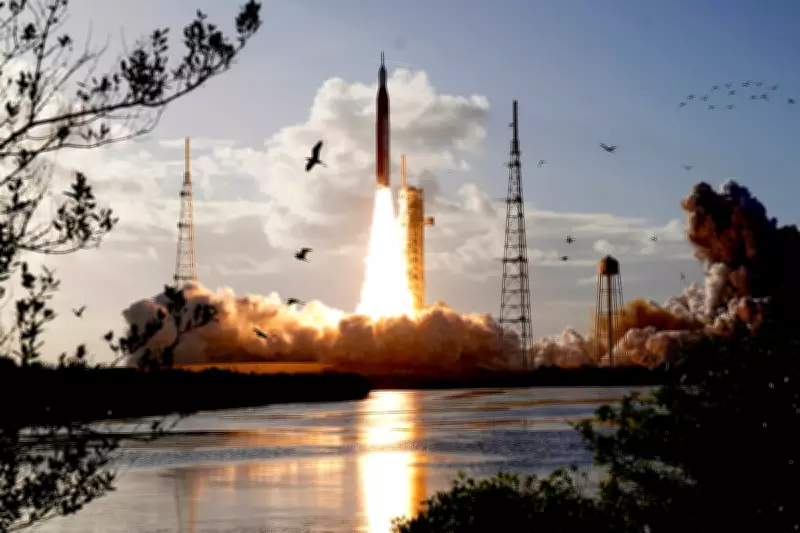
NASA's Artemis II moon rocket has successfully lifted off from the Kennedy Space Center in Cape Canaveral, US, marking a significant milestone in space exploration. However, this event has sparked a heated debate among Guardian readers, responding to an article by Zoe Williams that argued the space race is pointless.
Criticism of Space Spending
Robin Hambleton, an emeritus professor of city leadership at the University of the West of England, strongly supports Williams' view. He points out that the Artemis programme, with a budget of $100 billion, represents a massive misdirection of resources. For comparison, the UN World Food Programme, which was cut back by Donald Trump's reductions to USAID, had an annual budget of $10 billion. Hambleton argues that this global programme, benefiting over 150 million people annually in more than 120 countries, could be fully funded for ten years by the cost of Artemis alone. He emphasizes that investing in such humanitarian efforts would deliver greater social, environmental, and security benefits to the modern world.
Parenting and Priorities
Gabriella Herrick from Bath agrees with Williams and suggests applying standard parenting principles to space exploration. She believes no one should be allowed to go to space until humanity stops killing each other and destroying the planet. Reflecting on Eric Idle's assessment from over 40 years ago, she notes the irony in seeking intelligent life elsewhere when Earth faces so many challenges.

Defense of Space Exploration
On the other side, Peter Watts from Rhyl, Denbighshire, defends space exploration as essential for humanity's survival. He argues that if Earth becomes uninhabitable due to the sun's expansion or other crises, living on other planets or solar systems is necessary. Watts describes current efforts as tiny baby steps for our species, crucial for future generations. At a time when autocrats and religious bigots threaten a dark future, he sees space exploration as a shining light of hope.
Intelligence and Alien Life
Ian Hogg from North Leigh, Oxfordshire, praises Williams for her bravery in calling the space race a waste. He humorously suggests that if aliens exist, they might have higher standards of intelligence than humans, as evidenced by daily news in the Guardian. Meanwhile, Michael Fuller from Ampthill, Bedfordshire, challenges the notion that no aliens exist because we haven't seen them. Using an analogy, he compares it to scooping one cup of water from the ocean and declaring it void of life, highlighting the vastness of the universe with its septillion stars and 200 billion galaxies.
This debate underscores the ongoing tension between immediate Earthly needs and long-term cosmic ambitions, with readers passionately divided on whether space exploration is worth the investment.