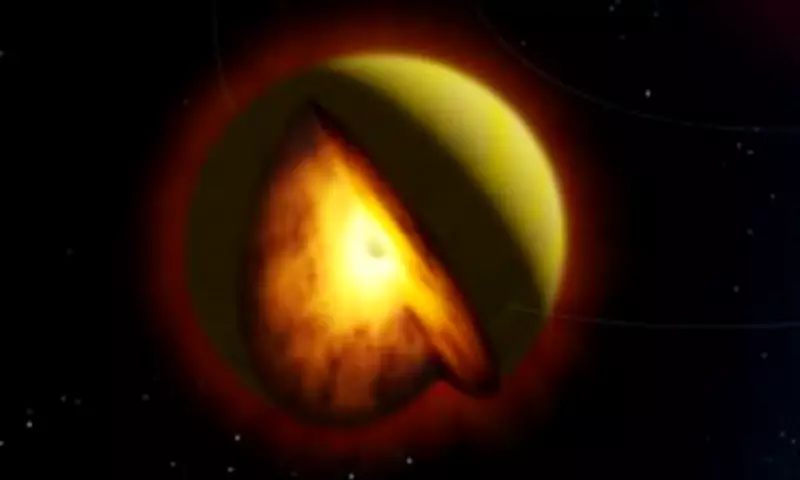
Scientists have identified a bizarre new type of planet beyond our Solar System—a searing liquid ball of lava where surface temperatures soar to a blistering 1,500°C. This exoplanet, designated L 98–59 d, harbours vast quantities of sulphur deep within a permanent global ocean of magma, releasing copious hydrogen sulphide gas into its atmosphere. Consequently, the distant world emits a powerful odour reminiscent of rotten eggs, marking a startling find in planetary science.
A Breakthrough in Exoplanet Classification
The discovery was made by researchers at the University of Oxford, who utilised the James Webb Space Telescope (JWST) alongside ground-based observatories to analyse the celestial object. They determined that the planet has an unusually low density for its size, which is approximately 1.6 times that of Earth. Previously, astronomers would have categorised such a planet into one of two familiar groups: either a rocky 'gas-dwarf' with a hydrogen atmosphere or a water-rich world composed of deep oceans and ice.
However, the new findings indicate that L 98–59 d belongs to an entirely different class of planet, featuring a global magma ocean extending thousands of kilometres beneath its surface. This vast molten reservoir enables the planet to store extremely large amounts of sulphur within its interior and maintain high levels of the pungent chemical in its atmosphere.

Simulating Planetary Evolution
Dr Richard Chatterjee, one of the study authors, explained the significance of computer modelling in this research. 'Our computer models simulate various planetary processes, effectively enabling us to turn back the clock and understand how this unusual rocky exoplanet, L 98–59 d, evolved,' he said. 'Hydrogen sulphide gas, responsible for the smell of rotten eggs, appears to play a starring role there.' Further investigation may reveal that such malodorous planets are surprisingly common throughout the galaxy.
The planet orbits a small red star located about 35 light-years from Earth and is estimated to be around five billion years old. The findings, published in the journal Nature Astronomy, suggest that the diversity of worlds in our galaxy may be even greater than previously imagined.
Redefining Planetary Categories
Lead author Dr Harrison Nicholls highlighted the implications for astronomical classification. 'This discovery suggests that the categories astronomers currently use to describe small planets may be too simple,' he stated. 'While this molten planet is unlikely to support life, it reflects the wide diversity of the worlds which exist beyond the Solar System. We may then ask: what other types of planet are waiting to be uncovered?'
The researchers believe that temperatures on exoplanet L 98–59 d, a burning liquid ball of lava, reach 1,500°C. This extreme heat contributes to its unique composition and atmospheric properties.
Insights into Earth's Own History
The team also noted that further insights into how magma oceans behave could inform our understanding of Earth's own geological past. This is because all rocky planets, including our own, begin their existence in a molten state. Co-author Professor Raymond Pierrehumbert elaborated on the broader implications. 'What's exciting is that we can use computer models to uncover the hidden interior of a planet we will never visit,' he said. 'Although astronomers can only measure a planet's size, mass and atmospheric composition from afar, this research shows that it is possible to reconstruct the deep past of these alien worlds—and discover types of planets with no equivalent in our own Solar System.'
This groundbreaking study not only expands our knowledge of exoplanetary diversity but also challenges existing frameworks for classifying celestial bodies, paving the way for future astronomical discoveries.