Human Spaceflight: The Irresistible Allure of Artemis II and Project Hail Mary
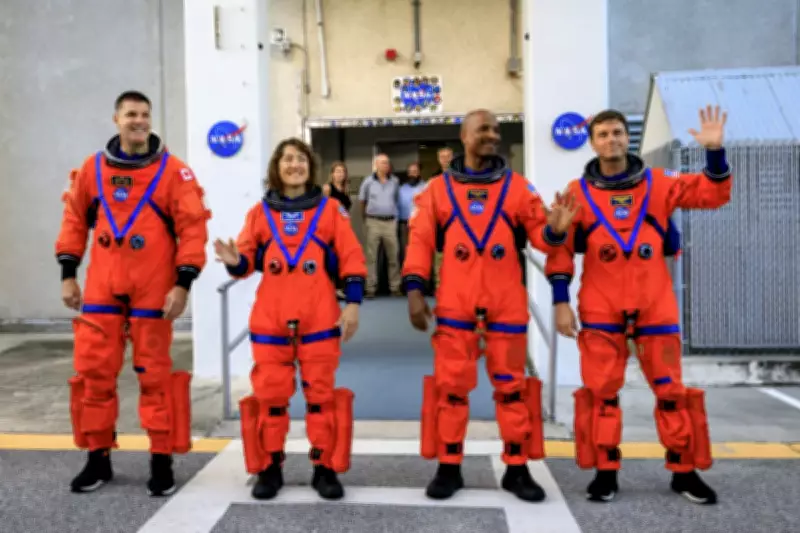
The four members of NASA's Artemis II crew are poised to captivate global audiences as they embark on a daring mission around the Moon in early April. This event coincides with the release of the blockbuster film Project Hail Mary, which features a heroic quest to save humanity through a long-shot space mission. Both real and fictional narratives tap into a deep fascination with human space exploration, despite the practical advantages of robotic alternatives.
The New Era of Lunar Ambitions
Artemis II represents a significant milestone in space exploration, sending astronauts deeper into space than any humans have traveled before. The flyby mission will test equipment for a planned lunar landing in 2028, with NASA outlining broader plans in March 2026 to establish a permanent base on the Moon. This ambition is not unique to the United States.
Private companies like SpaceX and Blue Origin are developing next-generation spacecraft, rovers, and drones to support an American Moon base. Meanwhile, other nations, notably China, are pursuing their own lunar outposts. These efforts view the Moon as a stepping stone toward more ambitious goals, including human migration to Mars in the 2030s.

Motivations and Risks Behind Space Exploration
Investments in human space exploration, whether through tax dollars or private funds, are driven by scientific, economic, and geopolitical objectives. NASA's new administrator, Jared Isaacman, has framed beating China to the Moon as a matter of national security, calling it "the ultimate high ground." He also promotes the economic benefits of a space economy involving lunar mining and manufacturing.
Subcommittees in both the House and Senate have passed bills to codify these initiatives into law, making a permanent Moon base official U.S. policy. These measures appear to have bipartisan support, with votes expected soon. However, as a biologist, I recognize the limitations and risks humans face as space explorers.
In my book, Becoming Martian: How Living in Space Will Change Our Bodies and Minds, I detail how longer missions deeper into space expose people to unknown health hazards. While scientists have learned much from six decades of human spaceflight, significant blind spots remain, particularly regarding deep-space radiation and partial gravity effects.
The Radiation and Gravity Challenges
The 24 Apollo astronauts who traveled to the Moon are the only humans to have passed the Van Allen radiation belts, which trap radiation and make Earth habitable. The Moon and Mars lack magnetic fields, leading to substantial radiation levels on their surfaces. NASA is conducting experiments with simulated galactic cosmic rays on rodents, with preliminary results suggesting potential cognitive impairment, though effects on humans are unknown.
Similarly, while zero-gravity environments cause muscle atrophy and bone density loss, little is known about prolonged exposure to partial gravity. The Moon has one-sixth Earth's gravity, and Mars has about one-third. Only the 12 Apollo astronauts who walked on the Moon have experienced it for more than 30 seconds, with the longest stay being three days. Scientists can only speculate about the health consequences of extended exposure.
Robots vs. Humans: A Practical vs. Inspirational Debate
Robotic missions offer practical advantages, including lower costs, higher risk tolerance, and success in scientific endeavors like NASA's Mars rovers, which discovered potential biosignatures of past microbial life. Economic objectives, such as mining and manufacturing, could also be achieved with AI-equipped robots, like those Tesla is developing, reducing human exposure to space hazards.
However, robotic missions often fail to capture public interest and imagination or demonstrate national prestige in the same way human missions do. The Artemis crew, much like Ryan Gosling's character in Project Hail Mary, will inspire global audiences through their daring exploits. This human interest is the common link tying together public and private space ambitions worldwide.

Conclusion: The Enduring Appeal of Human Endeavor
While robotic missions are more practical and cost-effective, they lack the inspirational power of human crews. Beyond economic, political, or scientific goals, space exploration is ultimately about people undertaking difficult challenges. As plans accelerate for lunar bases and Mars missions, the allure of human spaceflight continues to captivate, reminding us that exploration is as much about spirit as it is about science.